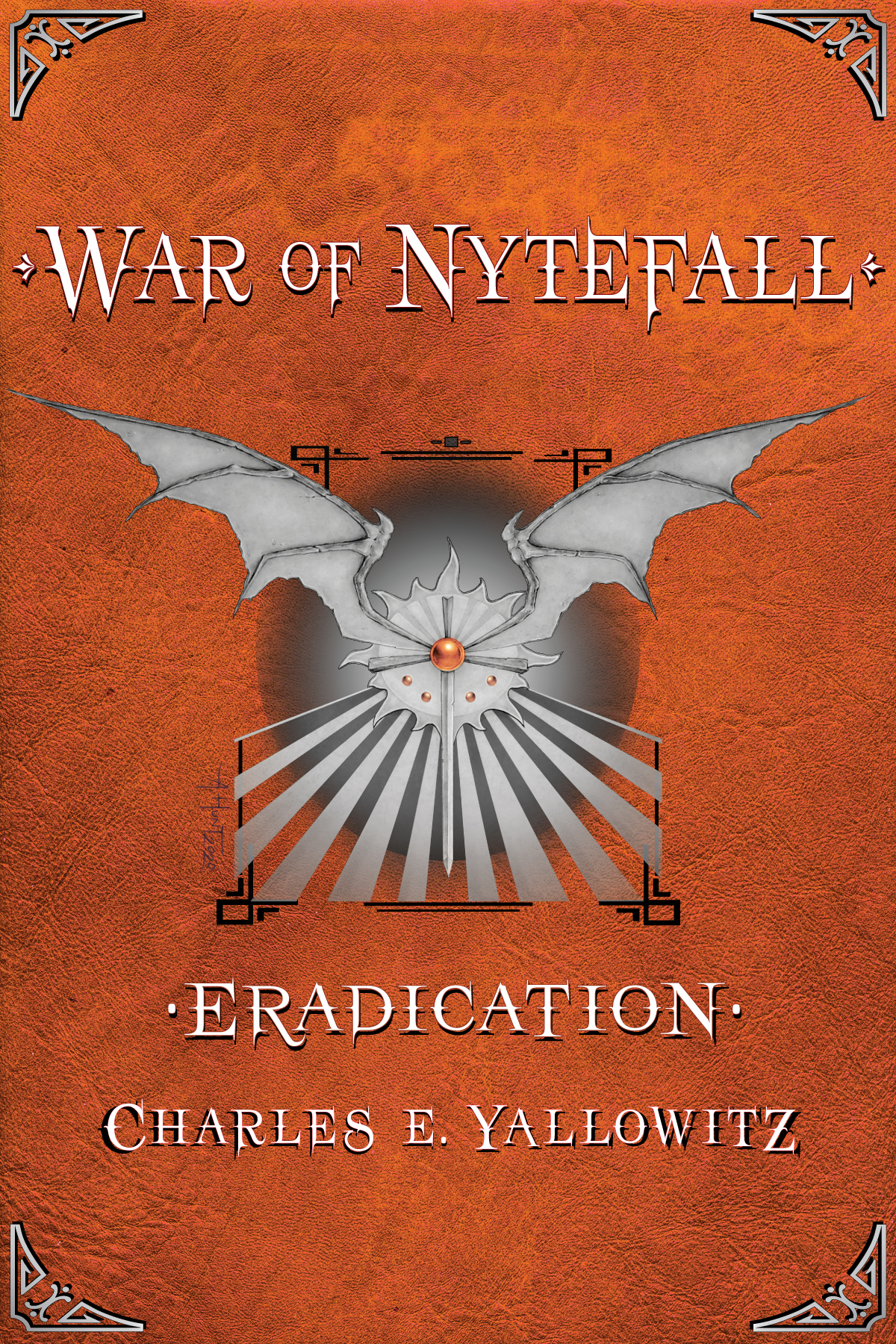
Cover Art by Alison Hunt
(Don’t think I’ve highlighted much of Archillious from War of Nytefall. His scenes did tend to be hard to share without spoilers or full context. Hence the length of this one. Enjoy.)
“You wish to keep your secrets. I understand,” Leo replies as he fixes one of his beard braids. Nodding his head to the bartender, he receives another mug of ale, which is capped with a triangular cover of foam. “The thing is that you remind me of a rumor that I recently heard about in my travels. Almost twenty years ago, there was a man who dressed like a jester and killed many people. There was never any pattern or reason for his slaughters, so he could never be caught. As quickly as he gained infamy, he seemed to disappear from the world. That’s a man I would enjoy meeting because I feel like we could make a deal.”
“Guess his reputation precedes the terrifying Archillious.”
“That was the name.”
“If you are a fan then you would know what my real job was.”
“Former assassin . . . Currently a Dawn Fang.”
“That explains the sun with demon wings on your chest.”
“I would rather not make a scene.”
“I thank you for sharing your hopes and dreams.”
The ominous tone of his voice causes Leo and his followers to tense up, which allows Archillious to identify his enemies. The vampire takes his time finishing his meal and his hunger drives him to lick the bowl clean. Not needing the spoon, he flicks it at the priest and watches it bounce off a protective spell. A worried look is on the bartender’s face when she realizes that a fight is about to break out in her tavern. Feeling sorry for her and having enjoyed the stew, Archillious rummages in his jacket pockets in search of payment. He hears a footstep behind him and whirls around to stab a knife into an approaching elf’s head. The poison on the blade causes the Duragian to stand stiff and await orders, which are for him to repeatedly punch himself in the face until he is dead. Unconcerned with the stampeding crowd, the assassin leaps over the bar and ducks a mace that is swinging at his face. Finding the cowering halfling under the sink, he places a bag of gemstones at her feet before standing up again. The studded weapon is caught in his fist and he takes his time climbing to the dining side of the counter without releasing the struggling mortal. Keeping an eye on Leo, the cautious Dawn Fang cracks the knuckles of his free hand and places it on the face of his victim. The infected mortal breaks into maddening laughter and runs around smashing the furniture with his mace until he abruptly flops onto his side.
“Mortals always seem to rampage for a minute and then their hearts explode whenever I take their sanity,” Archillious complains while smiling. He hears a woman begin to chant a spell, so he casually fires a crossbow bolt over his shoulder and into her throat. “As you can see, the exciting Archillious loves to make a scene. Not sure what you mean by Dawn Fang though. I’m your basic, yet very special, vampire like you would find anywhere. Can’t prove otherwise since it’s night. Now, how about you hand over that holy orb you’re carrying?”
“I forgot that your kind wishes to remain a secret,” Leo replies, his hand shaking as he reaches for his pouch. He yelps when a dart hits his platemail with enough force to knock him onto the floor. “I tried to use you as an argument for your kind’s destruction. If murderers and psychopaths like you are flocking to Clyde and Xavier then it’s only a matter of time before you try to devour us all. My fellow Duragians swore that that Dawn Fangs were chosen by the sun and my attempts to make you public were undone by my superiors. Yet, here I stand with a monster wearing the skin of a man. One that was evil before he got his fangs. The temptation of such power is intoxicating to those who seek destruction, so it should be erased completely from Windemere. Don’t you agree?”
“Actually, I do agree that wanton destruction is what the world needs,” the assassins states, his eyes narrowing into slits. He watches the priest’s hands to make sure he sees the orb, a slight pang of worry squirming in the back of his mind. “The two of us are similar if you look at the basics. You despise my kind and wish to erase us from existence. I find the world boring and want to kill as many people as I can. The only real difference is that you’re more specific in your goals and my dreams are . . . grander. Now, are you going to show me that orb or will I have to dig through your corpse to find it?”
A burly Duragian with glowing gauntlets jumps on Archillious from behind and tries to restrain him. The sun spells have no effect on the Dawn Fang, who lets the mortal enjoy a few seconds of struggling before turning around. His fangs sink into the man’s neck, but he gags at the blood’s sour taste. Swiftly tearing out the Duragian’s throat, the assassins spits the disgusting ichor into his hand. He chuckles at the sight of red foam and realizes that his enemies have a mild poison coursing through their veins. With a curious sniff, Archillious can tell that it was designed for old-world vampires and that it will do nothing more than give him a week of indigestion. Insulted by the mediocre toxin, he sends a jet of pink liquid out of his right sleeve and into the face of a gnome, who has been waiting for an opening to attack. The razor-sharp discs fall from her hand as she staggers back and screams at how the very air feels like sandpaper against her skin. An itchiness covers her body and she scratches at the sensation until she is ripping into her own flesh for any flicker of relief. Another Duragian rushes across the tavern while casting a healing spell, but is shot in the thigh by Archillious. The poisonous bolt causes him to lose control of every muscle in his body and he collapses in a heap, his glazed eyes staring lifelessly at the ceiling.
It is a faint hum that gives Archillious enough of a warning that he is able to leap away from the Fist of Durag’s blast. Even though he is grinning wide, the Dawn Fang is aware that he narrowly avoided getting killed. Facing Leo, he tries to guess what the dwarf is going to do with the orb that he is holding in his fist. The artifact glows, but the assassin refuses to move until he knows the direction of the attack. Becoming impatient, a purple fog seeps out of his pores to create a toxic curtain that obscures him from view. Archillious crouches low and is about to rush forward when a wide beam of sunlight cuts through his poison. Every deadly wisp is erased from the purified air, which smells like cherries and vanilla. Having not heard the same noise that preceded the first blast, the Dawn Fang feels less confident about his chances of victory. He licks at his fangs and considers spitting one at the dwarf, but knows it will be countered by the Fist of Durag.
The sudden thought of a room-sized wave being emitted from the orb causes Archillious’s mouth to go dry and he tries to judge the distance to the door. A crackle of energy down Leo’s arm galvanizes the vampire into action, the unexpected sprint helping him avoid a sloppy blast that is a few inches too high. Not trusting any of the furniture to act as shields, he continues running and dodging the beams. Several times, the assassin leaps backwards and runs to the side to prevent the priest from getting an idea of his path. It does not take long for Archillious to realize that he will be struck and depowered the instant he reaches the closed door. With no windows to leap through, he sighs and spins on his toes to run in the opposite direction of the only exit. Having been focused on the obvious escape path, Leo is too slow to stop him from barreling through the back wall of the tavern. A series of rapidly fired blasts follows the retreating assassin, but they sail harmlessly into the distance.
“Better luck next-” Archillious begins to say. His word are cut off when the building is destroyed by a giant orb that mimics the sun and sits in Leo’s palm. “That really does give off a lot of heat. Guessing that isn’t going to take away my powers. No, you’re out to kill and don’t care if you hurt others as long as I die. My kind really are nothing more than monsters in your eyes.”
“May your soul be cleansed by the Fist of Durag and enter his embrace,” the priest whispers as he leans back to throw the powerful spell.