The Hoatzin: This Is A Real Bird

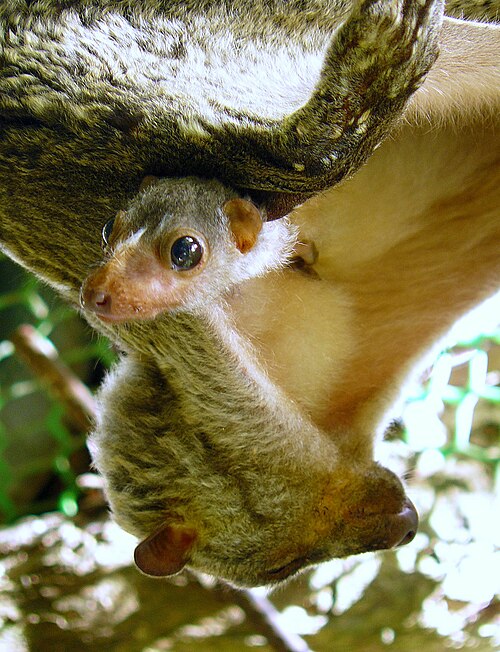
I don’t know where I stumbled onto the Hoatzin, but it looked and sounded interesting enough to make a post.  This is a bird found in the Amazon and is the only member of the order of Opisthocomiformes.  That means it’s the only surviving species of an avian evolution broup, which appears to have branched off from other birds around 64 million years ago.  They have no close relatives and there isn’t enough fossil data to figure out exactly where these guys fall in the evolutionary path.

Hoatzins aren’t good fliers and tend to jump through the canopy when they need to move around.  Unlike other birds, their sternum and flight muscles are underdeveloped.  They don’t survive in captivity, so the wild is the only place to find them.  As interesting as that is, there are really two big things about these birds aside from their mysterious evolutionary path.

First, they don’t digest food like other birds and are considered ruminators.  That means, they digest food using bacterial fermentation, which is similar to cows and sheep.  Instead of having a sack called a rumen, the Hoatzin has an bigger esophagus and crop.  These foregut areas are where the leaves are broken down, which can take 45 hours and is why they are usually just sitting around.  The fermentation also creates foul-smelling vapor, which is why they are also called stinkbirds.  Due to the process, their meat tastes terrible, which is why they aren’t hunted.

The second interesting aspect deals with their babies having two claws on each wing.  This reminds many people of the ‘first bird’ Archeopteryx.  Hoatzin nests are made over the water and the babies have these claws for 3 months.  They will drop into the water if a predator approaches and swim away to hide.  Once the coast is clear, they will use the claws to climb up the tree and return to the nest.  This usage is what makes them unique because they aren’t vestigial like in other species.

So, what does the Hoatzin look like?

Posted in Animal Posts | Tagged , , , , , | 10 Comments

Goal Post: Summer Break Trip

By the time this post goes live, I should be on the road for a father/son trip.  We aren’t going too far, but it should be fun.  A nice change of scenery, a fun museum trip, and just time to relax.  We have a lot to discuss about the upcoming school year, next summer, and future plans too.  That’s what the car trip will be.  I’ll be happy to not have to wake up early and head to work.  Don’t get me wrong.  I enjoy my job, but I need a breather for a week or so.

The trip won’t be for the whole week that my son is with me.  We’ll be back with enough time to . . get haircuts and handle a few appointments.  I think both of us are in a state where rest and minimal planning is needed.  Although, I’ve already made all of our dinner and lunch plans for the trip and following week.  This is to make sure I bring enough money on the trip AND don’t buy any food that I won’t end up using.  Meal planning is a great money saving activity that I need to utilize more often.

With the editing of Darwin & the Beast Collector finished, I didn’t really do any writing this week.  I perused the next outline and poked at ‘Phi Beta Files’, but life was too busy.  I was doing a lot of bus matron shifts at work and a sleepless Tuesday night gave me little energy.  Most of my post-work energy went to physical activity like Pokemon Go or biking depending on the weather.  Can’t afford to be sedentary during the days when I can be active.  Sadly, this means no writing, which isn’t too bad since I’m still struggling with my doubts.

Things will change in the coming week.  I’m bringing my notebook along, so ‘Phi Beta Files’ will get some work done.  I will try to work on more of it after coming home because I should move on to another story plan.  Once next Saturday hits, I’m going to start writing Darwin & the Joy Path.  It will probably be in the afternoon after I participate in the big Pokemon Go event, but I’m fine with that.  Walking around in the morning and socializing should get me in a better mood for writing.  Can’t be dour and depressed when writing Darwin.  Although, I won’t get to him until Monday because the weekend will be the prologue.

Everything seems rushed and scattered lately.  Feels like there is constant noise and activity around me until 9:30 PM.  Can barely concentrate even when I’m in my room because either my phone is going off or people keep shouting for me.  There hasn’t been much in the way of peace.  Could explain why my nocturnal panic attacks are back with a vengeance.  That’s another reason I’m looking forward to this trip.  I need the mental respite like I got with Oswego.  Praying I don’t come home to an immediate erasure of my calm though.

This might be another reason why I’m scared to start in on a new book.  So much is going on that I can’t guarantee I’ll have the energy, mindset, or freedom to write more than once or twice a month.  Ever since I stopped publishing and the books stopped selling, certain people have pushed harder to get me to stop entirely.  I will admit that work, parenting, and taking time for my physical health have nearly granted them their wish.  It’s hard to rationalize getting time to write when there’s no financial gain.  Keep in mind that I don’t mean rationalizing to myself, but to those who repeatedly request my time whenever I’m free.  A person asking to hang out or do something from time to time is one thing, but a constant barrage whenever I appear to be free is too much.

With any luck, the upcoming school year won’t be as hectic as the last one.  I doubt it since I know of various changes coming and I don’t have my schedule yet.  Trying to be positive, which isn’t in my nature.  I’d just like to get a bit of writing time in during the week, which might only be Thursday.  That requires enough energy to focus and get a chapter section done.  It’s also my day to treat myself to take-in, so I try to have an hour of Pokemon Go to work up an appetite.  Wednesday is shot due to it typically having an appointment and then the weekly Pokemon event.  I tend to need extra sleep that night anyway, so maybe I can make that an early bedtime day to make sure I have the proper amount of energy for Thursday.

I’m overplanning and stressing.  Part of the rambling is because I can’t talk about what’s really eroding my sense of safety and sanity.  The specific situation is getting worse and showing no signs of dwindling in frustration.  As far as I know, nothing major can happen to shake up what’s going on.  Yet, it could only be that I can’t do anything and the other person involved is able to throw a nuke onto the battlefield without any negative consequences to themselves.  The unfairness of what I’m dealing with is weighing on me every day.  Could this be why I’m scared to write since Darwin Slepsnor is inherently a positive, happy character?

Anyway, goals of the week:

  1. Drive safely to and from trip.
  2. Enjoy time with son away from home.
  3. Tinker with ‘Phi Beta Files’.
  4. Watch movies we’ve picked out when we come back.
  5. Join in various Pokemon events.
  6. Cook penne with vodka sauce.
  7. Haircuts!
  8. Back to school shopping if needed.
  9. Puzzle time when home and on my own.
  10. Take out trash on proper days.
  11. Complete more November blog posts . . . Anyone think I should do character interviews on Tuesdays at that point or stick with reviving old teasers?
Posted in Goal Posts | Tagged , , , , , , , , , , | 11 Comments

Revisit- Dungeons & Dragons: A Basic Walkthrough

This was first published on May 10th, 2013.  It was a comedic answer to how ‘Dungeons & Dragons’ work.  Hope people enjoy it.

LOTR and Monty Python

I’ve been asked by many people to explain Dungeons & Dragons.  I bring this game up a lot because my time in the game is the inspiration for my books.  That being said, I’m not even close to an expert.  I never owned all of the manuals or studied the ways to create an unstoppable character.  I was in it for fun and the storytelling, so that’s the viewpoint you’re going to get here.  Also, my whacky humor, so bear with me.

First a brief explanation:  Dungeons & Dragons is a tabletop role-playing game of the high fantasy genre.  You create a character alongside your friends (or random hobos off the street that you’re paying to play) and go on adventures that require the use of paper, dice, imagination, and sometimes little figurines.  Never call them dolls or your more avid (rabid?) players with get angry.

Without further ado, a thorough walkthrough on how to play Dungeons & Dragons:

  1. Buy dice of various sizes, pencils, paper, soda, chips, and at least the basic manual for whatever edition of D&D you’re going to play.
  2. Learn to say the die sizes as D-4, D-6, D-10, and D-20.  There’s also a D-12, but nobody likes the D-12.
  3. Gather your friends and decide who gets to be the characters and who gets to run the game.  If you have a friend that is dying to be the dungeon master, make him give his story pitch first.  Also, have him sign a contract that he won’t start trying to kill your characters within the first 10 minutes.
  4. If you have a female gamer, give the male gamers a 1-minute ogling time then tell them that she has the right to hit them for doing it again.  If need be, arm the female gamer with a blunt object.
  5. Start making your characters by choosing your fantasy race (elf, human, dwarf, halfling, gnome, half-orc, half-elf), your class (fighter, cleric, magic-user, etc.), and flush out the character with the personal details.  Age, hair, eye, gender, and other physical pieces of information are important . . . okay, only gender.
  6. Name your character.  Be creative.
  7. Roll dice to see what your stats are or use a point system where you divide a set number of points between the 6 stats.  These stats are Strength, Dexterity (Agility), Constitution (Stamina), Intelligence, Wisdom, and Charisma.
  8. Use your stats to find out what bonuses and negatives you have to various abilities.  This includes you skills and saving throws.  A saving throw is what you roll when you’re character is about to get fireballed (reflex roll), hurt bad enough to go into shock (fortitude roll), and resist a mental spell (willpower roll).
  9. Choose your skills and special abilities that depend on your race, class, role-playing style, and where you want to go with the character.
  10. Change character name because you thought of something better.
  11. Begin arguing over who has the prettier dice.  Let the woman win and I don’t always mean the female gamer.
  12. After agreeing on how much money each character starts with, buy gear for your character.  Remember that clothes, food, water, and weapons are not immediately given.  If you want to horde your money then prepare to be a naked, starving, dehydrated, defenseless character that will be thrown in a dungeon or eaten by a housecat within seconds.  Yes, stat-wise a housecat can beat a defenseless human in D&D.
  13. For magic-users and priests, choose your spells.
  14. For magic-users, choose a familiar too.  This is an animal companion that can give you a magical boost and deliver certain spells.  Acceptable familiars are crow, owl, mouse, hamster, cat, and other small animals.  Unacceptable familiars are lion, bear, moose, elephant, and anything else big enough to kill the entire group.  NO DRAGONS!
  15. Okay, maybe the first name was better than the second name.
  16. Everyone tired of character building?  Good.  Let’s start the adventure.
  17. Draw straws to get bathroom break order because everyone over-indulged in the soda.
  18. Now we start the adventure.
  19. Dungeon master forgets promise and kills group within 15 minutes.  Beaten with character sheets, empty soda bottles, and dice.  Fun until somebody clocks him with the monster manual, which will probably be the female gamer.  She worked hard on that character and endured a lot of ‘chicks in chainmail’ comments to get to where she is.
  20. Restart game as if nothing happened and have fun.
  21. Get angry at the magic-user for casting a spell that injures everyone.  Review the term ‘area of effect’ and explain that they have to be careful with their doom spells.
  22. Enter a town to let the depleted priest rest and get his healing spells back.  Remind the barbarian that he can’t read, so he should put the tavern menu down.
  23. Sit idly while the thief runs off to do his own thing.  Discuss leaving him in jail when he inevitably gets caught.
  24. Ask if it’s too late to change your character’s name again.  Pout when told your heavily armored warrior from a long line of champions is now named Betsy Cherrypie.
  25. Go through battles, traps, and adventure.
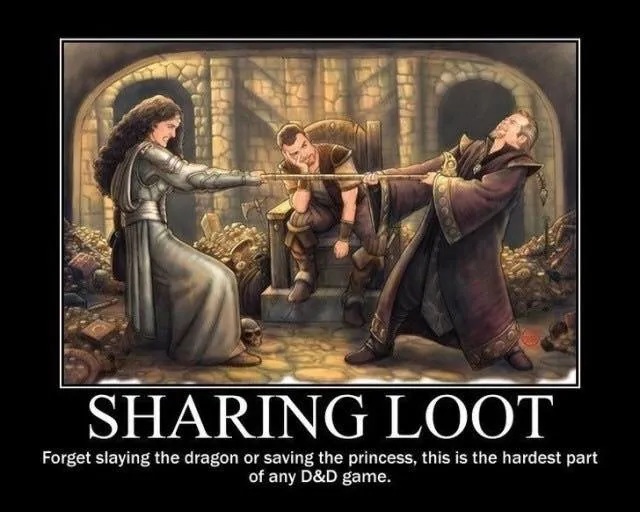
  26. Divide up the game loot.  Money split evenly after barbarian ‘checks’ thief’s pockets. Magical items go to whoever can use them most.  Let female gamer smack the guy who demands everything because he doesn’t understand the concept of sharing.
  27. Dungeon master hands out experience points based on creatures slain, adventure goals reached, role-playing ability, and other rules that are probably made up as people go along.
  28. Hug your character sheet as you see your 1st-level character rise to a temporarily impressive 2nd-level character.  Put new skill points where you want them to go and stare forlornly at the useful skills that your class is forbidden to touch.  Try one more time to beg for Animal Husbandry even though you’re playing a warrior.
  29. Agree to meet again and promise not to lose your character sheet.
  30. Lose your character sheet on your trip home.  Cry into your pillow.

The key thing with D&D is that you have to use your imagination.  The rules, dice, paper, and figurines are simple tools while your imagination is the main ingredient.

Posted in Uncategorized | Tagged , , , , , , , , , | 9 Comments

Amazing Resources for Neurodivergent Writers – by Jenny Hansen…

on Writers Helping Writers: My last post highlighted Writing Tips for the Neurodivergent Brain, but what about writing resources and tools? What …

Amazing Resources for Neurodivergent Writers – by Jenny Hansen…
Posted in Uncategorized | Leave a comment

Poetry Day: Sloth Rondelet

Yahoo Image Search

(A rondelet is a 7-line poem where the first line is repeated on line 3 and 7.  The refrain lines are usually 4 syllables and the other 4 lines are 8.  These were tough, so I hope I got them right.)

Is Sloth your sin?

Do you shy away from all work?

Is Sloth your sin?

You sit on your ass and waste air.

Only watching others work hard.

No spark or urge within your frame.

Is Sloth your sin?

Posted in Poems | Tagged , , , , , , | 9 Comments

Low Fantasy

Hi, gang. ✋ Craig here again. We’re continuing my series dive into the speculative genres. Today we’re tackling Low Fantasy. First of all, let me go …

Low Fantasy
Posted in Uncategorized | 2 Comments

Revisit: When One Book Just Won’t Do

Originally posted on May 1, 2013 . . . This one tries to hit everything, which shows where my mind was.  I was more interested in promos, poems, and random stuff as if this was a Livejournal.  Yet, flickers of the type of blog posts I would create show up from time to time.

Cover Art by Alison Hunt

So, you’re writing your book and burning through your story like an author possessed by a word-obsessed demon.  You’re nearing the end of your manuscript with a twinkle in your eye that is just slightly brighter than the bit of anxious drool in the corner of your mouth.  Then you stop like somebody slapped you.  The story will end and the characters will no longer be at your fingertips.  You contemplate slowing down or not finishing the story.  Possibly a lifetime of edits can stave off the horror of completion.  Once this insanity passes, you come to the only logical conclusion:

You’re going to write a series.

Welcome to the major challenge of developing characters and extending a story beyond a single book.  It works differently in this world.  You can’t end with finality.  You need to end on a balance of closure and cliffhanger.  The adventure for this book is done, but the heroes have more trials ahead.  You need to make that clear and that isn’t always easy.  If your heroes have achieved everything then they have no reason to move into another book.  If they have accomplished nothing then you just wasted your readers’ time.  Even a step back for the heroes can be appealing because it means they have a mess to fix in the next book.  The point is to make the reader want more.

There are various ways you can embed your story in your reader in terms of an ending.  Some methods are ending on a villain scene with them hinting at future plans.  You can have the heroes end with a feeling that something is coming.  Is it possible to continue a series while having complete closure in a book?  Yes, but that typically requires you make a time jump, so the hero has time to settle before the next threat arrives.  Another trick is to put a message at the end saying, ‘The Adventure Continues in . . .’  Truthfully, making it clear that another book is coming is one of the hardest tricks for an author with a series.

Coming in a close second is actually planning the series.  If you didn’t plan on it beforehand then you will find that you need to change some things.  Add some foreshadowing and a few events that give you an opening for a series.  You could very well be on the fence about writing a series, so just leave these openings in case you get the urge.  Don’t make them too big or blatant because that makes them plot holes.  Maybe a mention of a bigger threat from the past or the hero loses an important item that he/she manages to win without.  It’s all about subtlety when you aren’t sure.

When you are sure about writing a series, you can get away with a few blunt events.  Characters that appear and practically have a sign screaming, ‘We will be main characters in the future!’ or ‘I’m really a villain!’  Remember that you’re working a long game with a series, so you have to play Time Master.  You need to consider the past, focus on the present, and keep an eye on the future to make sure continuity is held.  This is why you want to keep notes and return to older books whenever you feel a twinge of doubt.  Forget a character’s eye color?  Go to their debut and NEVER guess.  I did this with Luke once where he started with green eyes and by book 3, he had blue.  Readers notice these things.  Having notes about future events helps too because these are what you would use for foreshadowing.  Is a character going to be faced with his fear of spiders in the future?  Then make sure there are a few incidents with spiders before you reach that plot point.

Patience is definitely important for writing a series.  You need to make sure your chapter scenes are deep enough to develop your characters because the readers are going to be with them for a long time.  Give your cast hopes, dreams, fears, quirks, and various subplots that will gradually play out alongside the main quest.  By the end of the series, you want the readers to look at the characters as old friends that they have to say good-bye to.  To this end, you also have to be careful not to overstay your welcome.  If it looks like the heroes are never going to reach their goals then the reader will either quit or start rooting for the villains.  A good example of this is Inuyasha.  An anime series (and manga, but I never read it) where every season, the heroes are rushing to gain a new power to permanently kill the villain.  Every time, they get the new power and the villain is already too strong for them.  Doing this repeatedly can turn your series into a joke instead of a serious form of entertainment.

Now, you might be wondering how you can develop a character through a series.  If you aren’t wondering then you need more coffee.  Again, patience is key.  In a series, a character can develop slowly.  The first book should not see them reach their full potential, but they can step on the right path to get there.  You can even have them evolve in the wrong direction at first to make the crash and rebuild later in the series.  For example, a hero that gets very cocky and arrogant with every victory only to be defeated in book 5 and then needs to rebuild his courage for the rest of the series.  As long as your character doesn’t peak too early or stay in the same position for the entire series, you’ll be fine.  Truthfully, there are so many ways to do this and some ways that haven’t even been invented yet.

The series isn’t for everyone and some series aren’t even directly connected to each other.  You can write a series that takes place in the same world, but with a different set of characters for each book.  I would recommend having a few characters make cameos either physically or by character conversation in the other books.  You need to give a sense of connection between the series.

So to all of you series writers, good luck and remember to enjoy the journey.  In other words, proceed forward in a calm, rational manner and no rushing ahead because you have an amazing idea.  If it really is amazing then it will be there when you need it.

Posted in Thoughts | Tagged , , , , , , , , | 12 Comments

Guest Post – Andrew Joyce and His New Book – Wicked – The men of Wicked Tuna.

I am very pleased to welcome Andrew Joyce to Fiction Favorites. He has a new book and it look like it is going to be a good one. Here’s the blurb. …

Guest Post – Andrew Joyce and His New Book – Wicked – The men of Wicked Tuna.
Posted in Uncategorized | 1 Comment

Teaser Tuesday: Bad Luck?

Cover Art by Circecorp

Here we have a piece from The Life & Times of Ichabod Brooks.  Short stories are definitely harder to get excerpts from unless you want to spoil the whole thing.  Enjoy!

Continue reading

Posted in Ichabod Brooks, Teaser Tuesday | Tagged , , , , , , , , , , , , , , , , , | 6 Comments

Noir Fiction: How is it unique?

Posted by Joy York Over the years, I have read many books and seen many films referred to a “noir.” They have always been a bit of a mystery to me. I…

Noir Fiction: How is it unique?
Posted in Uncategorized | Leave a comment