Google Image Search
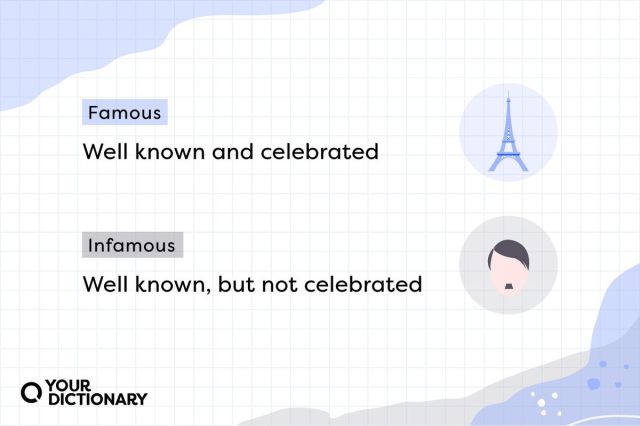
The meme is a little extreme, but it gets the point across. Thought I made a post about this long ago, but it looks like I’ve merely mentioned this in passing. People seem to get this wrong either by accident or on purpose. Guess there’s the mentality that any attention is good attention, but the truth is:
Fame and infamy are NOT the same thing.
Fame is when you are well-known and respected. Your deeds are good and you are seen in a positive light. There is a little gray here, but only because people will use fame for good and bad today. I’ve seen people say Beyoncé is famous and she is. I’ve also seen people say Jeffrey Dahmer is famous . . . Kind of. He’s definitely well-known. Though, he wasn’t a good person or known for good things.
That is why I think the word ‘infamy’ exists and should be used more often. It differentiates the good from the bad. Infamy is when a person is well-known, but they are either feared or hated. They did bad and horrible things, which is why they don’t get respect or positive attention. We tend to think of only high-level monsters being in this category, but it can be on a smaller scale. For example, bullies in high school would be infamous. The kids who are popular for helping others would be famous.
I feel this relates to writing in two ways:
The first is in regards to characters and how they act. I’ve run into a lot of readers who demand that a hero commit slaughter and murder for the slightest issue. All solutions are solved by killing regardless of character personality. For example, a handful wanted Luke Callindor to kill a man who was verbally goading him into a fight. Just flat out murder this asshole as if there wouldn’t be consequences. They still considered him a hero, but he would be a weak one if he simply walked away. Authors do this too where they have a hero who speaks of being a pillar of good, but will kill at every opportunity. If it isn’t done for hypocritical irony, it’s just sloppy characterization. The act of taking a life shouldn’t be so easily committed, especially by heroes who depend on their reputation. Would you go to a hero for help with a minor issue if you’ve seen them murder jaywalkers and litterers?
The second is the author themselves who might go along with ‘all attention is good attention’. Now, a negative review can drive people away, but not as much as an author publicly attacking the reader. Some will undermine other authors who they see as potential rivals and threats. In the eyes of an infamous author, they are in a battle to maintain their seat and audience. Others let their fame go to their heads and feel that they can get away with anything, so they will start attacking various groups they don’t like for a variety of reasons. They justify all of their actions as either a way to solidify their fame or a benefit, which really turns their reputation into one of infamy. Most readers won’t witness these interactions though and this can cause an author to grow bolder and bolder until their antics can no longer be hidden. This is when you get people trying to decide on if they should separate the art from the artist.
So, fame and infamy are basically the opposite sides of the same coin. It’s fairly easy to slip from the former into the latter, but harder to get back. I’d say it falls into the same category as trust. You would need to earn forgiveness and work hard to make up for whatever put you into the infamy category. Even then, it isn’t up to the person to determine their reputation, but those around them. This makes the two categories more difficult to both define and achieve. Maybe it’s best to simply not be known and stay in obscurity?