(Today, I have a special guest who is promoting a new collection of short stories that are well worth the read. Lisa Burton the Robot Girl is here to talk about pulp fiction, so let’s hand the blog over to get the party going. Give a friendly welcome to Lisa.)
Hi again, Charles. Thanks for inviting me back to talk about Craig’s newest book. It’s called The Experimental Notebook of C. S. Boyack II. It’s being released because the first one did so well.
You read the first one, and were a beta reader on this book, so you know what they’re like. For your readers, they cover a broad slice of the speculative arena. This time they cover more science fiction and paranormal, but there is one that might pass for fantasy.
Let’s deal with the book here. This Notebook is a collection of short stories and micro-fiction. It’s pretty easy to read a whole story on your coffee break, or on your commuter bus.
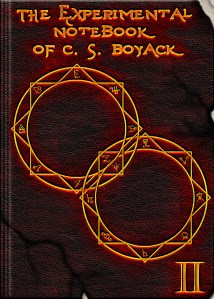 The artwork doubles the alchemy wheel on the first book to stay with a kind of theme.
You asked me to discuss the appeal of the pulp angle Craig has on some of these stories. Pulp was an age of fast, cheap, publication. They tell me there was no internet back then, and as a robot girl, that sounds like the stone age to me. People read more. In many cases there was only one production run, and the ink was likely to smear under your fingers.
Many of the stories saw the same character repeating over and over again, and this era influenced all genres. For Craig, this comes out as science fiction, and paranormal. Two of them might even drift into horror.
This is the era where science fiction didn’t always follow scientific rules. Imagine heroes with ray guns rescuing damsels from creepy aliens and you’ve got the picture. Modern science has proven that many of the ideas from this era are not possible. At this time, an author has to make a choice. Stick with science, or just have fun anyway. Craig chose to have fun, and that’s the thing about the pulp era. The stories may not have changed the world, but they were fun. They sold like crazy with the intent they would be discarded after reading them. By then the publisher would have something new on the stands.
These artificial science choices still go on today, it’s just after the pulp era. Light sabers might be a good example.
Many of the authors in that era “borrowed” from each other. Many of them were contract writers and wrote whatever the publisher told them to write. More than a few mad scientists created a horde of monsters. Damsels were rescued, and heroes flexed muscles. There is no formal stamp of what makes a pulp story, but Perry Mason, Conan, and Flash Gordon come to mind.
Some of the tales in the second Notebook reflect this era. Call them tribute pieces. Which brings me to your poster. I always bring posters when people host me, and this is a good one. It loosely reflects one of the pulpy stories in the book, Last Flight of the Rocket men. It’s me getting ready to fly the rocket-pack in zero-gravity. We wanted to have a real space background, but it turns out the artist needs actual oxygen to breathe. Robot girls don’t worry about such things.
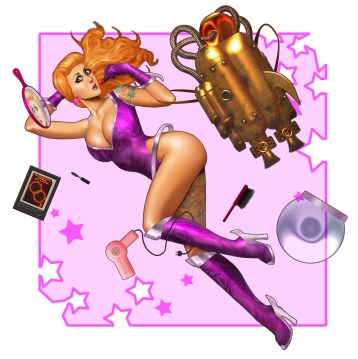
Lisa Burton
Your fans should feel free to use it as a background on their PCs, iPads, phones, or whatever. It’s a gift.
Craig wants me to remind everyone The Experimental Notebook of C. S. Boyack II is only 99¢. At that price, there is bound to be at least one story that gives you your money’s worth. Thanks for inviting me again, and we’re looking forward to hosting your next release.
***
Book Link- http://a-fwd.com/asin=B01KENADN6
Follow my blog: http://coldhandboyack.wordpress.com





 Full Paperback/Kindle Cover Image
 First Meeting…