

Photo by Andrey Zvyagintsev on Unsplash Good Morning, SEers. John is with you today, and I wish you a happy Friday. As you can see by the headline,…
Why Do Some Author’s Insist on Writing a Lousy Ending?
Photo by Andrey Zvyagintsev on Unsplash Good Morning, SEers. John is with you today, and I wish you a happy Friday. As you can see by the headline,…
Why Do Some Author’s Insist on Writing a Lousy Ending?
(Well . . . This poem was disturbingly prophetic.)
I hear you coughing
With nothing in your way
Spraying toxic spit
In the air I breathe
Forcing me to join you
In a fevered bed of pain
No one to care for us
Because we are too ill
You refuse to fight the virus
Hiding in a whimpering heap
Leaving me to push myself
Prolonging my disease
While you recover fast
And run off to join the world
Abandoning me to suffer
With the virus you have left me

Let’s all welcome Mae Clair to Entertaining Stories today. She’s here to tell us about her latest release, The Haunting of Chatham Hollow. Mae is one…
The Haunting of Chatham Hollow
What is leading from the back? It’s exactly what you think. This would be a military leader who stays away from the frontline. They give orders while analyzing information and listening to advisors. They’re still in charge, but not in as much danger as your average soldier. Sound familiar?
This is the type of general we see a lot in reality-based stories. It’s because modern generals don’t physically go into battle. Not typically anyway. Keep in mind that this isn’t a negative thing. It’s simply how war is waged in this global culture. This style requires that leaders aren’t the more physically aggressive or badass, but the ones who are smart enough to properly direct armies and resources. It could also be wisdom or some mental ability that makes them the best for the job. Think of them as the chess masters who are trying to outthink an opponent who isn’t in the room. Not easy and requires a lot of mental flexibility.
Generals who lead from the back are difficult to put in a main hero role. It’s because they’re not in the action that the author will have trouble maintaining tension. Movies and television can be easier with the more visual development of tension. You can also shift to action there with more ease than in a book where the general is the main POV. It can make stories clunky and disjointed even if you’re showing the proper reactions towards the events.
Another issue is that many readers might not think the general has anything at stake. A person may see a leader who stays in a safe zone as weak and not worth the respect that they’re given. This stems from how our culture pushes fictional heroes who are tough, aggressive, and violent. A real general isn’t likely to go charging into battle with two machineguns firing and a rocket launcher strapped to his back. General Nick Fury isn’t a real person! People tend to forget this, so seeing a modern general in action on the page will come off as boring.
Thankfully, there is an audience for this type of story. People who enjoy the strategy side of war would be interested in seeing things from the generals perspective. Also, anyone who is curious about the psychological impact on a person who is aware that their decisions cause others to die. Both routes require that the author show the mindset of the general, so you may be looking at a first person POV tale. They aren’t always the same people too. The first group might not be interested in the toll such decisions take on the psyche since they’re focused on the ‘art of war’. The second group might not care about how the war goes so much as how the general handles wins and losses. So, it can be a challenge to hit both marks.
The key to making an effective ‘lead from the back’ general is research. There are plenty of books and interviews out there. Generals have talked about their job for so long that the biggest challenge is to decide on whose mindset to follow. That’s the other part here because we’re dealing with humans. Generals aren’t cookie cutter leaders. Each one has unique strengths, weaknesses, morals, viewpoints, and strategies. For example, some generals will prefer bombardment to reduce their own casualties while others will have no problem throwing their armies into harm’s way. So, pick a general whose mentality and tactics fit with what you want then start from there. It doesn’t have to be a perfect match, but it can be a jumping off point, especially if the person has talked about the mistakes they’ve made.
So, what are your thoughts on this type of general?

Hi SEers! What does it mean to be a healthy writer? Do you eat lots of broccoli, run marathons, or write a lot? It’s mixed in there somewhere. To …
HEALTHY WRITERS—LESSONS FROM SCHOOL
I think this is another character type that gets overlooked or done with minor attention to anything other than the role. Any genres that touch on there being a military force will note that there are generals. Might not be much of a hierarchy beyond them, but you have military leaders. They typically fall into these categories:
Those are very broad, so you can say that any character could fall into those if you stretch things enough. The difference here is that generals tend to be thrown into these categories with nothing else given to them. Authors don’t typically give them depth unless they’re the main character, but that’s rare. So, they are relegated to these roles that are exclusively secondary and tertiary. Kind of a shame even though it makes senses.
The challenge with a general is that one doesn’t start out that way. You need to work your way up to that rank, which takes years. If that isn’t the main story then it’s going to be a slow and boring slog to the fun part. Even if you start with the hero having the rank, there’s a risk of boring. Generals are experienced and skilled, so they won’t be learning as they go like other heroes. They can handle most combat situations in a way that blocks tension from being fostered. You have a lower chance of mistakes or them facing a new situation. It’s why many authors gravitate towards novice warriors and inexperienced youths. These are characters that readers can relate to because they are learning about the world and how to grow as well.
Of course, you can always take a general who has lost his army and position. The former general is a common mentor and villain. Many times they’ve become bitter and depressed, so they join for a last bit of glory. Maybe the hero has a spark that they remember possessing and they want to see if they can keep it alive. I’m on the fence about this because it doesn’t really work off the general concept. It would be like any other previous career that brings in experience, skills, and history, but might not have the biggest story impact. Not when compared to a figure active in that role.
I’ll be touching on what I consider the 2 types of generals later this week. For now, I’m going to open the floor. What do people think of generals or any military leaders being used in fiction, especially fantasy?

I’m so glad to welcome back to the blog the amazing Sandra Nickel, who is here to talk about her latest picture book, Big Bear and Little Fish. It …
Check This Out: Big Bear and Little Fish

Image courtesy of Tumisu via Pixabay Hi SErs! It’s a day of Harmony here at Story Empire 🙂 Today, I’d like to talk about Unexpected Clues in a …
How to Use Prologues, Part 7, Unexpected Clues
Originally, I was going to do a post for each one, but I found that the subspecies all looked the same. That was becoming an issue for previous posts where I didn’t know if I had the right subspecies. So, I decided to simply make a big post about 4 of the 5 ratites. One gets its own post next Sunday.
A ratite is usually a tall, long-necked flightless bird with the exception of the one we’ll see another day. I’m sure someone will spoil it in the comments. Anyway, this group includes the following animals:
Early humans hunted the last two into extinction, so we only have skeletons. This means we’ll stick to the four living ones.
Rhea, Emu, and Ostrich have all been sources of food and clothing decorations. They have also been raised on farms to make sure they don’t go extinct. Feathers have been popular decorations for centuries and their hide has been used to make leather. Eggs have been used for food, water bowls, and art. Their meat is fairly popular too. I’ve actually had that and it’s surprisingly light. Standing out, the Emu is also raised to make oil from their fat, which is used for medicine.
A few populations of the previous 3 are considered endangered, but they are not considered such as a whole. Emus seem to have a history of being rather hardy and plentiful to the point where there was even a war. In late 1932, the Australian government ‘declared war’ on a large Emu population and took military action. The birds were destroying crops because of their large numbers. Hard to sum the whole thing up, so check up the Wikipedia page.
You’ll notice that I haven’t mentioned one of the ratites. The cassowary differs from the others in many ways. First, it prefers jungles to open plains like the others. They are also considered ‘the most dangerous bird’ because they are capable of killing dogs and humans if provoked. Their weapons are the claws on their three-toed feet with the middle one being a 5 inch dagger. The cassowary is considered endangered.
Let’s get to the pictures and videos then.
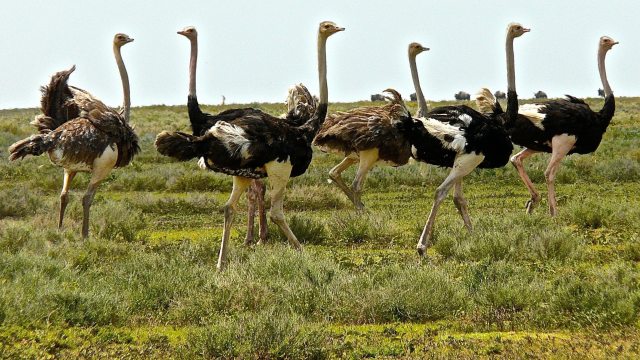
Ostrich
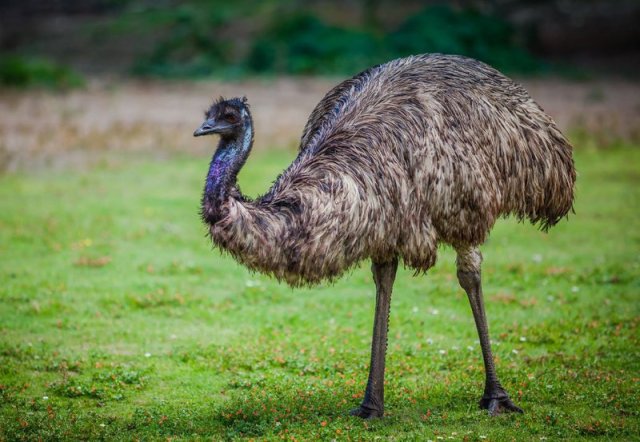
Emu
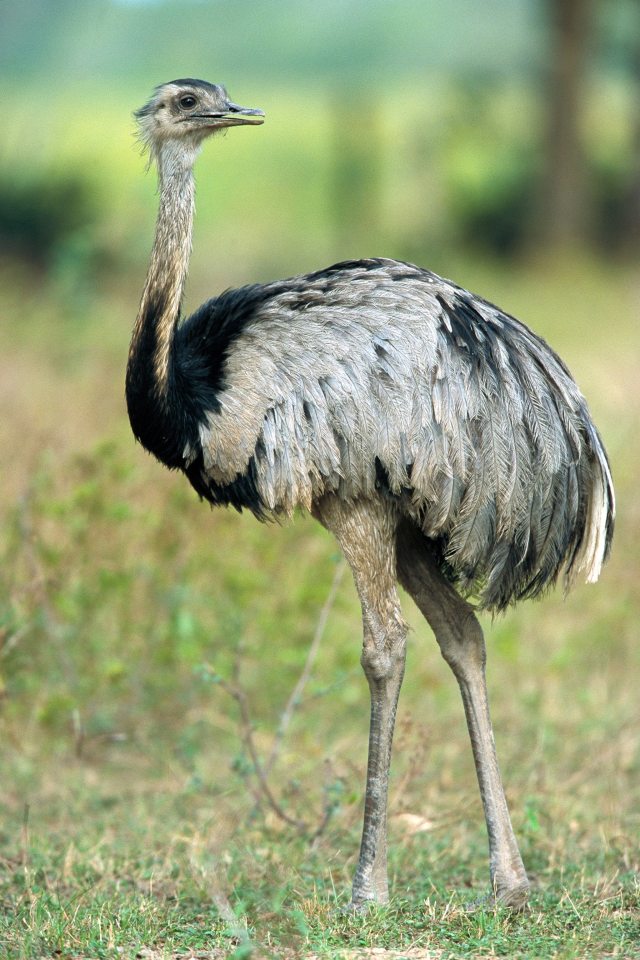
Rhea
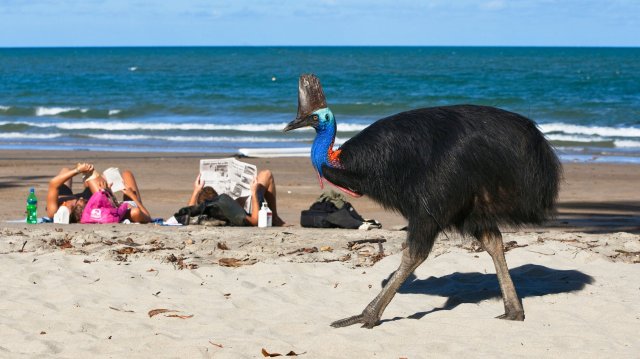
Cassowary




 Legends of Windemere