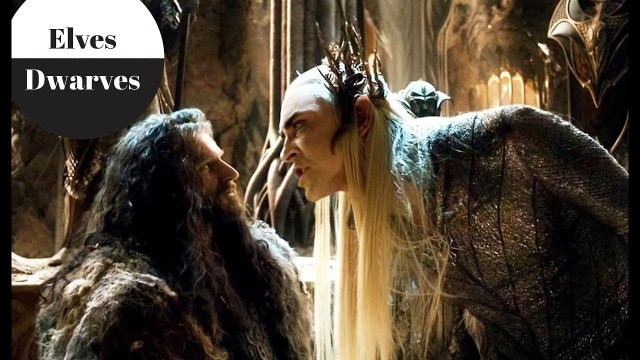
Middle Earth Elves and Dwarves
(I was going to write a post about the traditional Elves vs Dwarves in fantasy. Instead, I realized I had a lengthy section of Do I Need to Use a Dragon? (Fantasy Writing Tips) that covered the topic of racism in fantasy. So, this can act as a sneak peek of a book I hope to release before the end of the year. Enjoy.)
At the start of Beginning of a Hero, I touched on a cliché of fantasy because I didn’t know any better. A character is in a tavern and is hit on by an elf while a bunch of dwarves tease him for the encounter. Why did I do this? All because I was much younger and I never thought about going away from the overused cliché of elves and dwarves hating each other. It would be years later that I looked at the scene, which still worked for what I needed, and wondered why I took such a path. This racial feud never popped up anywhere else. In fact, I had a half-elf running a school where one of her senior staff was a dwarf who was one of her dearest and oldest friends. This relationship made the earlier scene even stranger unless one sees it as a bunch of drunks teasing a stranger being hit on by a woman. I went on to realize how often fantasy goes with the multiple races hating or distrusting each other. Why is this?
For one thing, fantasy has many racial traditions authors and readers accept without thinking about them. Elves hate dwarves, orcs are always evil bandits, humans are always seen with some disdain, and all vampires are monstrous killers. This brings uniformity between worlds, but it also shows a level of unoriginality when it comes to interspecies relations. It isn’t surprising though because this is a very sociopolitical area, which is easiest to do if you have everyone hate each other.
Personally, I think we gravitate towards this for more reasons than it being a fantasy tradition. We see plenty of hatred and distrust in reality, which doesn’t have the wide variety of species like fiction. It’s all humans here and we can be downright toxic to each other for many reasons that end in -ism or -phobic. So, an author and readers may not find a world where everyone gets along as believable because that isn’t how civilizations work on Earth. If a human hates other humans for something like skin color then one wouldn’t expect our species could be friends with a pointy-eared, nearly immortal elf.
Of course, this idea isn’t always consistent in worlds where such animosity exists. The proof is that you have half-breeds. This set piece is typically done with two specific races and humans. You have a long tradition of half-elves because an elf and a human either fell in love or had a one-night stand to produce a child. The second type are half-orcs, which are usually made by a human being raped. Both half-breeds are treated as outsiders to both worlds, but half-elves tend to be accepted more by civilization. These two cases show us both sides of the interspecies relationships. Half-orcs conceived this way demonstrate an idea that different races cannot truly coexist without conflict. Half-elves show there can be love and unity between different races even if there is distrust. This makes the interspecies relationship issue more complicated. You can’t show that groups despise each other and then have tons of half-elves born from actual couples. A limited amount could work, especially if it’s a forbidden love thing, but then they’d be treated negatively. This is a big thing to consider if you want to go with the traditional bad blood between species. You could effectively eliminate the possibility of half-breeds if you go too far.
Authors who use this world-building tool may argue this is the only or best way to create tension in a story. They aren’t wrong. If your story involves a group of heroes who come from different species then interspecies issues is a useful character evolution tool. They will have to get over their biases and pre-conceived beliefs in order to work with their new friends and claim victory. This doesn’t mean it is necessary or without risks.
Be aware that character drama doesn’t always lead to growth, especially if you’re working off racism. Things might be said or done, which a reader cannot forgive because you’re touching on a highly sensitive topic. You need to make sure the drama you are creating will lead to growth and not be there solely to entertain the audience. Sure, people enjoy seeing an argument even with fictional characters, but that can get old quickly if it doesn’t evolve correctly. One misstep can sink an entire series, so it’s best to be careful.
One of the more favored paths is that the characters eventually gain an understanding and become friends. They can still throw verbal barbs at each other, but it’s done in a way that’s more playful teasing than malicious insults. You don’t have the tension anymore since it has served its purpose and is no longer needed to evolve the characters. Keep in mind that this can’t be done quickly or without major catalysts. These characters need to be put in positions where they have to work together under the threat of one leaving the other to die. Actions can speak louder than words here, but you definitely need the latter. A heartfelt would come later in this evolutionary path and can even be the final step towards them putting their biases side to forge a friendship.
The riskier direction is to have the characters constantly bicker throughout the entire series to the point where it comes off as a distraction. Not everyone is going to be friends, but those sharing experiences have a high chance of establishing a level of respect even if they never become close friends. You have to decide on what the payoff is for the initial tension and it can’t be more tension. That’s like opening a box of donuts to find a second box, which doesn’t have the promised pastries.
To be clear, I’m not saying that you shouldn’t have these feuds. All I’m saying is you need to think them through and consider what their purpose is for the story. It can be minor such as a source of character tension or a central part of the adventure. You really do need a reason these days to show they hate each other. Well, people still fully accept if there’s hatred towards orcs and goblins since they’re typically shown as ugly and savage. Demonstrating the point of the hatred through actions and the plot, you can prevent a reader from feeling that the tension was thrown in out of habit.
Another way to show you aren’t doing this because of fantasy tradition is to reveal why the races hate each other. There has to be a history behind the bad blood even if it’s rumors or partial information. With an origin of the feud or stating of the reasons, you help a reader understand that this is part of the world. It’s no longer a plot device the author grabbed for easy tension or because they thought this is how all fantasy worlds operate. Now, it’s a well-developed piece of your world that brings more life to the overall tapestry you’re weaving. These origins don’t even have to be complicated or entirely clear since they may be spanning centuries. Some may even be solved and cleared up over the course of the story, which gives more weight to the characters’ actions and relationships. From there, you get an added dimension of growth and evolution.
It took me a long time to wrap my head around how to use interspecies relationships. I spent many days wondering if I wanted to go with tension in Windemere. My interest came and went because it didn’t feel right. That’s an important thing for an author. Follow your gut on these things because what you think should be added might not mix with what you’ve already established. My instincts brought me to a realization about Windemere. I had put in multiple historical events that spanned the entire globe and affected every race. This included the original demon-infected elves conquering the world, the magical plane crashing into the physical one to create the aura system, and a Great Cataclysm that changed the very face of Windemere. The only way for civilizations to survive was to work together, which made me realize that the different species hating each other made no sense. They had been through so much that there couldn’t be anything more than individual racists or friendly teasing between them. Is this realistic? Maybe not by Earth standards since this also led to me thinking that human-vs-human racism in fantasy makes even less sense. I mean, why would humans be freaking out about skin color among their own kind when they share the world with genuinely different races? It didn’t make sense to me.
Okay, maybe I’m a little naïve or idealistic, but this is where my mind went for this section of world-building. That doesn’t mean my way is the best, but it’s what worked for me given my own mindset and Windemere’s history. You have to do what is right for your world, characters, and story. Nobody can tell you that you’re wrong as long as you make sure these relations aren’t forced for the sake of existing. Work to make them natural through history, reasoning, and not having them steal from the overall plot. It isn’t easy. Honestly, the only topics I think are more difficult to challenge is religion and politics, which can get really crazy.





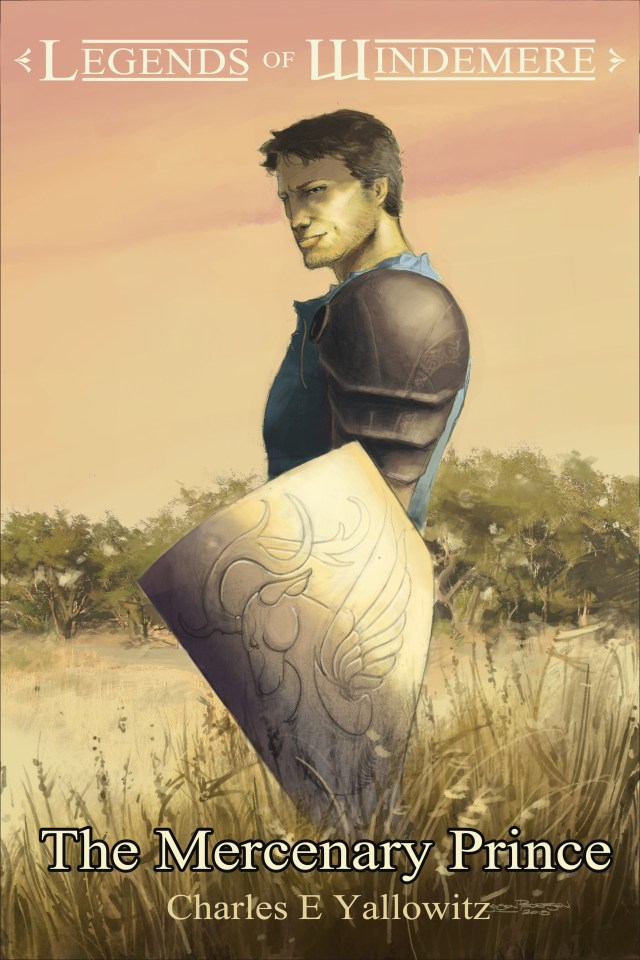




 Legends of Windemere