Looking for the Why of Autism

I’m going to ruffle some feathers here.  Only because I’ve met many parents who are determined to find the ‘why’.  They want to know what made their children autistic.  It can stem from:

  • A desire to help understand their child better.
  • A sense of guilt that it might have been something they did.
  • A feeling of anger at their and/or their child’s situation, so they need something to lash out at.
  • A hope for a ‘cure’ as if this is a disease.
  • Pure frustration.

Back when my son first became diagnosed as neurodivergent, I began reading up on autism.  To be clear, he wasn’t officially diagnosed with it until he was entering 6th grade, but it was mentioned a lot.  My research was mostly to see if he fit the criteria, but that’s when I learned about it being a spectrum and such.  Understanding the habits and ways to help him when he was having rough moments became a top priority.  I also got close to the edge of the ‘why’.

Now, it isn’t wrong to try and find out why your child has autism.  There is a heavy lean towards it being genetic, but science is still looking into it.  Unfortunately, this means many have stepped in to use autism as a scapegoat for their own ideas.  The one I butted heads with a lot years ago was ‘vaccines cause autism’.  The only studies that have ‘proven’ this have turned out to be faked or purposely manipulated to get the desired outcome, which isn’t science.  Of course, you have frustrated and desperate parents who will latch onto anything to explain why their child is autistic and more difficult to raise than they wanted.

IMPORTANT: It isn’t wrong for a parent to get this desperate or frustrated, especially if they have a challenging autistic child.  They are human and want explanations to help them through what they are dealing with.  It can turn into wanting to blame someone for hurting their child, so things like vaccines, various foods, and some rather outlandish boogeymen get targeted.  This doesn’t mean that the parent hates or lacks love towards their child.  They do love the child and want them to flourish, but they are letting out their own anguish.  It turns into a ‘I will not let this happen to someone else’s child’ situation as well.

One of the spiraling paths that this can take is the parent searching for a why and then wanting a ‘cure’.  Even writing this makes my skin crawl because a ‘cure’ makes it sound like someone with autism has a disease.  That’s not the case.  Their brains are wired in a way that they perceive the world more differently than the rest of us.  Yet, a child that is nonverbal and/or prone to violent outbursts can make a parent believe they are sick and need to be ‘cured’.  This is why autism gets lumped in with mental illnesses like schizophrenia and bipolar at times, which is wrong.  Big difference between a mental illness and being neurodivergent.

Unfortunately, the quest for a ‘cure’ can be somewhat dangerous too.  There is one theory that autism is created or at least made worse by heavy metals.  It is thought that exposure to heavy metals during pregnancy or early years is a big contributing factor.  Chelation is the procedure of injecting chemicals into a person to bind and remove heavy metals from their bodies.  So, some parents will opt to do this to their autistic child even though there is no evidence that it will work and has extremely high risks such as kidney damage and heart failure.  A terrifying result that parents who are only looking at the ‘cure’ possibility might not realize.

The only way to really handle autism is patience and getting your child as much help as possible.  There are so many local and national programs out there that will give support for autistic children and adults.  The earlier you start on getting your child the services they need, the faster they would progress towards gaining control.  It’s not easy and can be painful at times, which is why the quiet and good times need to be cherished.  Otherwise, you can fall down the rabbit hole of hunting for the ‘why’ and a ‘cure’ that doesn’t exist instead of utilizing services that can actually help.

Should a person NOT go looking into what causes autism?  No because we all want to know what triggers this.  Yet, everything out there is still being researched and very little is set in stone.  So, you have to be careful about being drawn in by predatory theories that want nothing more than to get the creators money and attention.


Posted in Thoughts | Tagged , , , , , | 17 Comments

Writing a Story vs Watching a Sporting Event In-Person

To be clear, I’m talking about American sports here.  I don’t know how it’s done in other countries, but it does seem like soccer doesn’t suffer from what I’m about . .

.

.

.

To talk about.

Way back in December, I went to a NY Islanders game, which I haven’t done since I was a kid.  This is hockey.  I was ready for some exciting, nonstop action like I remembered from the past.  They would be quick to get things moving after a penalty and make sure people don’t cool off.  I mean, people are always cheering and excited at these games.  I did hear that live football games have a lot of pauses for commercials and the baseball games I’ve been too can be a little slow.  Yet, the former required a lot of set up and the latter is a fairly low action sport when compared to the constant movement of hockey players.  So, how did it all go?

I couldn’t believe how often the action stopped to clean the ice, get some rest, or other things that I simply couldn’t understand.  There would be an average of 2 minutes of action and then a long pause.  I guess it was to get a bunch of commercials in on the television, but that didn’t give me any solace.  Didn’t help that the team I wanted to win was getting their butts kicked.  Even if I wanted the agony to end quickly, it felt like the experience was designed to drag on for reasons beyond the actual game.  The flow of action was so jerky that it took a lot of effort to not pull out my phone and catch Pokemon instead.  Think I did do that near the end.

This also got me thinking about writing a story.  There should be pauses between action scenes, but not to the point where it’s like stop-and-go traffic.  You also need something interesting to happen for the entire audience during the lulls.  Write stories more like soccer where there aren’t many full stops of the action and the slowdowns still have some game progress.  Not like the sports that will take a sudden break and not show anything happening to those watching in person.  It risks losing the audience and having to struggle to get them back.

Now, a big difference is that those at a sporting event can do other things.  Talk with others, get food, hit the bathroom, throw things at the other team to get kicked out (you know which fandoms do this), or just stretch your legs.  You paid a lot for that ticket and are kind of there, so you feel much more obligated to stay.  There’s also an understanding by many that this happens, which is why you have people launching shirts into the crowd and mascots doing stuff.  Guess this does mean that there is some action even though it isn’t the actual game.

Stories don’t have this benefit.  A reader can take a break to do those other things, but they aren’t doing it because the story stopped.  It’s usually a need and they plan on going back to the story if it hasn’t lost them.  If there is this kind of pause and the person walks away from the book, it’s more likely that they won’t come back.  Not unless they are the types to see these things to the end regardless of the frustration.  At the very least, you have a reader who will never touch one of your books again.  So, you have to be very careful with the flow of action.

This isn’t to say that books don’t have commercial breaks of some type.  One could look at chapters and chapter breaks as spots to give the audience a rest.  Unlike some types of sports, you have to give some temporary closure and not make this so sudden.  The audience needs to be able to walk away for a bit and come back, which again means you need it to work with the flow.  Still, these are the spots that you can use to create this pauses in the action.  Even looking at them as mini-cliffhangers, similar to end of a quarter or half, that will be swiftly fixed.

Maybe this is a shaky and simplistic analogy, but I think it works.  An author who enjoys sports can look at this explanation and get a good idea on how not to do a flow.  They can look at their own feelings when a sport is abruptly paused and they are left hanging until the action starts again.  Then, make sure such a sensation isn’t created by your own writing.  Whatever helps you improve your style, right?

So, what do other people think of this analogy and comparison?

Posted in Thoughts | Tagged , , , , , | 12 Comments

Character Occupations Follow-up

Follow-up! Greetings! Liz Gauffreau with you today. For today’s post, I’m doing a brief follow-up to my previous post on using character occupations …

Character Occupations Follow-up
Posted in Uncategorized | Leave a comment

Happy Easter: I Wouldn’t Trust the Rabbit-Made Chocolate

Happy Easter to everyone who celebrates.  Still don’t quite get how crucifixion of Jesus involves bunnies, colored eggs, chocolate, and ham.  Then again, Jews eat willingly eat gefilte fish, so I guess religion and culture doesn’t need a reason.  Enjoy the holiday.

Screenshot

Posted in Uncategorized | Tagged , , , | 5 Comments

Goal Post: End of Break and Back to Work

Well, I’m still in upstate New York after arriving Thursday afternoon.  I’ve only edited one chapter of Darwin & the Beast Collector, but I plan on getting another done today.  I wanted to start editing on Thursday, but the trip up had a lot of construction and it was simply grueling.  Instead, I stretched my legs with a walk through a park, stopped by the exotic snack place, and grabbed dinner.  The rest was kind of a blur of exhaustion and sorting through some mental stuff.

I don’t know if I’m going to get together with friends because the few I talk to had work, kids, and Easter to handle.  Figured it was a chance to get some time alone to think, edit, and catch Pokemon when the weather held.  Editing and catching were slow going, but my brain is definitely bouncing around like a deranged maniac.  I think coming up here causes my mental walls to weaken, so old memories and emotions leak out.  Without work or my son to keep my occupied, I start examining my life and where I am now, which doesn’t go smoothly.  So much has happened to me and I’ve done so much since I left Oswego, which might be the last place I was living for myself.

Uh, backtracking a bit, I should say that I started the break with my son and celebrating Passover.  He wasn’t happy about only having matzah to eat, but we eventually cheated by going to Burger King with my friend.  The story behind that is that this is the same friend in high school who convinced me to go to BK to cheat and that nobody would know.  We came walking out with our burgers only to find my dad walking out of the bank right across the mall walkway.  So, a BK cheat has become a funny tradition if I decide I can’t take matzah any more.

Really isn’t anything majorly exciting that happened since the plan for spring break was solely to relax.  Monday is back to work and the final stretch for the end of the school year, which means a lot of work.  I’m going to try really hard to fit more editing time into my weekends and maybe a few evenings.  I’ll have 6 more chapters to go once I get home from Oswego.  Might shoot for more since I don’t have much else to do today and not finding the Pokemon group means I can’t do the event.  Can’t tell if I’m wasting my time here or if I’m being productive.

There was an interesting point during the drive where I started noticing a plot issue with the character of Rayne.  Nothing that involves the adventure she has with Darwin, but something with her future adventures.  I should probably start setting things up in this book even though the truth would be revealed in another series.  I don’t really know if that makes sense or how I’m going to make it work.  Don’t know if I’ll ever get to writing at the rate I used to either, so this could all be moot.  Still, I guess I should have notes down in case somebody can do something with it.  It’s fun coming up with this stuff, but it always draws me back to the ‘stalled author’ mentality that lingers in my mind.

Goals of the week:

  1. Enjoy last day in Oswego.
  2. Drive home safely tomorrow.
  3. Edit more Darwin & the Beast Collector.
  4. Laundry
  5. Food shopping.
  6. Back into the swing of work.
  7. Help son with school.
  8. Catch Pokemon for exercise.
  9. Sleep.
  10. Work on some June posts.
Posted in Goal Posts | Tagged , , , , , , , | 7 Comments

Adventuring Lovers Scenario

Haven’t done a scenario post since I tried them out in January.  The experiment was okay, but I still don’t know how to work it very well.  Some people needed more information while others ignored pieces that were given.  I’m going to try again with this week’s topic and make it fairly simple to see how it goes:

You are an adventurer and you begin a relationship with one of of your fellow adventurers.  Both of you are on a quest to save the world, so you can’t exactly head off to do the usual dating stuff.  Many of your adventures are dangerous too.  Battles, monsters, and traps are weekly dangers that you two deal with together.  Either of you could die at any moment, but you don’t care because it’s love.

So, how do you nurture the relationship without ignoring your quest?  Keep in mind that both of you are aware that the world ending will lead to both of you dying, which pretty much ends the relationship.  So, you can’t leave the adventure.

Posted in Questions 3 | Tagged , , , , , , , , , | 12 Comments

Poetry Day: Pitter Patter

Off to Handle the Weeds

(A happy poem?  Guess I have a few in the folder.)

Tiny feet on the run

Rushing down the hall

Mingled with a cackle

Birthed of baby glee

As he runs unattended

Awake before the guards

Who stir behind their door

Closed by tiny hands

To give him a head start

On trouble for the day

Clothes are thrown

To bathe the room

Talking toys turned on

Noise to drown his steps

While he sneaks into a room

Padded toes creeping

Toward the groaning guards

Before a sudden charge

Skidding around the bed

And clambering on high

To attack with laughs and tickles

Posted in Poems | Tagged , , , , , , , , , , , | 8 Comments

7 Tips to Adding Romance to a Non-Romance Story

Danilo Thann and Arilyn Moonblade (Forgotten Realms)

As much as some people may hate romance being added to stories like adventures, there are ways to minimize the interference.  Let’s dive right into it.

  1. Remember that the romance is a subplot.  It isn’t the main story, so it shouldn’t steal the spotlight for more than part of a chapter every now and then.  Once you begin paying more attention to the love story instead of the established story, you will lose audience members.  That isn’t what they picked the book up for since this isn’t a romance book.
  2. If your story is an adventure, you can’t force regular relationship events.  Imagine being on a quest to save the world and stopping to go on a fancy date.  This connects to the first tip in that the characters need to make sure their priorities are correct.  If they put their romance above their quest then it will cause the audience to drift away.  After all, why would a reader care about the fate of the world if the heroes no longer do?
  3. Romance can be done with small gestures and occasional words.  There doesn’t always have to be big gifts and heavy make-out sessions.  You can maintain the presence of this relationship without making it invasive.  For example, simply noting that the characters are sharing a bed, give a kiss goodnight, say they love each other, or anything that reveals emotions without being over-the-top.
  4. Plot events can open the door for the romance characters to do some ‘normal’ stuff, but it shouldn’t be forced.  Biggest example is them having to go to a party for some reason, which allows them to dress up.  There will be dancing and compliments and what one would expect from a date.  It’s still part of the major adventure and will focus on that, but it gives the romance characters a chance to strengthen their bond.
  5. Even if you’re adding a romance to make it a tragedy and create heartache later, you need to put effort into it.  Just like going too far can derail the story, not going far enough can make the tragedy fall flat.  So, you need to find that middle ground of having them act and grow like a couple, but not so much that it becomes the focal point of every chapter.
  6. A key component of every relationship is communication.  So, the characters have to discuss things like the feelings, the future, and their general relationship.  This establishes a strong and realistic bond.  It also takes time away from the adventure, which is where you can run into problems.  Find lulls in the action where every character has downtime to have these events take place.  For example, staying at an inn for the night after pushing through the wilderness.  Another option is them healing up after a big battle and having nothing else to do.
  7. Do NOT always listen to the loudest voices in the room when it comes to the romance subplots.  People will want you to junk it for a variety of reasons.  Others will feel a different relationship will work better and push for that.  Some will want you to go further with attention to the romance.  You are the author and know where the story is going.  Control this volatile subplot and don’t let others push you into making it explode by accident.
Posted in Uncategorized | Tagged , , , , , , , , , | 18 Comments

How to write a non-fiction book with Sally Cronin

Hi SE’ers its Robbie with you today and I have a lovely treat for you in the form of an interview with influencer, Sally Cronin. Sally is sharing …

How to write a non-fiction book with Sally Cronin
Posted in Uncategorized | 2 Comments

Parenting An Autistic Child

Yahoo Image Search

This is a post I wrote about parenting and autism back on May 3, 2021.  I thought it would be good to trot it back out and even edit stuff a bit with my current knowledge.  Enjoy even though it’s pretty long:

I work with autistic and other neurodivergent students who are at various levels of the spectrum.  I’m the parent of an autistic child who is high on the spectrum.  I’ve taken classes on how to work with these kids and learned from own experiences as a parent.  Yet, I can’t stand here and declare myself as someone who can talk at length about autism.  Part of it is because I am not autistic, so I do not have the hands-on experience that my son and students do.  Also, it’s a spectrum for a reason and that’s because it’s not the same for everyone.  When younger, my son responded to a reward system to help him deal with transitions and minimize negative behavior.  He has since grown out of that, but still requests rewards for difficult tasks. Others don’t care about such things, so you need to find alternatives.  So, I can only talk about what I know, which could be entirely different from what another special needs parent believes.

Truthfully, the biggest tool in a parent’s belt is patience.  There will be great days and nightmarish days, but you need to be patient and calm.  Not all the time though because you will slip at times.  It can be stressful and nearly every parent has a moment where they yell or cry or make a mistake.  This can be painful and disheartening because it can be a shock to their system, which may trigger a meltdown.  You walk away feeling like you’re a terrible parent, but you’re only human.  As long as it is not a constant screaming, you haven’t destroyed the relationship.  Thankfully, this frustration is temporary because you eventually calm down and return with a clearer mind.  After all, you love your child even with the challenges.  At least, that’s what should happen.  There are situations where a great mistake occurs and causes lasting trauma.

Many people believe is that those who are autistic can’t feel emotions.  I’ve met parents of autistic children who act like they’re working with a heartless robot when that’s not the case.  Even someone who is nonverbal has emotions.  They can become scared and angry and sad.  They can be happy and recognize they are loved even if they don’t understand the emotion.  A parent who loses their patience can do lasting damage if they don’t return to show they still love the child.  Soft voices, hugs, kisses, or anything that will show you aren’t angry any more, but it depends on the child.  Some don’t like physical contact when they are overstimulated.  More importantly, you should genuinely apologize for your behavior even though you are the parent.  This is essential regardless of if a child understands the words because they will read faces and voice tone.  Again, this is from my own experience.

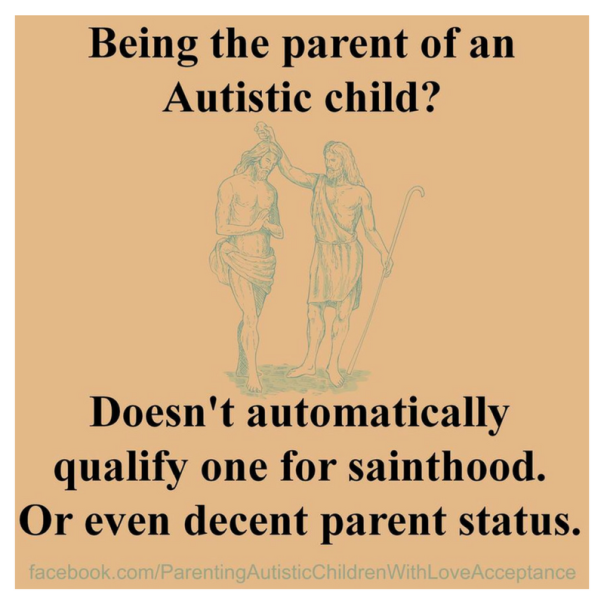
Now, you might be wondering about the image at the top since I’m saying mistakes happen.  Well, that statement is true, but there’s a difference between mistakes and being a shitty parent.  I’m being kind of blunt, but I’ve seen it happen.  First, you have parents of autistic children who deny they have it even after a diagnosis.  This results in them forcing the child into situations they can’t handle without accommodations or are beyond the skills that they currently have.  They won’t suddenly learn everything they need while under stress, so damage is done to their progress.  Sometimes it creates negative behaviors that are incredibly difficult to reduce or eliminate by the time they are older teens or adults.  Commonly, those with autism need routine or consistency, so they won’t break away from their comfort zone even if it such a place includes negative behavior.  I feel that this is easier to handle when the child is younger because all kids are dependent on their parents early on.  So, they won’t feel different from their peers when their behavior is being adjusted, rewarded, or punished even in public.

Let’s get to the punishment part now.  By punishment, I mean the removal of something they enjoy.  I’ve done this before and it’s a habit I try really hard to break.  This is fairly self-explanatory because we’re used to it from long ago.  We do something bad and get grounded or having something we love taken away.  This makes us not want to make that mistake again.  With autism, you’re coming up against a variety of factors that can include impulsivity, inability to connect actions with consequences, and anxiety in regards to transitions. So, they may impulsively do something we perceive as wrong.  The parent bans their favorite TV show for a month, but they can’t see this is associated with their actions, especially if their mistake wasn’t TV show related.  All they know is they are being punished and their comfort zone has changed to no longer have a relaxing activity, so they are upset.  This can be traumatizing and lead to more negative behaviors instead of a reduction.  Parents who continue doing this when it clearly increases anxiety become a problem, especially if they refuse to stop in the face of growing issues.  It can create some terrible habits as well.  For example, a child makes a mistake and goes right into a meltdown before an adult can respond due to fearing punishment.  One could call this a trauma reaction.

It’s better and more effective to go with a reward system that is immediate.  Stickers, candy, TV time, and anything else that is simple and they love will work.  I used to do sticker systems with my son to help him with eating.  When he earned enough, he could trade them in for a bigger prize such as a Funko Pop or Lego set.  The reason this differs from punishment is because it’s all positive.  For example, a child refuses to eat dinner and you respond by taking away their favorite bath toy until they do what they’re told.  Even if you get them to eat, it isn’t a strong achievement and can fall apart due to it being a negative creation.  Instead, you tell them that they get a sticker of their choice for every meal they eat.  Now, failing doesn’t result in them losing something they have already gained.  It means they didn’t earn a sticker and can try again the next day.  The more times they succeed, the stronger the positive behavior is and the reward system can slowly fade away.  Of course, it’s important to explain this to them and be consistent.  I was told that you want to have the rewards be solely for that event too.  This is why I had candy for my son eating his lunch and stickers for breakfast since the two meals had different behavior issues.

I’ve just kind of ranted here, so I hope I made some good points.  Parenting an autistic child is always a challenge that changes as time progresses.  You find new methods or the child develops new habits, so you never know what the day will hold.  That’s why patience is important as well as accepting that this is how your child is.  Not to the point where you don’t try to help them learn and develop coping mechanisms.  Acceptance means that you understand that things will difficult and you need to focus on the child that you have instead of the one you wished you had.  That sounds cruel, but I’ve met a few parents of autistic children who talk about curing them and gaining the child that they always dreamed of.  Hurts my heart there because while these parents are thinking of a child that doesn’t and will never exist, they are ignoring the unique child that they have.

2025 Add on– These days I don’t do many reward systems with my son.  He acts like every other teenager with fighting me on homework and waking up in the morning.  The big thing with his is that he has trouble understanding social situations and various ways of speaking.  Many people with autism will take things literally and he’s like that.  So, wordplay and idioms confuse him.  I just have to be careful how I explain things and still be patient.  All that being said, he does really well in school and has friends that he tries to interact with.  His fixations still get the best of him when he’s not focused on anything, so he’ll go for Yugioh and Pokemon instead of breakfast or homework.  This is where reward systems still come into play.  If he does what he’s supposed to do in the morning, he gets to play Pokemon Go on the way into school.  If he does his homework correctly and quick enough, we can go out for some PoGo in the park or games on the Switch.  This doesn’t feel any different than with anyone though.  We all have rewards that we require for doing various tasks.  I mean, a salary and benefits are pretty much a reward for working.  If an employer doesn’t give us that, we’ll go off and find them somewhere else.

Posted in Thoughts | Tagged , , , | 13 Comments