Delighted to share the news of my latest release this week of a poetry and short story collection Variety is the Spice of Life: A Blend of Poetry and Prose – the book is available in Ebook and print.
About the collection
Variety is the Spice of Life is a collection of poetry and short stories about relationships with others, including pets and animals inhabiting the world around us. The connection with others brings love and friendship, excitement and sometimes surprises, danger, mystery and sometimes the unexpected.
The poetry explores human nature, the fears, desires, expectations and achievements. Nature offers a wonderful opportunity to observe animals both domesticated and wild. Even in a back garden you can observe a wide variety of creatures and the daily challenges to survive a harsh environment.
The short stories introduces you to a healer whose gift comes with danger, a neighbour determined to protect…
I was 50/50 on the goals I made for myself last week. I did help my son with schoolwork, used my bike twice, went to work, and finished ‘Lupin’. I DID NOT finish January posts, sleep better, do any paperback formatting, or start the February posts. So, what would I say the verdict is?
‘Adulting won and creative free time lost.’
I was definitely toiling away from dawn to dusk this week. If I wasn’t at work, I was helping my son with schoolwork. If I wasn’t doing either of those things, I was passing out while watching ‘Warrior Nun’. Had to restart episodes so much that I gave up trying to stay awake past 10 PM. Just wasn’t happening with everything going on. Things aren’t even worth talking about. They were just busy. A few things did happen to explain the upheaval a bit.
First, my son had an allergist appointment. I’ve mentioned before that he has a peanut and tree nut allergy, which causes some concerns. You don’t realize how much those things are in food until you can’t eat them. Freaking everywhere! It had been a while since he was tested, so we got him checked. All but 2 of his food allergies may have disappeared. Fingers crossed that it’s the case because it would make his life a lot easier if he only has to avoid two things. This required a bunch of conversations with him after the fact.
We also had parent-teacher conferences, which took away another night. This is probably why I didn’t get as far as I wanted. All of the reports were stellar because he’s a great kid and student. Participates, works hard, studies, and most of his grades are good. A few stumbles here and there, but that’s normal. I knew it would be like that, but it gave me a chance to get some questions answered.
At least I’ve only got 3 work days coming up and they’ll be fun. I get to rest up this weekend, so maybe I’ll finish Legends of Windemere paperbacks. I’ve got 10 more to day. Then the 8 War of Nytefalls, Quest of the Brokenhearted, Life & Times of Ichabod Brooks, and the 2 Bedlams. That means I’ve got 22 paperbacks to format and submit. It’s possible to get that done by the middle of December, which means I can do promos on the Tuesdays in January. Might take a bit longer because I might do something else on Thanksgiving.
Since I don’t have my son for the holiday, I’m strongly considering tackling at least one of the Tales of the Slumberlord outlines. That way, I can start writing Darwin & the Demon Game during the Holiday Break. Having 6 days to work with, I should be able to get 3-4 of the 16 chapters done. Maybe even 5 if I’m really lucky. Probably shouldn’t push my luck there. If I can finish the book before the summer, I’ll be in good shape, especially if I’m working during that break.
This is what I need to figure out. I have to be able to write my books during the school year. That way, I can work over the summer. Be nice to make enough money that I can be more flexible, but that’s not possible. This whole thing is a challenge when you add the blogging into the mix. My weeknights would have to go to that and my non-parenting weekends/holidays would go to writing. Of course, I’ll be pulled away for family events and such too. Means it’s going to be a lot of slow progress, which hurts for someone who was able to dig into a project and work on it for days without a break. This is why I feel like I’m in a holding pattern. Just not used to being slowed to a crawl when it comes to creativity.
Guess we’ll just see what happens. Got nothing else to really talk about. Hoping to find some good Black Friday deals online. Mostly tech for my son’s holiday presents and some specific Lego sets. Fingers crossed. Not sure I’m going to tackle a store, but we’ll see if they’re still crazy during the late morning. Never really tried in-store shopping during that day, but the presents aren’t simple this year.
Let’s get to the goals since I’m exhausted from multiple busy days. I’m writing this late Friday night and have to get up early for a doctor appointment too. So, we’ll see how coherent things are:
Go over Darwin & the Demon Game outline. Might be in better shape than I realized.
Finish January posts.
Complete paperback formatting. Hopefully finish Legends of Windemere.
Help son with homework.
Father/son time when possible.
Keep using the bike. Might be shaky this week.
Black Friday shopping.
Sleep in on Sunday.
Try to stay out of trouble on Twitter. Getting harder and harder every day.
As a Fantasy reader, I love a good dragon character in a story, yet sometimes I have to wonder, why dragons? Why do they get more attention than other mythological creatures?
In traditional childhood stories, dragons usually fill the role of antagonist. You have dragon slayers who go out to save the village by killing the fell beast and getting rewarded with marriage to the princess for his heroic bravery. Not a great basis for a relationship if you ask me!
To be fair, a lot of modern children’s books have presented less threatening and even comical dragons, for which I credit Peter Yarrow who wrote Puff the Magic Dragon, both a story and a long favoured children’s song.
Sometimes the dragons in stories can speak to humans, like in The Hobbit. In most early stories, they are tricky and seek to use clever ruses to defeat the dragon slayer…
I was on the fence about writing about this because I thought it was a given. Then, I ran into people who didn’t know the difference. Others swore that a good story is one where the main character doesn’t change. Guess we live in a world where ideal heroes are preferred over flawed ones. I mean, really flawed characters instead of slapping arrogance or a mild shellfish allergy, which don’t cause any issues. Okay, I’ll get back to this rant in a bit.
What are we talking about here?
Dynamic Characters– These are the ones that change over the course of a story. They are your protagonists and antagonists, but can also be supporting characters. The whole point of them is that they do not end a story where they started. Their flaws are conquered or accepted, which makes them stronger. It isn’t the toys and powers they get either, but the way they change as people. This need and ability to change creates a personal story arc, which adds tension to the overall tale. For example, a superhero who starts off being selfish and ends knowing what it means to be a hero. (Nobody say Iron Man because he had this story arc in at least 4 movies. Guy has the memory of a brain damaged goldfish.)
Static Characters– These are typically found in supporting areas where they have no need to change. They end a story the same they started because none of the events forced them to evolve. A reason for this is that they aren’t designed to be anything more than pushing the story, evolving the main characters, and showing that there are other beings living in this world. They have no story arcs and their personalities can revolve around one aspect without causing harm. You find your comic reliefs, mentors, goons, henchmen, and other limited roles in this category.
I remember this being a very basic lesson that I learned in middle school. It wasn’t about writing either, but about identifying the two character types. You were shown how the dynamic ones had the spotlight while the static ones came off more as set pieces. It helped us understand the concepts of protagonist and antagonist because those were always the dynamic ones. Didn’t take long to get the concepts, especially when it was paired with talking about conflict. Dynamic characters are heavily affected by conflict while static characters aren’t. Seems simple.
Yet, I keep seeing people push for characters who won’t change to be the protagonists. I don’t think I’m seeing a majority, but it’s enough to make me worry. People attack heroes for their flaws even though these are things that are going to be worked through. They complain about the hero being anything other than the ideal, which means they want them perfect from the start. These readers are fine with the flawless protagonist gaining more abilities and toys, but they don’t want quirks. Arrogance disguised as rude confidence seems to be the exception because it’s ‘strength’. Fairly easy to get rid of arrogance too with the hero having one loss, acting sad, and then coming back to save the day. They change a little, but not enough to alter their personality.
As an author, you have to decide on if you want static and dynamic characters as your main cast. It’s fine to do either, but you have to accept the cons. As I said, dynamic means the heroes can start off rough, unlikable, and weak. Readers with no patience for the hero’s journey will be vocal about their boredom. Those who enjoy the long evolution of a flawed character will be quiet because they know it will take time. So, you can get hit hard with negativity. It can cause you to consider rushing the evolution, which will be sloppy and annoy the other group. I think it’s best to do what you feel is right for the story and the readers who want to see it through to the end will stick around.
Static characters avoid the initial negativity of those who don’t like their heroes with any real flaws. You may get a false sense of confidence here too. People who expect protagonists to change will read along expecting a plot event to knock the hero down and force them to evolve. A static character doesn’t do that unless you switch them to being dynamic. If they’re static the whole time, some readers will leave because they feel the story is boring. There’s no sense of tension or possibility of the hero really failing. All their mistakes are minor or swiftly fixed with no long-standing consequences. Some even fail into victory. This is why static characters don’t really make good protagonists for long stories. They could work for short stories and parodies where they don’t need to evolve or the action always resets. Kind of like a sitcom where everything goes back to ‘normal’ at the end of most episodes.
Is this really a personal preference? Maybe. Certainly feels that way considering how often I argue with people about protagonists. I really can’t wrap my head around heroes who start off perfect and stay that way. Even Goku and Superman lose fights and have to evolve over the course of their adventures. There’s no harm in having a hero who has flaws and needs to grow. Not only grow, but work hard to survive and become the perfect version of themselves. If they’re just handed everything, they’re going to stay static because nothing happened to alter their personality. Anything changes after they are given things feel superficial and forced. As if the author did it because they felt they had to instead of being natural.
So, what do you think about dynamic and static characters?
(This is heavily inspired by Luke Callindor’s storyline throughout Legends of Windemere. First book is still free.)
*****
Is it a blessing?
To be born to fame?
Descended
From heroes
And legends
Of many bardic tales
Holding the respect
Of thousands
Without a single deed
People praise you
For what you may do
Ignoring
That you did nothing
It is called
A gift of birthright
Impossible to revoke
Driving many youths
To a destructive path
Many indulge
In the life of ease
And grow no will to try
They feed off the fame
Hiding behind stories
Of what their priors did
They add nothing to prestige
Tainting the legacy
For generations
The others fight
Refusing to accept
What they have never earned
With a passion
Rivaling the hottest dragon fire
They set out
To prove their worth
Swearing to the gods
That they will die trying
Both paths will destroy
Breaking bodies
And eroding spirits
Yet some will overcome
To live a happy life
Retiring in wealth
Or humility
With a fame
They can call their own
The one issue I have with writing this post is that omniscient is a pain to write. I get it wrong half the time. So, I might cut this short to stop getting frustrated. That and I think it’s fairly straightforward.
Now, I write in a present tense 3rd person style with a limited POV. I went with limited because it never felt right to have characters or the audience know things that weren’t shown in the book. I push the boundaries whenever I can when describing new locations, but I really have to use dialogue and discovery to get the facts out. This includes character thoughts because I always imagine others standing around waiting for inner monologues to end when I picture a scene. Still, that’s just me and I probably work fast and loose with the rules here. Might even have it wrong now that I think about it. It’s another reason why I needed to look a bit more into this.
So, what are omniscient and limited POV?
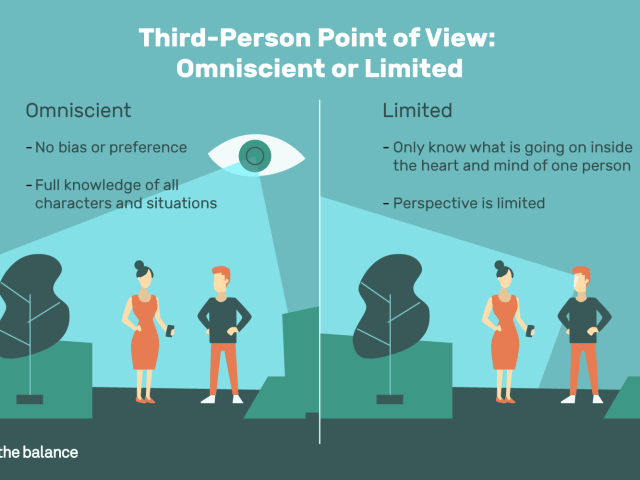
Omniscient is when the narrator knows everything. They are aware of all events, thoughts, and feelings in a story. This also means that the audience is aware of all these things as well even if the characters are not.
Limited is when the narrator relates only what they are aware of. They cannot share any thoughts, feelings, and knowledge that they do not have.
Right off the bat, I can see why my own style is going to require a third category later in the post. Anyway, these POVs work off stable and established narrators even if that role changes by the chapter. It’s why people don’t like things switching in mid-chapter and get confused on who they are viewing the world through. After all, POV is the lens that you use to reveal the story. So, you need it to be clear on who is talking and showing the world even if it’s a faceless/bodiless narrator.
I’m sure most people would agree that one is not better than the other. With omniscient, you can share a lot and not be restrained by having to holding some things back. The feelings and thoughts of characters are out there. With limited, you can’t be as free, but you can easily establish more tension and mystery. You’re hiding a lot until the right moment and people will understand why it wasn’t shown at the start. There are different levels of this too, especially since you can be flexible. Most audiences are only subconsciously aware of POV, so that gives you wiggle room. Means beta readers are helpful to see if the ‘feel’ is right.
Now, I did find that there is a third category: Limited Omniscience. This is probably what I use without realizing it. Part of this is due to the present tense since past tense makes it easier to use the two main POVs. Now, this one has the narrator experience actions through a character, but not the thoughts and feelings. You can get that through actions and expressions, but the inner workings of a character are kept hidden until they reveal them. That is the limited part while the omniscient part is knowing all of the experiences and actions that are going on. For example, Luke Callindor’s actions in battle are omniscient POV while his feelings and thoughts are predominantly limited until he makes them known.
I really like the combo, but that’s because it’s what I’ve been using for years. So, I’m rather biased on this. What do other people think about this topic? It’s both fairly simplistic and complicated, which makes it hard to write about. I think it doesn’t help that we all use POV differently even slightly.
We were all new authors at some point. Not that we weren’t writing before for school or other reasons. It’s just that there was a point where we decided to take the trade seriously and refine our abilities. Of course, this is usually after we’ve developed some terrible habits that nobody would correct in every day life. It is funny how we have to be grammatically correct when writing, but not really when speaking. This is why dialogue can be a nightmare with editing.
I’ve had some doozies in my life. Overusing the word ‘just’ or ‘only’. Not knowing any dialogue tags other than ‘says’, ‘asks’, and ‘exclaims’. Having no idea how to use commas until after college. All of these pale in comparison to the first habit, which is what led to a major aspect of my style.
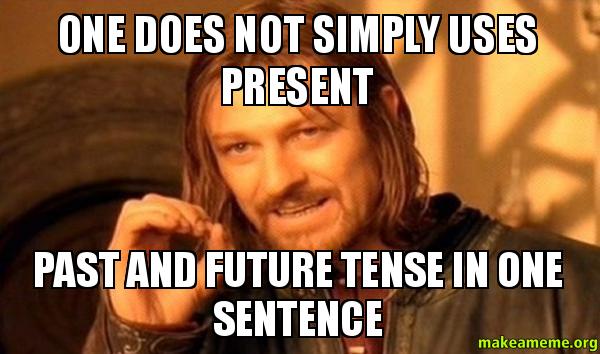
In high school, I started trying to write detailed stories. The problem was that I couldn’t keep a story’s tense straight if my life depended on it. The meme above is all about me at age 15. I’d start a sentence with past and end it with present. Future would show up randomly in a paragraph. I was all over the map and my writing teacher finally had me stay late after school to have a talk. This is when I was shown the differences between the tenses and told to pick one. I went with present because the images I was explaining on the page were going on in my head in real time. Had no idea present tense stories were so rare. Of course, nobody told me until I published ‘Beginning of a Hero‘.
I still make these mistakes at times, but I’m able to catch it. So, what was the worst habit you had to overcome as an author?
Been thinking about how people tend to give advice. It’s usually unsolicited stuff, but you get it when you ask too. Don’t worry because I’ll bring this writing rather quickly. Just from the title, I’m sure people know where I’m going. Some probably already jumped to the comments.
Many people give advice in a way that makes it feel like they are giving orders or talking about utter truths. They believe that because something worked for them, it will work for others. Maybe they had to go through a tough experience and feel that it’s something everyone should experience. So, they tell others to do the same and ignore a few basic facts:
Everyone is different.
No experience is completely identical.
People take different lessons from the same event.
Empathy and understanding is needed for good advice.
Don’t get upset if the person doesn’t follow your advice.
#4 is a big one specifically because many people have one, but not the other. They understand what a person is going through on a logical level, but ignore the emotional side. Others feel the emotions, but don’t put any logic towards the problem. This creates a one-sided piece of advice that will either trigger an outburst, make a situation worse, or being ignored and lead to #5.
Personally, I think people do this because they give advice to make themselves feel better and not to help others. It’s a total ego stroke because you get to be proud and get thanked if you lead someone in the right direction. Once things go wrong, a person who did it for themselves can become a problem. They’ll blame the person for not following the advice perfectly, refuse to accept any blame, or just walk away. In the end, this makes things worse and is why people need to be careful about giving advice.
This brings us to writing where people scream various phrases like they’ve been engraved on the left ass cheek of God. ‘Show, Don’t Tell!’, ‘Kill Your Babies!’, ‘You NEED a Newsletter!’, and ‘This Marketing Idea HAS to Be Done! are some favorites. You can see that these pieces of advice fall into two categories:
The first two phrases are mottos that people shout without giving any explanation. It goes this way because many who say them don’t understand them at all. I’ve had people complain about showing and not telling because they don’t like me using present tense, which changes the way things feel. Someone once told me that I’m not a real writer unless I kill my babies by deleting 80-90% of what I first write. These people got angry when I didn’t follow this advice even though it didn’t feel right for what I was doing. They just used them because they saw it being used by other authors as constructive criticism.
The other two phrases are when an author has success with a writing or marketing concept. They start telling everyone to do it and refuse to believe that it could fail in any way. Many times I’ve done the same marketing as other authors and come out with nothing while they found success. Some admitted that what I did was good for my genre or noted there were major obstacles that they didn’t face. Others put the blame squarely on my shoulders for ‘not doing it right’ or ‘missing the boat’. The point is that marketing is fickle and what works for one author may be an utter disaster for another. It makes sense since we’re all individuals with our own styles and play to different audiences.
This is why I always try to say that things worked for me, but it might not work for someone else. If I ever get around to publishing Do I Need to Use a Dragon? (Fantasy Writing Tips), you’ll see that I make this a big sticking point. I feel like even the top authors can’t really claim to have all, if any, answers. For one thing, they got successful during a different era where publishing and reading were different. People always argue this with me, but you don’t have as many readers as there used to be. You might think it’s the same, but that’s because you hang out with many readers. Most of the people I know are too busy to read or stick to non-fiction with no interest in things like fantasy. You also have readers who go into series only after an adaptation and most of those won’t wander away from that franchise. It wasn’t like this when older authors were finding success, so some of the advice that is given simply doesn’t work.
So, what can be done if someone asks for advice? Personally, I think it’s best to give it with the caveat that I mentioned. Tell them what worked for you and offer more support than words. Show them what happened and discuss both the pros and cons. Don’t make things out to be sure bets because they rarely are. Try to see situations through the eyes of the person you want to help instead of your own. That will make it clear if your suggestions are even feasible. For example, don’t suggest dropping hundreds of dollars into marketing to someone who is struggling to buy groceries. That will come off as insulting and almost elitist because you’re basically saying ‘I am rich enough to succeed and you are not’. Same goes for free time, support systems, technology, and other aspects that an author might be restricted in for a variety of reasons.
Funny thing is that this post is basically giving advice too. So, maybe none of it will work for some people. Weird paradox there.


 About the collection
 As a Fantasy reader, I love a good dragon character in a story, yet sometimes I have to wonder, why dragons? Why do they get more attention than other mythological creatures?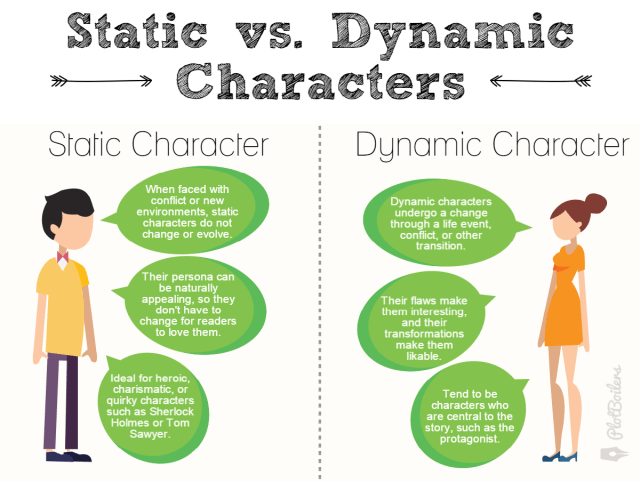




 Legends of Windemere