Love and Characters

Hi SEers! Denise here to talk about character relationships on the day many celebrate love or Valentine’s Day. If you celebrate this day, I hope it’s…

Love and Characters
Posted in Uncategorized | Leave a comment

Poetry Day: Not Sick Enough

Fry Meme

(I think many of us have been in this situation.)

Though limbs ache with every twitch

And you cough more than your breathe.

Your head swims without much cause

Turning your stomach instead out.

You are made to carry on.

No fever to prove you’re really sick.

Pride stops your food from rising.

The fact you walk is against your case.

No rest is given for your ails.

Until your body can take no more

And lays crippled upon your sheets.

You are deemed not sick enough.

Posted in Poems | Tagged , , , , , , , | 21 Comments

Detour on the Eternal Road Tour – Stop Eleven with Marie Ann Bailey

I have known Marie Ann Bailey almost since the first day I started blogging. We somehow connected and then collaborated on a simupublished set of …

Detour on the Eternal Road Tour – Stop Eleven with Marie Ann Bailey
Posted in Uncategorized | 3 Comments

Source Of An Apprentice’s Fall?

The fallen apprentice and most other characters who fall from grace tend to succumb to a specific personality trait.  Some may call it egotism and others narcissism.  I’m going to use a different term that is popular in fiction:

Hubris

This word comes from ancient Greece and was deigned a major flaw of mortals in their mythology.  Through hubris, a person will defy the gods, display extreme vanity and pride, and may even go so far as to claim divinity themselves.  We can even see this in real life examples where a person acts superior until they are knocked down a few pegs.  In fiction and reality, they lack any sense of consequences.  Even in the face of the results of their actions, they may continue to demonstrate hubris and blames others.  This is why narcissism can be closely related to this personality flaw.

As far as the apprentice archetype, it isn’t too hard to see how this can come about.  If one is gifted and continually praised by their mentor, they might feel that they are superior to those around them.  Whatever ideas and beliefs they assume are considered the best even if it causes them to hurt others.  The egotism becomes so strong that a moment of not being the best can cause them to crash.  It’s almost unheard of their mind for them to lose, so they begin going down a dark path.  Maybe it’s to gain more power outside of their mentor’s teachings or to grab that they would normally earn at an earlier date.  The hubris-fueled actions of these characters can lead them to do horrible things to the heroes because they become an emotionally wounded animal.

The funny thing about hubris is that you don’t really see the turn that much today.  Yet, it’s clearly still being used as a plot device.  So, one could say the concept is hardwired into our natural psyche.  It could even be an instinctive warning for humans not to get too confident since we weren’t designed with built in weaponry.  I mean, we’re predators, but I don’t think we would be apex predators without our technology.  So, a sense of not messing with things stronger and more dangerous than us could be part of our natural mindset.  Since it isn’t as common a problem anymore, we demonstrate the continued existence of this instinct through fiction.  Probably explains why we become fascinated by real life people falling from their pedestal too.

Hubris isn’t a permanent state either.  One can learn humility and pull themselves out of the dangerous position.  A subplot can always be such a character learning to listen to others and accept they could be wrong.  This is a challenge since a major aspect of hubris is a sense of superiority.  This is why one normally can’t change until they suffer severe consequences.  Happens in real life too.  Unfortunately, the consequences can be fatal, which there’s no coming back from.  They can also, as previously stated, push a person into a vengeful and more sinister mindset.  Always dangerous popping someone’s inflated ego.

So, what do you think of the use of hubris in fiction?

Posted in Thoughts | Tagged , , , , , , , | 16 Comments

Detour on the Eternal Road Tour – Stop Ten with Annette Rochelle Aben

Annette and I are from Michigan. I know that doesn’t mean much to most, but to those of us who are, a bond is forged out of that fact. You see, …

Detour on the Eternal Road Tour – Stop Ten with Annette Rochelle Aben
Posted in Uncategorized | 5 Comments

Teaser Tuesday: The Tribe Baron

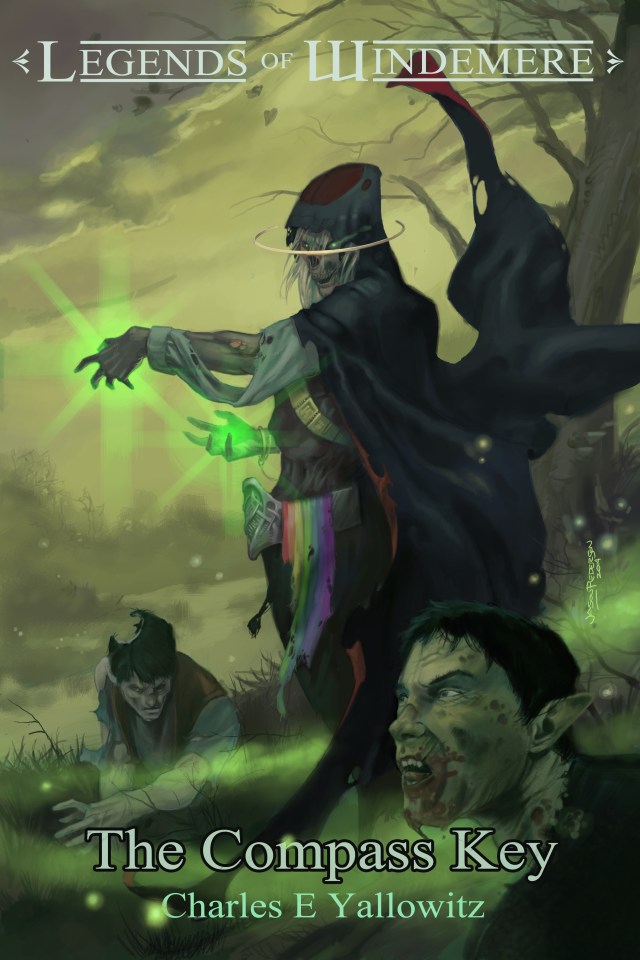
Cover Art by Jason Pedersen

The Compass Key had so many good fights, but it was tough to pick a teaser without spoiling a lot. This fight between Delvin and the leader of a giltris (lizardmen) army is probably one of the safest to show.  It really showed how Delvin could operate in a battle when he was alone too.

Continue reading →

Posted in Legends of Windemere, Teaser Tuesday, The Compass Key | Tagged , , , , , , , , , , , , , , , , , , | 7 Comments

The Fallen Apprentice

Darth Vader and Zamasu

So, I was watching Dragon Ball Super with my son when we got to the storyline involving Zamasu.  He is a character being trained to watch over the universe by the current person, but he develops a hatred towards mortals.  This steadily grows as he watches events unfold then he decides to take action to wipe out all mortals.  It reminded me of other fallen apprentices like Darth Vader and Tai Lung.  So, why is this such a common theme in various genres?

I think this stems from the fascination with falling from grace.  We love to see heroes fall or potential heroes fail to reach their potential.  Something about the sight of a person becoming the opposite of what their teacher intended stirs an interest.  It isn’t even a conscious fascination for some people.  They just sense that it’s makes a good story and can’t look away.  Perhaps it stirs a combination of pity, disappointment, and sympathy for someone who failed to reach their goals.

From a psychological standpoint, one could also see fallen apprentices as lessons.  Using their journey, one can see how a sense of superiority can lead to tragedy.  It serves as a warning that ego can blind us to a dark path and cause us to take actions, which hurt others.  In another sense, we can begin to identify those around us who demonstrate these negative traits.  So, one can protect themselves or even stop another person from making fairly big mistakes.

Fallen apprentices also act as a dark mirror for heroes.  Many times, the protagonist has either been trained alongside or after the villain by the same teacher.  They may even have been taught specifically to defeat the fallen apprentice.  It means they have similar, if not identical, powers and abilities with the villain simply having more experience and less restraint.  Readers get to see how the apprentice can go either way by having a character for each path.  This conjures thoughts about morality and how it can be twisted by those who think they are doing good by being evil.  For example, Zamasu really did think he was making a better universe by wiping out all of the violent mortals.

I wonder if there’s more of an emotional connection.  This is a long shot, but it could be about the potential redemption arc.  If a fallen apprentice finds redemption and turns back to good then we gain hope that real people can do the same.  Not only strangers, but ourselves being able to find forgiveness for anything we’ve done out of ego.  A person who let down a mentor or role model might see this redemption arc as a possibility that they can regain that lost respect.  It could even show that there are worse ways to fall from grace than simply failing to meet expectations.  I know this is very personal and probably not common, but it could work for some people.

So, what do other people think of the fallen apprentice stories?  Any obscure ones that you can think of from fiction?

Posted in Thoughts | Tagged , , , , , , | 15 Comments

Detour on the Eternal Road Tour – Stop Seven with D.L. Finn

Denise can project happiness with just a word. Her mantra is “To follow your inner child,” and that concept will keep her young forever. Under the …

Detour on the Eternal Road Tour – Stop Seven with D.L. Finn
Posted in Uncategorized | Leave a comment

Slang! What’s the 411?

Greetings to one and all. Beem Weeks back with you again. This month, I’m going to have a little fun talking about slang! Whether we realize it or …

Slang! What’s the 411?
Posted in Uncategorized | Leave a comment

Autism Sunday: Misconceptions of Autism

Today is ‘Autism Sunday’ or ‘International Day of Prayer for Autistic Spectrum Disorders’, which originated in the UK.  Not really a fan of that second name since that makes me think people are praying for a cure or something.  Anyway, the day is supposed to be about raising awareness of autism.  So, I thought I would touch on some misconceptions that I’ve run into being the parent of an autistic child and working with neurodivergent students.

  1. Autistic People are Nonverbal–  This isn’t true at all.  Many people think of the side of the spectrum where the person cannot communicate, operate in social settings, or understand the world around them.  It’s the ‘extreme’ version that Hollywood will push if they aren’t going for the ‘Autistic Savant’, which is another fallacy.  Being that autism is a spectrum, you will find a variety of communication abilities.
  2. Only Boys Get Autism– Not really true.  In reality, boys are more likely to be diagnosed due to how society perceives them.  Girls are more likely to be misdiagnosed.
  3. Autistic People Are All Introverts–  While many can be nervous about social situations, they still want to interact with others.  Yes, crowded settings with loud noises and flashing lights can trigger overstimulation, but there are tools to help get through such things.  If nothing else, just going to a quiet place to decompress for a bit before going back.  Others don’t have this issue and will dive into a gathering like every other extrovert.
  4. Autism is a disease– Not . . . True . . . At . . . All.  Never compare this to something like the flu or polio.  It’s just how a person’s brain has been wired, which stands out more due to our societal standards.  It’s just who they are.  Calling it a disease makes it sound like it’s something that needs to be cured, which many with autism would find insulting.
  5. Autism is Caused by Vaccines– Comprehensive studies have been done and shown that there is no connection.  The two Wakefield studies that ‘proved’ a connection were deeply flawed.  The first one was done when 90% of children in England were getting the MMR vaccine, which is administered around the age one would normally see signs of autism appearing.  Correlation does not imply causality.  The second report focused on presence of measles being more prevalent in those with autism.  The problem is that there were no signs it was a blind study, the method used had a history of creating false positives, and various pieces of distinguishing information were omitting from the report to make it look like a clear connection.
  6. Increase in Autism is Due to the Environment–  I wondered about this years ago, but then I did some reading.  Got to thinking about how kids were treated when I was growing up.  Autism wasn’t really common in the 80’s and 90’s beyond the two stereotypes of savant and screaming meltdown kid.  We did have a ton of ADHD, ADD, learning disorders, and other labels that have reduced since we have gained a better understanding of autism as a spectrum.  So, many of the people we knew growing up who didn’t fit in, had trouble comprehending school, or received of the labels probably would be diagnosed with autism today.
  7. Only Children Can Be Diagnosed as Autistic–  Given that autism was barely understood when many of us were kids, it does seem like it’s only the younger generations getting diagnosed.  Of course, nobody was evaluating us for autism.  This means that many adults can be diagnosed if they go through the testing.  For some who do this, it can bring a greater sense of understanding of themselves.  It can also be hard to accept after a lifetime of being diagnosed with something else or firmly believing you were neurotypical all along.
  8. Autistic People Have No or Fewer Emotions–  From experience, I can tell you that those with autism have all of the emotions.  In fact, they can feel them stronger than neurotypicals since they don’t always have filters.  Overstimulation can create big emotions in those with autism, which can cause meltdowns or pulling away from social settings.  They can also show their emotions in unique ways since they are navigating a world that wasn’t designed to accommodate their habits.  This also means that one can easily hurt their feelings, which some don’t think are possibly, especially if the autistic individual is nonverbal.  I can tell you from experience that even a person who cannot speak their mind can tell when they are being ridiculed, insulted, and bullied.
  9. Autistic People Lack Empathy–  Again, this is something that they can feel more of because they lack the filters to handle.  Empathy may also be very different for someone with autism.  From a young age, they are taught to watch their own words and feelings to keep them in check.  They are raised to primarily look inward to watch their own actions in a social setting.  So, they can miss emotional cues from others, but that doesn’t mean they lack the ability to make a connection.  When relaxed and not fixated on something else, they are adept at picking up on voice tone and body language.
Posted in Thoughts | Tagged , , , , , | 14 Comments