
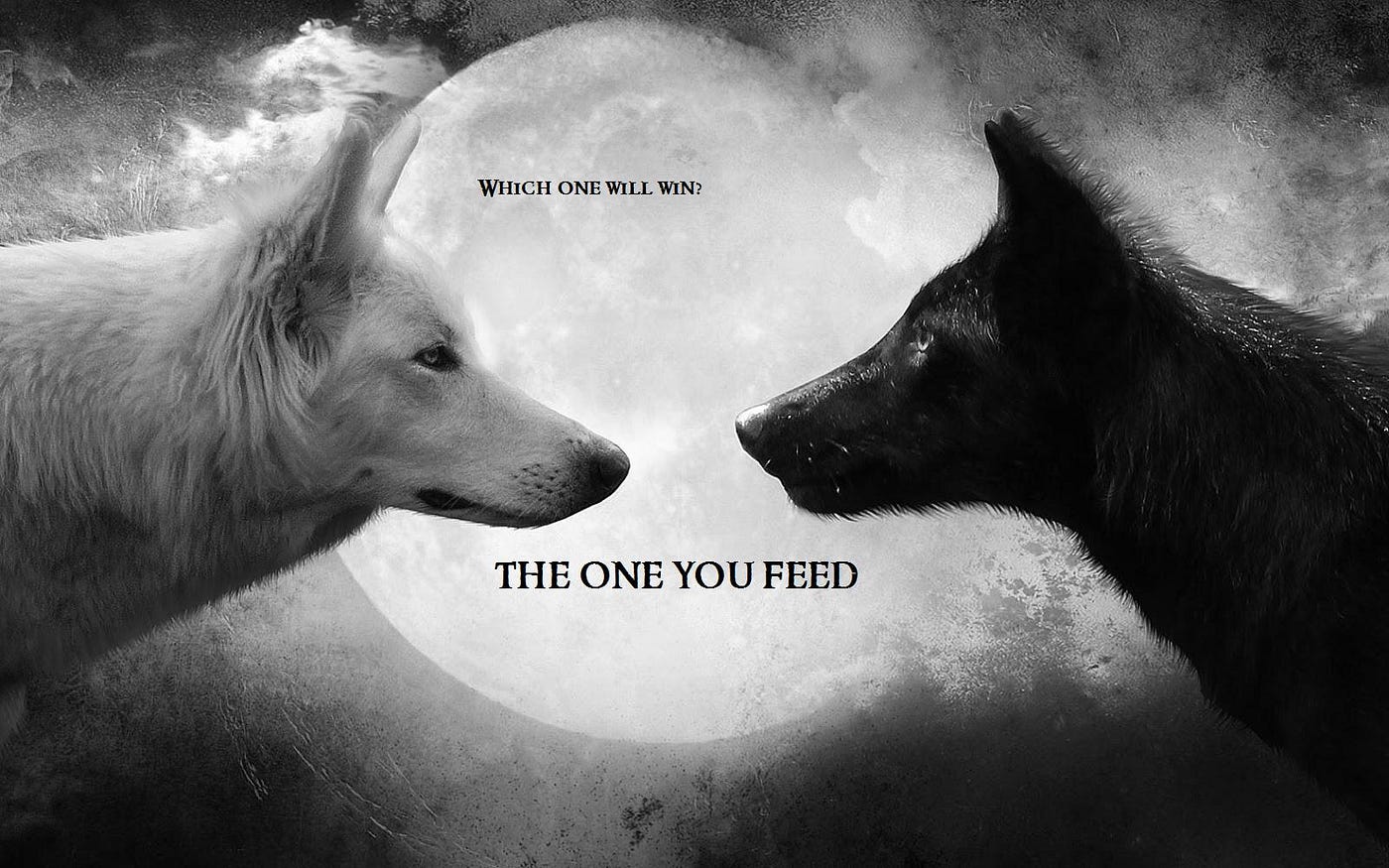
Many of us have probably heard the story about the two wolves inside you. It can vary with what each one means, but it’s typically a good one and an evil one. The one that wins is the one you feed. It’s associated with Cherokee folklore, but it could also have come from modern Christian evangelicalism. Either way, this can be fairly helpful when creating a character that isn’t one dimensional.
First, what do we mean by ‘feeding the wolves’? The simple explanation is that the version of you that gets used the most will become the stronger one. For example, if you act bad more often then this path will be your more likely decision. It becomes your developed nature and will affect other aspects of your life. Morality, personality, relationships, world view, career, and everything will be influenced by you being more bad than good or vice versa. So, the feeding is what kind of creates your mental/emotional foundation.
Of course, you can switch with a lot of work. If you start running into problems while being bad, you might try to atone. This means feeding the good wolf more and starving the bad one. It doesn’t result in the bad one going away completely, but it can change all of those aspects I previously mentioned. Many people who walked a dark path find a way to return to the light through focus and work. Keep in mind that you’re going against your developed nature here, so it isn’t easy. One slip revives the other wolf and can push you back further than a single taste moves you ahead.
In terms of fiction, you need to think about the actions of your characters. Even if they are pure good or pure bad at the start, they can slide to the opposite direction. This can create a deeper character with nuance, but you have to be careful about pushing them too far. It might be fun to have the noble hero do bad things because they are forced to, but you can’t do it too often without corrupting their nature. You have to shift their thoughts, words, and actions as they move along the spectrum of good/evil instead of having them stay in the same place.
You have to consider the pace of change as well. Certain actions (murder, rape, noble sacrifice, love, etc.) are big enough that they can cause a huge leap to the other side of the coin. These tend to be major plot events, so you typically can’t use them often. Instead, you can get further with smaller actions caused by minor decisions. These can shift the character without them fully realizing it until they reach one of those big ones and find the decision isn’t as simple. This happens in real life where people steal little things they need to survive. As they continue without getting caught, they might try for bigger needs and maybe a few wants. It doesn’t make them evil, but it does change their developed nature due to desperate need.
This isn’t that foreign a subject though, but we might not think of it. Definitely not with the wolf analogy. It’s really the corruption of a hero or the redemption of a villain. The target of the plot has to change their behavior and the perceptions of others. That second part is important because those around them need to notice when they are either falling or rising. I think this means you can use the ‘wolves’ of one character to influence the feeding and starving of those in another. You can really get a domino effect in an adventuring party if one stumbles and takes the others with them. It can also lead to a full fracturing of the heroes or even a villain group.
Finally, you can use this analogy to help with balance or maybe imbalance. An author who keeps this in mind will pick up on when a character is acting too much out of their nature. This can help them change decisions to be more inline with the character or to change their behavior going forward. Otherwise, you might have things be inconsistent and readers will repeatedly drift out of the story. They won’t take the hero or villain seriously if those characters aren’t stable.
So, what do other people think of the ‘two wolves’ use on character balance?




 Legends of Windemere
A very interesting post. I think of Tony Stark, a hero with an ego and an impulsive personality that caused him to make some poor choices at times. That made for a more nuanced character, as you mentioned.
Foreshadowing is a great tool to help prepare readers for shifts. Because of the trauma and anxiety Tony Stark went through, you’re not shocked when he creates an Ultron to feel more in control. And you’re not shocked that this was a bad decision. I think people object to character changes when they seem to come out of nowhere and just seem to be shock value based.
LikeLike
My own experience shows that the balance between these forces shifts based on daily choices. A small change in focus can change which instinct takes the lead.
LikeLiked by 1 person
Very good point. The two wolves are always shifting even by the minute.
LikeLiked by 1 person