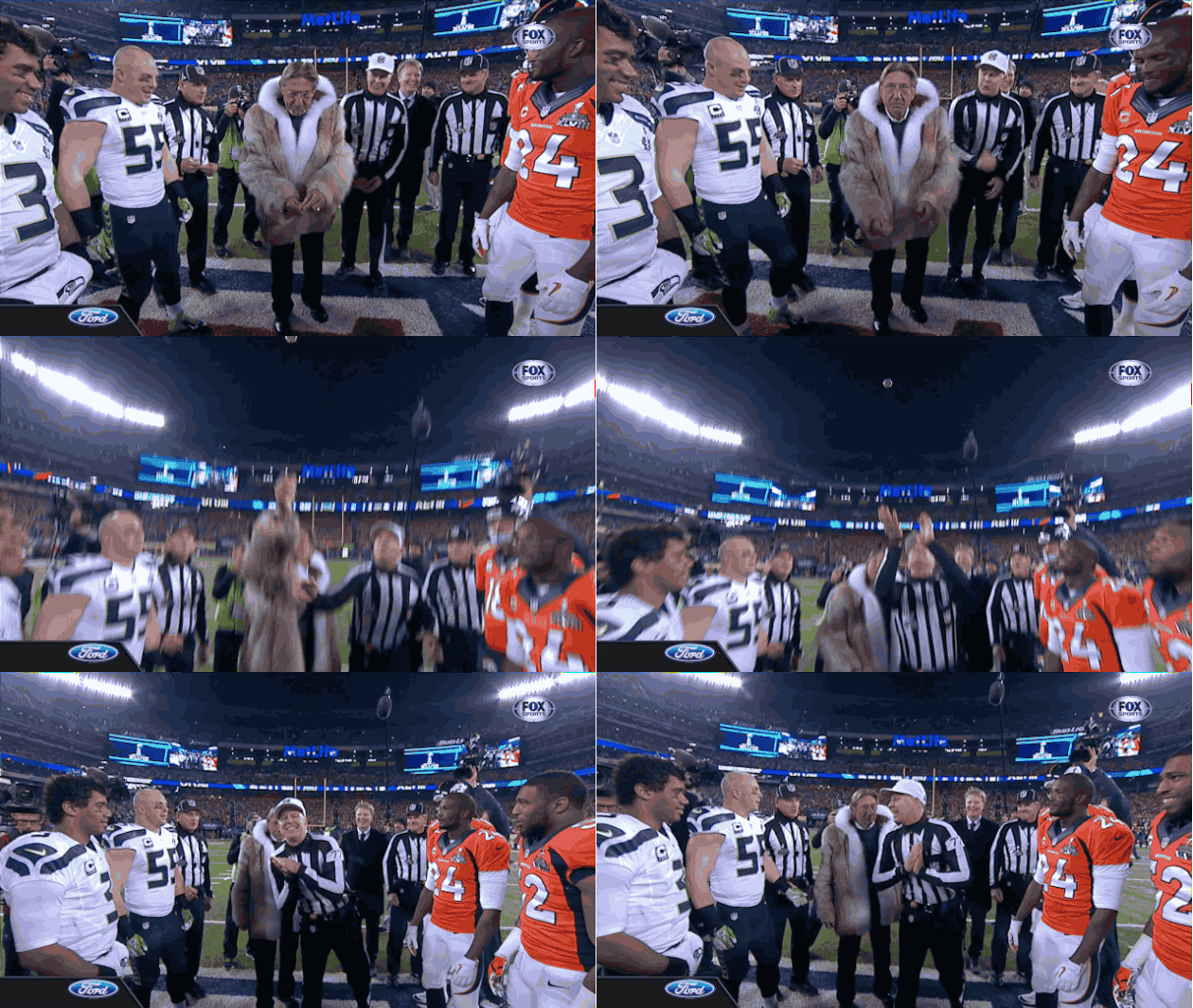
Super Bowl Coin Toss
(This is an experimental guest post style suggested by C.S. Boyack. We pick a topic, take a side, and do a back and forth over email. Let’s see how it works. FYI- We don’t know where the referee came from. He just kind of showed up in the kitchen and wouldn’t leave until we let him flip the coin.)
Hello ladies and gentlemen, welcome to the first edition of Point Counter-Point. A possibly recurring debate between authors about issues in the writing world. Prior to this show, each author mailed in their choice of heads or tails.
Our guests today are Charles Yallowitz and Craig Boyack. Today’s topic is series vs standalone novels. The winner of the coin toss can choose a side, and whether to have the first or last word.
Coin toss graphic
Charles, it appears you’ve won the coin toss. What is your pleasure?
“I’ll debate the merits of a series, and I’ll take the first word.”
“Very good, Charles. Take it away.
Charles:
Now I’ll admit to be biased here because I’m working on a lengthy series and predominantly read series. The multi-book epic is practically a staple of the fantasy genre. So this is where my mind goes for a story and I tend to follow many of the ideas for a character instead of choosing one plotline. To me, this allows a hero and/or villain to be grown to their full potential without rushing or missing a beat. I’m not saying you can’t do this in a standalone, but you have more time and story to make it happen. Less compact and more of a roller coaster style of evolution.
Character development is one of the bigger merits of a series because you can go up, down, and every which way without squishing the events. Book 1 can be a rise that carries into 2 and then a fall in 3, which is steadied and recovered from in the final book. Going beyond this means you can choose a variety of levels for the character’s progress, which I find to be fairly realistic. Most people have had good and bad periods in their life, so you can create a connection with a reader who thinks ‘I remember when I had a bad time like that and it kept getting worse’. If you play it right then you get the reader to follow along and be ready for more of the same character instead of them having to start again fresh.
Even better, you can use a series to evolve a bunch of characters and not have to focus only one or two mains. For example, I have 6-7 main heroes in my series and certain books focus on different ones. The others step back into the supporting roles with some small steps in evolution while the central ones get a bigger push. This tends to go along with the main adventure of the book, which pushes the heroes as a team. It is more complicated and requires constant note-taking, but none of it would work if crushed into a standalone. I’d have to eliminate characters or reduce them to a ghost of what they are supposed to be. So I would say the big merit that a series has is a longer time to accomplish a deep evolution.
Craig:
Good points, Charles. I prefer stand-alone novels. I read series, but I’m picky about which ones I start. It’s all a matter of time for me. I’d rather read multiple stories over the course of six months than dedicate that same time to one story line.
My own fiction reflects this, in that while everything is speculative, there is science fiction, fantasy, and paranormal in my catalog. Lately, I’ve even been writing short stories and micro-fiction.
Solo novels won’t be able to explore multiple leads in depth, but that’s never been a problem for me. Most of the time, the life of a character isn’t interesting from cradle to grave. They have that one moment of something extraordinary, and return to a normal life. There are plenty of fleshed out characters in my epic fantasy novel, but it’s the lead who goes on the hero’s journey.
Most solo stories still follow a three act structure without the need for a trilogy. Characters still go through hell in the middle of the story.
From an author’s position, I think starting over with new characters every time has made me a better writer. I could say the same thing about world building. I’ve forced myself through two of the most difficult parts of the writing process fresh each time out, and I’ve learned from that.
Charles:
I can definitely see how one can grow and evolve when they go from the end of one story to the beginning of another. Almost like you have a blank slate that you can use your new knowledge on. It’s very different than a series, especially with the setting where you continue building the world with new cultures, locations, and other pieces. This part doesn’t really end until you finish the story even if the characters reach their top tier or are replaced by new ones.
One thing that I’ve seen done in series is having each book with a contained story while the big plot carries on in some form. For example, my series has a new adventure in every volume that has a clear beginning, middle, and end. The main plotline connects through villains, prophecy pieces, and the main characters evolving, but it doesn’t always take the center stage. Going by my outlines, I use this method a lot. So it’s have a BIG PLOT and then a series of smaller, contained stories.
So I guess you can see how some aspects of standalones can be used for a series. Not sure if the opposite can happen though.
Craig:
I respect an author who can focus on an overarching plot along with the single book plot. Even television has moved to that point today.
I’m too worried that I’ll fall victim to one of two possibilities. Either my single book plot will become so much fluff to the main story, or my main story will feel shoehorned into my single book tale. I’ve seen both things happen, and think an impartial editor might have helped.
If the overarching story is the important one, maybe editing out the side adventures is the way to go. If individual stories are the better tales, maybe more of a serialized schedule is better. (More like James Bond or Sherlock Holmes.)
For me personally, I want to focus on telling one story to the best of my ability. I want to leave it all on the page, and never doubt whether I held something back for the overarching story. I also never want to worry if I’ve written one 900,000 word story and sold it in “fun size” portions.
***
Gentlemen, thank you for participating in Point Counter-point today. Both of you made some valid points, and now it’s time for our audience to weigh in.
As readers, do you prefer books in a series or a stand-alone format? Do you read both formats, or remain fiercely loyal to one over the other?