7 Psychological Tricks For Book Promotion

Nicholas C. Rossis's avatarNicholas C. Rossis

Book marketing psychology | From the blog of Nicholas C. Rossis, author of science fiction, the Pearseus epic fantasy series and children's booksImage: Gerd Altmann, Pixabay

Book marketing has come a long way since Medieval scribes advertised their services in the Middle Ages. For one thing, there is an entire branch of psychology that deals specifically with marketing. I recently came across a great post by a marketing student with 7 psychological tricks you can use in marketing. That post formed the basis of this one, only this one deals with book promotion in particular instead of marketing in general. I hope you find it useful!

1. Your Book Needs To Fit Your Genre

It’s important to understand your readers and what they expect from you. Every genre has some common traits. And you need to respect that.

Everything about your book, from your title to the book cover, needs to fit your genre.

Let’s take YA fiction, for example. Your readers will probably be 15-to-25-years-old. The most…

View original post 643 more words

Posted in Uncategorized | Leave a comment

Jung’s Archetypes: The Self Quarter

Here’s the final grouping that focuses on the Self.  This does feel like it’s very close to the soul, so it can be confusing.  The difference that I can see is that there is a focus on influencing others through power in Self.  The Soul is more emotional and has a bigger internal factor.  You can tell how close the archetypes come to each other as we’ve moved along, which makes sense.  If they cover the majority of the human psyche then you’ll have some slight overlap.  Now, to complete the set.

The Jester

Motto– You only live once.

You would find comic relief characters here, but it’s more about why the Jester is being funny.  It is a way to connect to others and stave off boredom.  Even if they are on an adventure, it’s laughter that they crave and helps them learn about both themselves and others.  This can be a sign that they are immature, but also a shield to hide their fear or bring down the defenses of those around them.  A downside here is that they don’t always pay attention to lines and will cross them at times.  This means you get friction between the Jester and the more serious characters.  Their antics can be seen as wasting time and obnoxious, especially when one’s sense of humor doesn’t match the comedy.  Still, you can use these characters to defuse tense situations, which can get you out of an emotional dead end.

One of the hardest things to do is have the Jester be taken seriously by the audience.  As I said, the joking can be seen as immature even if that isn’t your intention.  Many people don’t see humor as a coping technique for stress or a way to communicate, so they will chalk the character up as childish.  This makes any serious moments hard for them to believe.  Best way to do this is to spread out the jokes and not have them be nothing more than comedy.

The Sage

Motto– The truth will set you free.

The Sage is nearly the polar opposite of the Jester even though they are both focused on the self.  Instead of humor, these characters utilize wisdom and knowledge to guide their actions and advice.  They believe the success and freedom is gained through understanding as much as possible, which can lead to them becoming fixated on certain things.  Sages don’t always have the flexibility of Jesters and Creators because they are locked on the truth and facts of a situation.  You would need to temper them or show that their biggest flaw is an inability to think outside of the box.  This is strange considering they seek freedom, but the box is a means to an end to them.  Authors have a habit of making these characters very wordy and occasionally overbearing, which shows how we perceive intellectuals.  In reality, they can be simple in explanation and easy-going without losing their ‘wise’ persona.

Many times you find the Sage as a mentor character, but they can take on various roles depending on the story.  You can even use this as a villain who dislikes anything they see as pointless or immature.  This is if you don’t find a way to balance the focus on knowledge with something else.  If the character only wants to learn and talk then you might not get very far with them in certain stories.

The Magician

Motto– I make things happen.

While it isn’t surprising that the Magician is setting out to leave a mark on the world, it might be a shocker that we have to think of this without magic.  This is only a term and doesn’t specifically mean wizards.  The Magician is very active in their power and set out to change things.  They’re one of the most proactive of the archetypes since they don’t wait for events to come to them.  Similar to the Sage, they seek knowledge and information, but they are utilizing it to change the world instead of obtaining freedom.  Think of the Magician as a catalyst for plot events because they are the ones most likely to move the ball along.  Not that they are impatient, but they will act once they see an opportunity.  It isn’t a random move either.  They usually have a plan and a goal in mind, so there is a deep focus on results and the path.

Unfortunately, Magicians can be wrong and make a mess of things.  A flaw in these characters is that they can unravel a situation by thinking they are making the correct move.  Instead, they make a mistake.  This can stem from them not being obsessed with research like the Sage and miss something or they’ve developed some arrogance.  It can even be that the villain manipulated them, which brings us to another flaw.  Magicians run a high risk of manipulating others to the point where they usurp the free will of both friends and enemies.  If they want a certain result then they may do whatever it takes to get there, which is dangerous.  It’s a good way to have a Magician fall from hero to villain as well.

The Ruler

Motto– Power isn’t everything, it’s the only thing.

The Ruler is out to create structure through power, but falls under Self because they tend to have a high level of arrogance.  That is unless they’re tempered by more a empathy-driven secondary.  One of the oddest things when I read up on the Ruler is that nearly everything made them sound negative.  That motto, fear of being replaced as leader, focus on control and power, and mention of a desire for everyone to listen to them.  Only one site talked about them wanting stability and pointed out that the Tyrant side of this archetype is a negative possibility.  Yet, we do see more Rulers put in as villains, inept secondaries, or obstacles to the heroes who work outside the law.  This makes it rather difficult to go into details about how to use these characters.  Personally, I think it’s more interesting to create a Ruler who seeks to create stability while remaining a beloved leader instead of going full dictator.  You can have the temptation there and they may slip, but they can show that power doesn’t always corrupt.  Authors seem to be rather obsessed with that ‘power corrupts’ thing.

One thing I can suggest with the Ruler is to have them assisted by another archetype.  It could be the Sage or the Magician or the Hero.  Maybe even the Jester or the Lover can make sure this character doesn’t go dark.  The truth is that it is fairly easy to prevent such an outcome, but we all know that people enjoy seeing characters fall.  For a Ruler, that would be losing power, being killed, or going evil.  Even though this is a possible outcome, it is fairly common and doesn’t hold the same oomph that it did years ago.

(There you have it.  All 12 Jungian Archetypes.  Let me know what you think of this week’s topic.  Enjoy the weekend.)

Posted in Thoughts | Tagged , , , , , , , , , , | 20 Comments

Friday Book Share: A Comprehensive List

Staci Troilo's avatarStory Empire

Ciao, amici! This is my last book share for the year, so I’m going to do something a little different than usual. I’m choosing five books. That’s right, not one, but five. Why? Two reasons:

  1. This might help you choose a holiday gift for friends and/or family (or even yourself).
  2. I want to show my SE family some love.

The Story Empire authors were quite tolerant of me this year. They filled in without a single complaint when I couldn’t be here, and they put up with more rants than I care to admit to having. They also gave me sage advice. Scratch that. They give me sage advice. All the time.

These authors are all talented in their craft and have much industry wisdom to share.

To that end, I want to give back. I’m going to share (in last name alphabetical order) one book of theirs that I…

View original post 854 more words

Posted in Uncategorized | 5 Comments

Derailing Bedlam: End of the Brakeless Line Part 2 #fiction #adventure

As usual, here is your warning that this story has cursing, sex (not graphic), innuendo, and violence.  It’s my Rated-R action adventure called Derailing Bedlam.  This is the fourth outing (third official) for Cassidy and Lloyd, so feel free to click on one of the two covers to see how it started.  Each one is 99 cents!

Cover by Jon Hunsinger

Cover Art by Jon Hunsinger

.

.

.

.

.

.

.

.

.

.

Continue reading

Posted in Bedlam Series, Derailing Bedlam | Tagged , , , , , , , , , , , , , , , , , , , , , , , | 10 Comments

How Do People Read Online?

Nicholas C. Rossis's avatarNicholas C. Rossis

Most of us are writers, one way or another. We share our thoughts in blogs and ebooks. And you may have noticed that I have been experimenting recently with emphasizing certain parts of my posts, breaking up longer texts in chapters, and playing around with various formats.

I am doing this to test the so-called F-Shaped pattern of reading. This is a description of how people read online. It was first identified in 2006 by the Nielsen Norman Group. They recently published an update, clarifying that:

  1. Scanning on the web does not always take the shape of an F. There are other common scanning patterns too.
  2. The F-pattern can be bad for users and businesses.
  3. Good design can prevent F-shape scanning.

Let’s examine all this in detail, shall we?

What Is The F-Shaped Pattern?

F-shaped pattern | From the blog of Nicholas C. Rossis, author of science fiction, the Pearseus epic fantasy series and children's books Image: Nielsen Normal Group

As you can see for the heatmap above, people’s eyes focus on certain…

View original post 1,120 more words

Posted in Uncategorized | 4 Comments

Guest Post: When a Fellowship Fails by Deby Fredericks #fantasy #adventure

(A beig welcome to Deby Fredericks who is here to promote her newest book ‘Minstrels of Skatyhe II: Dancer in the Grove of Ghosts’.  Enjoy her essay on when groups fail in fantasy.)
Quest fantasies have been a staple of modern fantasy, right from the beginnings of the genre. J. R. R. Tolkein set this standard by introducing his readers to the Fellowship of the Ring who were dedicated to destroying the One Ring. Even since, readers have enjoyed watching a disparate group bond and grow stronger through a series of adventures.
But what if that bond never formed?
In my novella Dancer in the Grove of Ghosts, the wounded guardsman Cylass is snatched from the brink of death by a mage who hides her power by dancing with a troupe of minstrels. Their accidental alliance could save them both. Unfortunately, the alliance may prove impossible.
Skaythe is an upside-down world, you see. Merciless aggression is “good” and caring for others is “bad.” Cylass has been so warped by his service to the regime that the most reasonable course would be to betray his benefactor. For her part, Tisha took an enormous risk by helping Cylass when she would have been safer allowing him to die.
This might seem like a cynical “genre swap,” but as a writer I found it tremendously energizing.  Any quest worth writing about will involve characters who gather for a greater purpose. The adventures of their quest allow friendship and trust to grow stronger. Each of them knows the others “have their back.”
It added a new level of tension when no common purpose existed. Neither Tisha nor Cylass could assume their comrade would have their back.
I can’t claim to have invented this strategy myself. Even Tolkein included a potential traitor in the ranks — Boromir, who lusted for the One Ring even as he was Aragon’s rival for political power. Still, I found it really rewarding to work with two characters who knew better than to trust each other.
I hope you’ll journey along with Tisha and Cylass as their uneasy alliance unfolds.
—–
Dancer in the Grove of Ghosts
“He’s dead. He just doesn’t know it yet.”
Mortally wounded, Cylass is abandoned on the battlefield by comrades who would just as soon have him out of the way. But as he waits for death, a strange savior appears. The dancer, Tisha, heals him with her forbidden magic, but also draws the wrath of his cruel former lord.
Soon guardsman and renegade mage are on the run. Will Cylass help Tisha, as she helped him? Or will he do the smart thing, and turn her over to the vicious Count Ar-Dayne?
—–
Amazon e-book:
Other e-book formats:
Author website:
Author newsletter:

—–

Deborah Fredericks

Fantasy and Children’s Writer
Find out more at my web site or my blog
or join my mailing list.

Posted in Guest Blogging, Spotlight | Tagged , , , , , | 7 Comments

Jung’s Archetype: The Soul Quarter

Here we are with the next group, which are the archetypes that fall under the ‘Soul’ category.  These characters pursue fulfillment of the spirit and all have some sense-  of freedom within their core.  This may be physical, emotional, or mental freedom depending on the archetype.  As before, there is one per cardinal orientation that helps further define them.  Let’s check them out.

The Explorer

Motto– Don’t fence me in.

Being in the ‘Freedom’ orientation, the Explorer is one who sets out to evolve and discover themselves through adventure and activity.  It might not be crossing the Sahara or battling ogres, but they seek to build themselves through big experiences.  Characters under this archetype don’t always have a clear goal, so you can find them within the primary and secondary cast.  It can be a braver adventuring hero or a risk-taking partner.  You will see an exaggeration here in the area of risk-taking because the Explorer typically has a fear of boredom and becoming trapped in a rut.  This can lead to them wandering away from a quiet period in the story, which will lead to problems.  While not necessary, you typically do need them to be full of energy and curious.

Now, the Explorer can work very well as a companion for other archetypes.  It would be a secondary drive in the primary category.  For example, a Hero Explorer could be a character that sets off to be a hero through great acts.  A Lover Explorer is one that takes romantic risks.  I’ve found that this is one of the better archetypes to slide under the surface because it has a versatile level of degrees and use.

The Rebel/Outlaw

Motto– Rules are made to be broken.

Can we say anti-hero?  Thriving under the ordinal of leaving a mark on the world, the Rebel/Outlaw is what you might expect.  They act against the system either for attention or because they truly want to change the world.  Some even do it out of a grudge, which adds a level of irrationality to the archetype.  That’s rather rare because while these characters tend to be angry or negative, they usually have a clear idea of what they are doing.  You can reason with them to a point as well.  Emotions run pretty high with them and there are trust issues, especially towards those that still support or are part of the hated system.  Development here is gained by winning even the smallest battle against whatever they are rallying against.  As such, failure can result in a rise in rage or a severe crumbling of the psyche.

Aside from anti-heroes, you can get anarchist villains from this archetype too.  They are further along the negative spectrum, but they share the hatred of a system.  Unlike the former, the villains have less concern about others.  They may only want to shatter their target and don’t care about innocents.  Anti-heroes usually have some level of concern for innocents, which is what differentiates them from the villains.

The Lover

Motto– You’re the only one.

Much like the previous two, the Lover is pretty familiar to people.  It’s just as common as the Hero archetype.  Obviously, these characters seek to make connections with others and they do it through intimacy.  Not only physical, but emotional.  That’s an important part of these characters because going only for sex can make them feel two-dimensional.  Even if they are more interested in the physical side of things, you need to show the emotional or somewhat explain the lack thereof.  On the less lustful side, these characters can be very attentive and doting on those that they have connected to.  They define and evolve themselves by the love they both give and receive.  It creates a very fragile balance because going too far to one side can be detrimental.  Give too much and the Lover becomes used and possibly manipulated.  Receive too much and they can become addicted to the attention then become a manipulator.  So, you need to work both sides to keep these characters in the middle.

As with the Explorer, the Lover can work very well as a secondary.  It does possess a challenge though.  The Lover side can override the primary if the story focuses too much on it.  Basically, a romantic plot line in a non-romance story runs the risk of overshadowing everything if too much attention is given to the Lover archetype.  This might actually go back to the ‘receive too much’ issue, but this is by the author.

The Creator

Motto– If you can imagine it, it can be done.

Seeking to create some structure in the world, the Creator is probably an archetype that many of us can relate to.  After all, we write stories and seek to design some structure through them.  The funny thing is that I thought it would be under the ordinal of leaving a mark, but that’s not the main drive for artists.  It is really the act to create and legacy is secondary.  Characters can be concerned with that part, but they need to focus more on the former.  Examples of this could be an architect designing a building, someone building a boat for a race, a wizard specializing in conjuration spells, and anything else where something is being made.  Creators can be difficult to deal with since they dislike mediocrity and might pursue perfection to the point of self-destruction.  There is a high level of eccentricity and not the best social skills that can go with these characters, but that isn’t necessary.  We like to do this to enhance the sense of their imagination, but there are plenty of real-world artists who don’t stand out like awkward thumbs in society.

You can be fairly passive with this archetype.  They don’t have to be bold and out there like the Explorer, Rebel/Outlaw, and Lover.  Creators can work fairly well in low-key stories and evolve at a more mellow pace.  They don’t need to fight anyone, face a nerve-wracking challenge, or make a deep social connection.  All they need is a dream and a story arc of them pursuing it.

Posted in Thoughts | Tagged , , , , , , , , , , , | 10 Comments

Revisiting Legends: Delvin Cunningham the Subtle Warrior #fantasy #adventure

Cover Art by Jason Pedersen

In the initial planning of Legends of Windemere, I didn’t have anything special for Delvin Cunningham.  He grew into the tactical leader of the champions, the secondary peacemaker, and the kind of romantic interest of Nyx.  This was unfortunate because he had a lot going for him in terms of character.  A lot of world-building stemmed from Delvin, which is why I redid my plan to give him a book that focuses on his personal story.  After all, everyone else had it while Delvin got his big debut at the end of Family of the Tri-Rune.  So, he was overshadowed by Timoran appearing earlier and kind of came off as an afterthought.  Was this because of how he was?

Oddly enough, I think Delvin’s initial laid back demeanor allowed him to be introduced in a more low key method.  He proved himself as a character fairly quickly by showing that he could meld into the group without a problem.  There wasn’t a learning curve with him because he could figure out the strengths and weaknesses of people almost subconsciously and adapt.  Having been trained by Selenia Hamilton, he has a more standard fighting style than the flashier champions.  Again, Delvin is more passive and patient since he’s about defense and looking for an opening.  The only times he’s very aggressive is when Nyx is injured or he’s following Luke’s lead, which is something he quickly becomes aware of in the series.  He probably came the closest to figuring out the cores and how they affect others before the final book.

Two world-building areas got boosted and flushed out thanks to Delvin.  First, I called him the Mercenary Prince, which led to me creating the organized system of mercenaries. This was established by Selenia Hamilton, his teacher, before she retired to run her academy and hand over the Mercenary Queen title.  I had it that there are the four ranks that are given to the most successful mercenaries, which tends to be agreed upon by the community.  The Queen, King, and Prince were active in the series with the Princess only making a brief appearance.  This means I’ll have to do more mercenary stuff down the road.  She’s still a mystery to me though, but I have a feeling that I know who will be showing up with the title in the future.

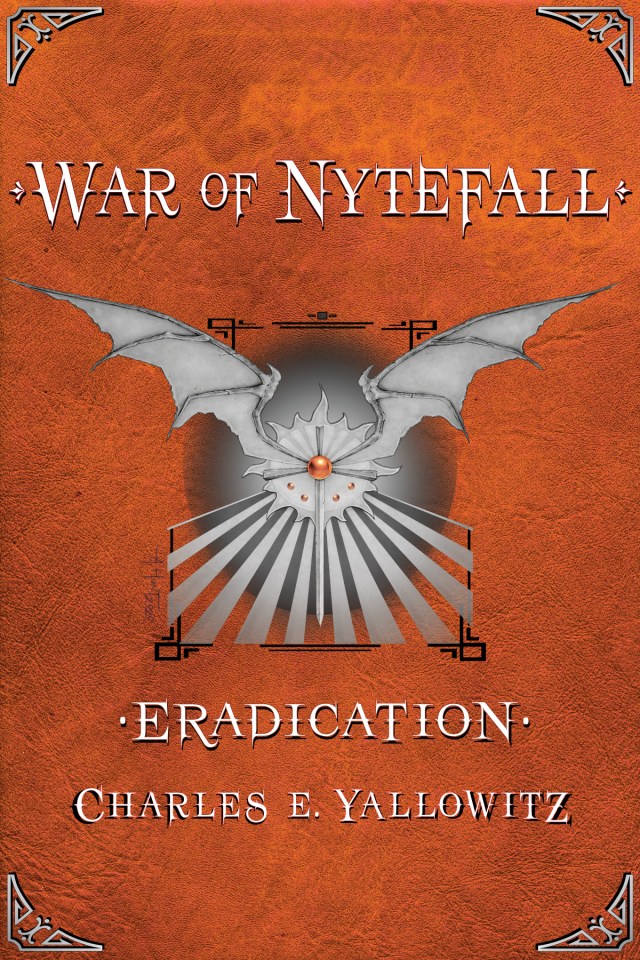
The second area that I worked on was the Yagervan Plains, which is a huge chunk of the Ralian continent.  Delvin came from this region, which is inhabited by wandering groups that follow various migratory animals.  It isn’t part of the Serabian kingdom, so there is a stark break from forest and meadows to grasslands.  Walls have been put in a few areas where there are more aggressive nomads since not all of the groups have trade treaties with their neighbors.  So, Delvin is actually a foreigner because he was lost as a child when his family followed a herd into the icy region of the north.  Bullies pushed him onto a piece of ice that floated away and he was eventually found by a ship.  His story involves going home, which is difficult since his people are superstitious.  Nobody looked for him because he was thought to be dead and they would mistake him for a ghost, which means they are being cursed.  By the way, The Mercenary Prince is also where Mab from War of Nytefall makes her debut to create a crossover.  Definitely a fun story that you should check out.

Delvin’s core was one of the most difficult things to figure out because he had similarities to Timoran in terms of behavior.  I considered one being honor and the other loyalty, but that felt like Delvin was being overshadowed again.  It was only when I put him on a solo adventure with his old crew of mercenaries that I got an inkling of what really made him tick.  Friendship is a very important part of Delvin’s life.  He doesn’t look at the champions or the Frozen Blades as simple allies and coworkers.  They’re his friends.  He makes strategies that will not put them in harm and he does whatever it takes to get everyone out of situations alive.  Even the powers that awaken within him are more useful in helping others than strengthening himself.  That isn’t because of how they work, but it’s how he functions.  Delvin is the last one on his own mind when he is planning, so he puts friends ahead of him almost out of instinct.

A final note is that I still put Delvin in a category that is similar to Sari.  I feel like I could have done more with him.  Unlike Sari, who fought me on such things due to remaining broken, the challenge here was Delvin being very passive.  It’s described as lazy early on in the series, but that isn’t the case.  While Timoran would sit and listen to conversations, Delvin would sit and observe.  He is always analyzing the world around him in case he needs to make a strategy.  This forced him into the background fairly often because it really wasn’t in his nature to be running wild.  Maybe I should say that I could have done more, but he wouldn’t let me?

Posted in Character Origins, Legends of Windemere | Tagged , , , , , , , , , , , , , , , , , , , | 9 Comments

Jung’s Archetypes: The Ego Quartet

You can see examples of each one in the above picture, which I’m going to attach to each of the posts.  This one is going to be about the 4 Ego Archetypes, which are Innocent, Everyman, Hero, and Caregiver.  As you can see each one is in a different cardinal section, which helps further divide them.  Now, I’m going to do my best to give my own take on this in terms of writing.  Will it be perfect?  No, but I’m hoping to get clear points across and help people in the character creation.

The Innocent

Motto– Free to be you and me.

The Innocent falls into the ‘Freedom’ cardinal, which is a desire for paradise.  These are characters that want safety and are scared of doing something wrong.  They might have a severe fear of punishment, but also a naivete that allows them to be led into unwittingly going against their own desire.  Innocents can be overbearingly optimistic and some readers will find them annoying because they will continue smiling even when bad things are happening.  Many authors use them as obnoxious side characters that are destined to be broken over the course of the story.  Still, there is strength in an unwavering positive attitude if written correctly.  It can even be their greatest weapon.

Reason for this one being under ego is because they are fueled by ego.  It is their personal belief that there is good in everyone that drives them.

The Everyman (Also Called ‘The Orphan’)

Motto– All men and women are created equal.

The Everyman is part of the ‘Social’ cardinal, so they have a focus on connecting to other characters.  They want to belong and fear being left out, which can also turn into a fear of standing out.  Unwilling heroes can fall into this category even though they may have to eventually change to another archetype.  An interesting aspect of the Everyman is that due to wanting to be part of a group, they have a high risk of losing their individuality.  This can be a character who is taken over by a belief system that causes harm to them or others.  You might think these characters are weak, but they do have a strength in that they tend to be very grounded.  Unlike the Innocent, they aren’t as positive and have a level of standards.  That possibility of brainwashing isn’t as easy to do as you would think because the groups they join needs to attract them.

Now, I mention ‘The Orphan’ here, which is an alternative and darker version.  These are characters who have been emotionally and/or mentally betrayed.  A sense of abandonment is here to some extent. Characters want someone to take over their life or at least guide them to a better one.  Failure to connect creates more disappointment, which can turn them into an angry and manipulative character.  Personally, I’m not a fan of this being called ‘The Orphan’ because of the connotation.  I would call it ‘The Outcast’, which would be the Everyman’s shadow.  Both want to connect, but one is still trying for good while the other is using the connections to lash out.

The Hero

Motto–  Where there’s a will, there’s a way.

This is probably the archetype that everyone can imagine fairly easily.  The Hero is the character who sets out to leave a mark on the world.  You see them in mythology and modern tales, each one sharing the same courageous core.  This archetype actually has a fear of being afraid, which can lead to arrogance and reckless behavior.  You get a variety of ego here though.  Some characters will acknowledge their limits then work within those or seek to extend them.  Others continue on as if they are perfect, which is asking for trouble.  Even if you knock a Hero down a few pegs, they continue marching on or find an alternate route.  Don’t think I really have to say more about this one since it’s the clearest of the 12 Archetypes.

The Caregiver

Motto–  Love your neighbor as yourself

The Caregiver is part of the ‘Order’ cardinal, which is why they are focused on protecting other people.  It isn’t always the same level.  Some characters will want to defend all they see while others have a single charge that they are focused on.  Martyrs are fairly common here.  While the Everyman has empathy, the Caregiver is even more so.  The former senses the emotions in regards to their own state while the latter feels the emotions of others to know how to react.  Seeing pain and sadness will drive them to fix the problem.  Sacrifice is not uncommon for these characters, which can make them very powerful.

The downsides here are that they can be easy to manipulate or cross a line in their desire to protect.  A villain can force a Caregiver to work for them by taking hostages.  It’s not a great plan since it falls apart once the people are hurt or the Caregiver finds a way to free them.  Still, this is a commonly used weakness.  The crossing of a line is when you have a villainous Caregiver.  They are determined to protect someone to the point where they are hurting other people.  Best example that I can think of is the version of Mister Freeze who was trying to help his cryogenically frozen wife.  He was doing evil deeds to protect and revive her.  Villains like this can be turned hero if their charge is rescued from a situation or convinces them to change their ways.  On the other hand, they can also go full berserker if the one they protect is killed.

What do you think of the Ego types?

Posted in Thoughts | Tagged , , , , , , , , , , , , | 20 Comments

New Release: Serang by C.S. Boyack #fantasy #adventure (What Do You Think of Prequels?)

(Today, I have C.S. Boyack, who is here to promote his newest book.  It is called Serang and is a prequel to Voyage of the Lanternfish.  It’s his first prequel, so I asked him to talk about this experience.  Enjoy.)

Thanks for having me over again, Charles. I decided 2019 was the year I dove into series work. I’m taking on two of them, in two different styles. One is the kind that uses the same characters in new stories and can last as long as I have ideas for them. The other one is intended to be a classic trilogy, and that’s the one I want to talk about today.

Voyage of the Lanternfish is a pirate adventure/fantasy. I’m knee deep into the second story right now. One of the things I tried to do is pepper the crew with a colorful cast from all over the world. In my mind, pirates were kind of the downtrodden and outcasts of society. To that end, a character named Serang joined the crew.

I made an effort to give the more important pirates a line or two of background, but nothing that would be considered an info-dump or excessive backstory. It all worked out pretty well, allowing me to keep focus on the main tale, but the character of Serang fascinated me.

We visited her home country to pull off what amounts to a big con job, and the country itself had a lot of potential. It occurred to me that it’s popular to write a supporting story for a series these days. One of my partners over at Story Empire did it, and they were good stories in their own right. It made sense for me to write Serang, and it has the added bonus of holding fans over until I can finish the next book in the trilogy.

That’s where the problems began, or so I perceived. On the one hand, Lanternfish has a lot of comedy elements. Serang is not one of them. She’s a very serious, and even dangerous character. You can see this problem taking shape in the form of what to do with reader expectations. New readers won’t have expectations, but Lanternfish fans will. Will they expect the ass kicker version of Serang they already know, or will they expect more of that Lanternfish undertone of humor?

Splitting the baby might seem like a reasonable option, but that’s not what I did. This is a coming of age story about a girl who’s seen a lot of violence and suffered great emotional trauma. She went through the fire and came out steel. Serang is the story of that fire.

It’s still one of my stories, so there are some light moments and some fun banter, but I knew whatever I wrote had to lead toward the character Serang is in Lanternfish. It’s a neat exercise for an author, because you have to think a bit deeper about where you’re going to wind up. At the end, she has to be the person we saw in Lanternfish, or nearly so.

Lanternfish has fantasy elements, like sea monsters and magic, some of which is Serang’s magic. She doesn’t completely understand it, but I had to include bits about how we got there. This book has bits and pieces of an explanation that will let readers understand the basics without totally explaining it. That’s also a tightrope, because magic shouldn’t be completely explained.

I needed to keep that compass pointed toward the version of Serang we saw in Lanternfish, so I added bits about one of her masters who plays an odd clay flute, this is how she came to adopt her own bamboo flute. I added snippets about her strange attire, and readers will understand why she wraps her fists and forearms all the time. (She’s hiding something.)

I’m pleased with the end result, but readers will be the true judge of how I did. Serang is a stand-alone novel, which is something I built my writing career around, but it also supports the Lanternfish trilogy. I hope your fans will give it a whirl.

***

Monastic life is all about duty, service, harmony. For Serang, a young girl abandoned at the temple by her mother after the death of her father, that life becomes all she knows. The monks give her purpose, and become her new family.

When political upheaval causes chaos throughout the land, Serang again loses everything and everyone she loves. Alone, she struggles to survive. She convinces a wandering monk to take her under his wing and complete her training. Thus begin her adventures through strange lands and her trials to become a confident, capable, independent adult.

This is a coming of age story set in a fantasy world. It’s filled with monsters and martial arts, difficulties and dangers. The serious situations preclude the story from the levity of its predecessor, Voyage of the Lanternfish, but it provides a compelling look at the origin of one of the saga’s most fascinating characters.

Purchase Link http://mybook.to/Serang 

Social Media:

Blog My Novels  Twitter Goodreads Facebook Pinterest BookBub

Posted in Guest Blogging, Spotlight | Tagged , , , , , , , , , , , , | 19 Comments