
(This was originally posted on February 15, 2023.)
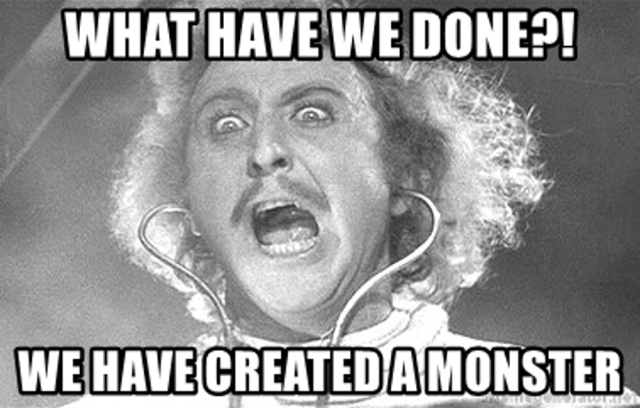
Young Frankenstein
Let’s be clear. There really aren’t many solid rules to monster making. At least when it comes to fiction. In reality, you have to struggle with the ethics of creating a monster and hope it doesn’t kill you when it escapes. Anyway, let’s dive into some general advice that can help you along.
- Have a reason for this creature existing. Not just in terms of story, but of the world in general. Monsters are basically the animals of another world. Just like on Earth, they will have some kind of niche. Maybe they’re an apex predator or they keep another creature’s population in check. It doesn’t have to be that scientific, but figuring out their role can guide you in designing their abilities.
- Be careful altering established monsters. You do have some leeway, but you have to retain some aspects of the original. Otherwise, you’re slapping a known name on an unrelated creature. This can come off as lazy or full-blown lying. For example, you can have a dragon that is covered in feathers and doesn’t breathe fire as long as it still has the form of a dragon type. You can’t slap feathers on a dragon and call it a roc. It doesn’t work that way.
- Naming your monster doesn’t have to be right on the first try. Many times, your initial name for a creature might be a placeholder. You’ll write them in a scene and realize that the name doesn’t roll off the tongue. Maybe it fails to capture the essence of what you have created. Just go back and change it with a ‘find/replace’.
- Size isn’t everything! Many authors think that they have to go big with monsters. The thought of a giant beast barreling towards the heroes or crashing through a wall has a lot of appeal. Yet, there is something to be said for smaller creatures. Large monsters need a lot of room and they are huge targets, which are not known for speed. The advantages of smaller ones is that they can be placed in small locations without sacrificing mobility. One can believe that they will be faster, harder to hit, and maybe even harder to notice. So, consider going tiny instead of huge.
- Not every monster has to be aggressive and a threat. If you want to paint a vast world of magical creatures, you should consider those that are passive. Consider how some real animals will runaway instead of attack, which can guide you to create these ‘window dressing’ beasts. They might not be essential to the plot, but it shows that the world has more than dangerous monsters. It shows that you have an actual ecosystem out there.
- If you’re going to use a real world animal for a base, try to keep the main form intact. It isn’t a requirement, but you picked the initial animal for a reason. If you change it so much that it isn’t even close, the monster might no longer work for what you initially intended. For example, if you take a bear then it’s best to keep the animal stocky and strong. If you change so much that it is now slender and agile with not much in the way of strength then there was no point in the bear starting point. You’ve basically gone with a cat, but you don’t have that in your mind enough to give your monster the benefit of that form.
- Try to maintain a list of creatures you’ve created. This is mostly for those who are going to do a series. You never know when you’ll find a place where your monster will work out again. This saves on time since you already have something to fit that niche and it makes the creature feel more widespread. It’s no longer alive in that single area, but it has a range like any animal.



 Legends of Windemere
A great post! No wonder it’s in the top ten. I can see the appeal to creating monsters. And I see why people think, “Go big or go home.” But not every Godzilla film stuck the landing. I hope to finally see the new Godzilla sometime this weekend! Friends said it was phenomenal.
LikeLike
Thanks. Hope you get to see the new Godzilla movie. Totally worth it.
LikeLike
Your point four about size brought to mind, Chucky. He was small but terrifying.
LikeLike
That’s exactly who I was thinking of too. 🙂
LikeLiked by 1 person
😊
LikeLike
“Many times, your initial name for a creature might be a placeholder.” Not only monsters, an awful lot of the names in my stories require more than one try. Especially if I’m struggling to come up with a specific spelling.
LikeLike
I’m weird with characters. I tend to go for the name first by researching meanings to fit what I’m imagining.
LikeLiked by 1 person
This was a great post. I like the small monsters and have gone down that path a couple of times. Swarms are scary.
LikeLike
I agree. I don’t do them often because I don’t want to overdo it, but it’s mayhem in scenes when I do. Just total chaos.
LikeLiked by 1 person
Good post. Love the fact you used Gene Wilder here from Young Frankenstein, if I am not mistaken.
LikeLike
Yup. Excellent movie.
LikeLiked by 1 person
They do not make them like that any more.
LikeLike