
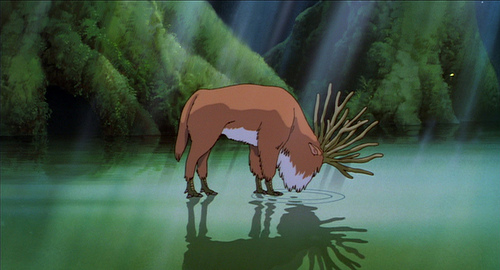
Forest Spirit from Princess Mononoke
One thing I’ve done in Windemere revolves around the monsters. Griffins, dragons, perytons, goblins, and all manner of beasts roam the wilderness alongside those that we have in our world. They’re part of the landscape even though we don’t have them in our world. After all, these creatures exist in Windemere and are about as fascinating to the locals as the more exotic animals of Earth are to us. This brought up a big question for me:
Do I make a big literary deal about them and capitalize them?
This might seem like an odd question for some and I thought it was a simply mentality when I first made the decision. I quickly realized that this is something people can be picky about. Several fantasy fans claimed that the refusal to capitalize Elf, dwarf, orc, and dragon were signs of bad grammar. Arguing with a reviewer is bad form, so I couldn’t really say what was on my mind. That is how we don’t go Tiger, Lion, Bear, and Three-Toed Sloth when we write about our real animals. Not unless they’re at the beginning of a sentence or a character’s name.
This decision has done a lot for my opinion on Windemere. It’s a bigger, natural world when I look at these monsters are animals. They aren’t foreign beasts that have invaded the land, but creatures born from the magical nature of the world. It is their world just as much as it is of the whales, squirrels, and bumblebees. Even writing this post, I’m not really sure I can fully explain why this makes me smile. Maybe it feels like I take my world more seriously than I would if the ‘monsters’ were treated more as anomalies and accidents.
I won’t say that I never treat the monster types like out of place creatures. Specific dragon species and demons do get capitalized because of their nature. Demons are the unnatural invaders in most ways. The dragons simply have ancient designations like Verenstone and Darkvawn. As far as the Weapon Dragons go, they’re not natural and get the proper title for that. This feels right to me, but I’m sure it confuses people. Much like reading and finding a monster in lowercase lettering.




 Legends of Windemere
I wouldn’t bother me either way. I’m not real picky about such things, but I know some are. I think consistency is most important. I’ll chalk the rest up to house style.
LikeLike
I agree. I’m fine with it as long as I understand what’s being referred to and the author isn’t purposely switching creature names. For example, someone using the word griffin and the creature is described as a winged horse. I wish I was making that one up on the spot.
It is interesting how people may take offense to the author’s choice of capitalization, especially in fictional worlds.
LikeLiked by 1 person
Your graphic reminds me of one of my favorites. here: http://beerstreetjournal.com/wp-content/uploads/Anderson-Valley-Boont-Amber.jpg
LikeLike
I’m suddenly thinking of Jackalopes now. If I ever see a bear with antlers coming at me, I’m just going to sit down and take the death. Beast like that means the world really has it in for you.
LikeLike
They use him on all their labels. He’s what you want to find at the end of a long day. Bear + Deer = Beer.
LikeLike
Oh! Clever. Guess it makes more sense than any other combination.
LikeLiked by 1 person
In my story, I don’t capitalize people or animal groups. Elves are elves. Dragons are dragons. I’m just weird that way. 🙂
LikeLike
Same here. I capitalize on special species like specific dragon and demon types.
LikeLike
That’s also my philosophy!
LikeLike
Thoughtful post. I appreciate that you used an image from Princess Mononoke, one of my favorite anime films ever!
LikeLike
Think it was one of the first ones I ever saw. At least out of the movies. That and Vampire Hunter D were seen around the same time. Surprisingly, I still haven’t seen Akira.
LikeLiked by 1 person
I haven’t seen Akira either, honestly.
LikeLike
At this point I’m scared. It falls under the category of ‘heard so much praise that it will probably fall flat’.
LikeLiked by 1 person
I know, right, or it’ll be just as great as they all say. We could be missing out.
LikeLike
I have heard that the manga is better, but people always say that.
LikeLiked by 1 person
Yeah. And honestly, I liked the GITS shows/movies better than the manga.
LikeLike
I just got into another series that I’m still trying to figure out. It’s called Tsubasa and I got it cheap. Only a few episodes in, so I’m staying neutral.
LikeLiked by 1 person
I think if the animals are part of the world, then the examples you used make perfect sense 🙂
LikeLike
Thanks. 🙂
LikeLiked by 1 person
I like the way you handle the capitalization of the creatures. I know when I see a capital it’s special.
LikeLike
Good point. Didn’t entirely realize the specialness of it. Just kind of came about after a little thought.
LikeLiked by 1 person
Can I come and live in Windemere for a while please?
LikeLike
Sure thing. Though I’d bring a sword along just in case. 🙂
LikeLiked by 1 person
🙂 Am already dragon… too late… will supply sparring equipment to other residents of Windemere on demand though, just really want to come & rest my wings a bit….
LikeLike
Plenty of wilderness to do that in. Most people aren’t foolish enough to mess with a dragon anyway.
LikeLiked by 1 person
Oh, I’d know a few.. 😉
LikeLike
I love the thought of small case signifying these are just normal animals in Windemere 🙂
LikeLike
Thanks. It was a quirk that appeared late in the development when I realized I was being inconsistent. That and spellchecker is always arguing with me.
LikeLiked by 1 person
Sigh… Spellchecker…
LikeLike
Either the bane or the helper of the author. Never in the middle.
LikeLiked by 1 person
I think there’s an important difference between monstrous beasts (griffins, for example) and intelligent races with their own language and history. To take perhaps an overly general example, we refer to people from Italy as Italian, and their language is Italian. But when dogs bark, we don’t refer to them speaking “Dog.”
One could argue that Dwarves and Elves should be capitalized when it refers to their ethnic group, and their language should be called Dwarven or Elvish just as with Italy and Italians. But for a monster, such as a griffin, you wouldn’t capitalize unless they had a defined language, kingdom, etc.
However, I have to say this is all fantasy. There really isn’t a “right or wrong way” to approach this. If someone really gets that upset about capitals, I’d think maybe they need to get out more.
LikeLike
True. That’s one thing I was trying to figure out when making the decision. I realized that we don’t capitalize human, which is why I made the dwarf, elf, halfling, etc. decision. But as you said, all’s fair in fantasy. As long as I’m consistent, which is always the challenge. 🙂
LikeLiked by 1 person