
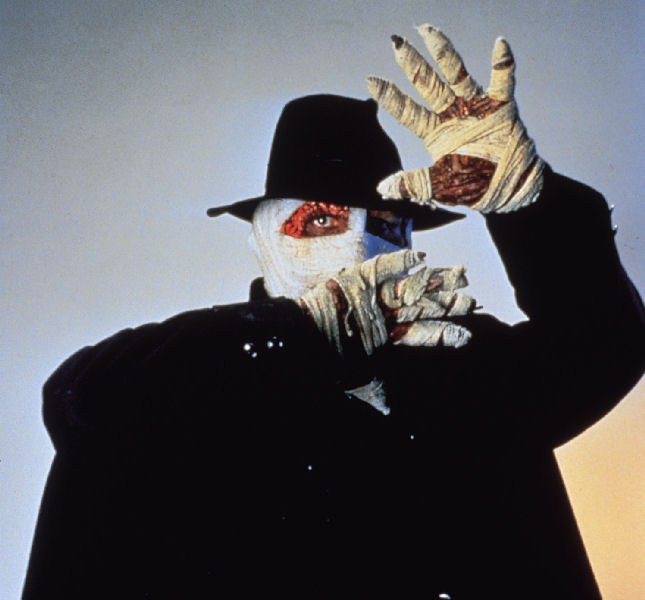
Darkman
While thinking about how much I reveal about myself, I began thinking the same toward my characters. There’s an odd balance between what they show to the audience and what is kept under the surface. The trick is to know when and how to bring the underside of a character into the light. One that starts off with their emotions and thoughts on their sleeves is easy. Another that keeps something locked away for most of a series makes thing more difficult. This is why writing Luke Callindor is slightly easier than writing Timoran Wrath. I’ve established that Luke doesn’t hold much back while Timoran is rather restrained. As I near the big reveal for the red-headed barbarian, I find myself slipping out a few hints. Not sure if this is a good or bad thing.
This is a difficult thing to do too because not every reader will enjoy the appearance of a hidden persona. Showing that the tough hero has a soft side can result in people accusing you of damaging the character. It’s even more challenging with a villain since many people have told me that they don’t want bad guys to be humanized. You’ll probably see several comments about this. It’s interesting how we want depth, but there are limits to what we want revealed. Does Baron Kernaghan have a more sensitive side? Maybe, but I’m sure some readers wouldn’t be happy to find out. So you always have that risk when it comes to adding a facet to a character.
That’s where some confusion can come from, especially within a series. There are aspects and stories of a character that might not come to light over the course of the books. One can argue that if they weren’t written then they weren’t important, which I can agree with to some extent. If it had no impact or connection to the events then the reader wouldn’t really care. Yet these things are still there for the author and it falls into the ‘true self’ of the character. It does seem that problems occur when an author does an after the fact reveal. People think it’s solely for attention and you really can’t prove that the information existed prior to the completion of the books. After all, a series can contain some parts that the author wished to do differently.
I really don’t have rules or a system when it comes to revealing a character’s true self. It simply happens when it feels right. Writing in present tense helps me with this because there is a sense of the ‘now’ and many revelations happen in the heat of the moment. So there is an emotional weight and release that comes with such scenes. Guess it’s a hazard of fiction writing since we know our characters better than anyone else and have added more than we actually use.




 Legends of Windemere
I’ve been reading everywhere that characters should grow, overcome some conflict, evolve… they can’t really do that if things aren’t revealed.Even the best Superheroes and villains have some vulnerability.Series, like sequels, are touch and go. People blasted Alexandra Ripley for making Scarlett so virtuous in her sequel to Gone with the Wind. Luccia Gray is getting some flack for making Rochester such a vile character in her sequel to Jane Eyre. (Even though his flaws showed in Jane Eyre, people had wrapped their head around the fact that he had helped Jane rise up from nothingness…how could he be so bad?) As an author, you have to make your characters into what you want them to be and let people deal. The characters ARE yours.
LikeLike
I didn’t even know they made a sequel to ‘Gone with the Wind’. Always thought that ended pretty nicely. Same for the Jane Eyre one.
The thing that comes up here is that one can create backstory that they find amusing, but doesn’t fit into the story. So I do wonder what happens with those tales. Like silly things that I created about Luke’s childhood. Those got cut due to them being unnecessary, but I still write with them in my head. It’s weird because I’m not sure if that comes through in the book. Not that it should.
LikeLike
To keep from putting too much back story into my work, I write each character’s profile out, so I really get to know them and where they are coming from. Little bits of it are dropped into the stories as needed. But my characters are growing and changing as I write, based on the experiences I write for them. That’s how I’m looking at my new series.
LikeLike
Cool. This the detective series?
LikeLike
Yeah. He’s a private investigator. I don’t think his background really lent itself to being open to same sex or transgender relationships. His wife ran off with a woman. He wasn’t homophobic, he just never really gave it much thought until then. Now, living in a primarily gay community with a transgender sidekick it’s a part of his personal reality. I think that’s growth.
LikeLike
Definitely sounds like growth.
LikeLike
I really like it when a new aspect of a character is exposed. I think it makes it a better journey.
LikeLike
True. Though I have learned that some parts are superfluous. Mostly the childhood tales that are designed more to embarrass than explain.
LikeLike
If I may suggest, don’t do a big reveal. Keep the secret a secret. Your readers will think about your characters more, trying to discern it for themselves; and you will avoid backlash from ruining a reader’s favorite character (as a reader might say it). Also, mystery generates and sustains interest.
LikeLike
You mean avoid releasing the nuances and mysterious backstory like Lucas and Rowling are doing?
LikeLiked by 1 person
Maybe bits. Let the reader’s own imaginations work for you 😉
LikeLike
It’s a double-edged sword, but it’s probably the best tactic.
LikeLiked by 1 person
It’s sad that people have commented to you that they don’t want villains humanized. What’s wrong with creating well-rounded characters? Do they think villains should be one dimensional? But then the same people will probably complain about that aspect. 😦
I’m glad there are new avenues to explore with Timoran. 🙂
LikeLike
Somebody said it once that there might be a fear of seeing some of yourself in a humanized villain. For many, it’s easier to see them as evil and only have various degrees of said evil. Guess it depends on the readers and villain.
Timoran definitely gets some fun in Book 10. Wouldn’t really call them new though since it’s always been the plan. 😉
LikeLike
I agree. To me, Hitler is all the more monstrous for loving dogs. It brings home that the person next door might be a monster in disguise.
As for villains, some readers prefer black vs white, while other enjoy grayness. Personally, I find a clear-cut good vs. evil story enjoyable, but juvenile. So, my writing falls into the latter camp. It is your story and your characters, though. Just listen to them, and they’ll tell you what to do.
BTW, had you heard how Elsa was evil when Frozen was first written? She was turned into a much more complex character during the rewrites, and I, for one, applaud. 🙂
LikeLike
Hitler is all levels disturbing.
I did hear that Elsa was going to be evil at first, but they switched it around when they wrote ‘Let It Go’. Definitely a better choice.
I tend to prefer the grayness too, but there are times when a clear-cut one is what my mind needs. All about the mood. I think I like using a group of villains too because you can mix the various levels in. A little something for everyone.
LikeLike
I think there’s a big difference between humanizing a villain — a good thing, I think, because we want to know WHY they do what they do, if nothing else, and showing a “bad guy” doing good things sometimes makes sense because humans and human-like people are never PURE evil — and trying to justify or make readers accept/agree with the truly horrific things some villains do in fiction.
LikeLike
True. I personally never really considered the second one humanization. It can get uncomfortable if it seems that the author is trying to justify the evil. Though there are grey areas. Like someone who is trying to conquer a land because he thinks he’s the best one to lead.
LikeLike
I once read that Dillinger’s last words were something like, “but I’m a nice guy.” Or, as Socrates put, no one is knowingly evil. It is our job as writers, IMHO, to explain how the villain’s mind works in such a way that people can’t help but see their point of view, even if they still hate them.
LikeLike
Love that Socrates quote. It really does make a villain more believable if you know their motivation.
LikeLike
It doesn’t bother me when new facets of an established character are revealed. In fact, it’s one of the things that keeps long series from becoming tedious. If we feel we know these characters a little too well, it gets harder to worry about them.
LikeLike
Becoming too close also makes it a challenge to do anything bad to characters.
LikeLike
Unless I purposely decide otherwise, I do make every attempt to eventually edit a poem back to its universal feeling or thought. Even if it ends up personal…I hope it’s personally felt by others besides me. It’s very helpful, for me, to think in these terms sometimes: this is my experience (truth) and that of others, too, perhaps. And poems are sort of like characters, right?
Great to keep reading you, Charles.
Ellespeth
LikeLike
Poems can be characters. Never really though of it that way, but they do have feelings behind them. So I’d say they count in this discussion.
LikeLike
“I really don’t have rules or a system when it comes to revealing a character’s true self. It simply happens when it feels right.” – to me, that right there is the absolute nub of how it happens! Otherwise, I find it always seems forced.
LikeLike
Definitely. Many readers pick up on the forced stuff too.
LikeLike