Thank you to Oloriel Moonshadow for writing a great post on Books and Tarot.
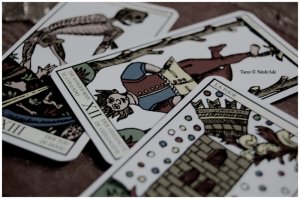
Tarot by NinfeAde on DeviantArt
Books and stories are no strangers to mentioning Tarot, the divination tool and practice. The curiosity for the unknown, improvable, emotional and untouchable is inspiring quills all around the world. If a book has a mention of divination, Tarot is often used as the entity to represent it. But how concise is the literary Tarot to the cards themselves one might use to divine in real life?
A book has always been and always will be a story, whether it is a retelling of real life events or a fiction account, it lived and it lives within and outside us. With this in mind, we can also reflect to the fact that there is not just one Tarot deck, one form of divination with it – that we can draw our inspiration from for our stories or use it as a key element. Different Tarot decks are usually vastly different from one another, even when the archetypes are unchanged and when all of them use the same names for their suites.
They differ in theme, meaning, suggested way of working, symbols, even the colors and paint used to depict meaning on the physical cards themselves.
This provides a lot of levee to the author. It is much easier to navigate precisely to the tarot deck and divination practice with it that would suit the book best.
I find most authors who use Tarot in their books to be very prone to extensive research before including it in their writing, especially as a side element. It is much easier to connect the patterns of inspiration when Tarot is the main element of or behind the story, but when it is presented as, for example, a tool of the trade of a young fortune teller in a dystopian novel, the readers tend to focus more on yearning for details, the mysterious ways of this divination have little space to flourish.
The decks most commonly used and described in literature are the Deck of Marseille and Rider Waite’s deck – just like, in the real world, they are the go-to decks for beginning Tarot practitioners. These decks have geometrical designs, with precise color association, making them the easiest for beginners. They are the decks you most commonly see in movies, TV shows, on various covers and paintings. They are most used in literature as well, because the writer is working with something that is presented as difficult to fully grasp yet still familiar to the reader, due to their exposure to it in the media and different branches of art.
There are decks which are crafted using the regional mythologies and histories, which are often a better fit for a genre book, like Arthurian tarot would fit better in a book centering and using Arthurian legends, their time period or place of origin, in all ways, than the other two mentioned decks.
But the real way in which Tarot adds to a story is with its esoteric mystery, the sense of the paranormal, the scary, the secretive and occult. We understand more about Tarot now then we did years ago, when we have so much literature and physical decks available to us, when we are so vastly exposed to it all daily, that even when we are not specifically paying attention to the meaning of a certain card, we subconsciously learn and remember all about it. We use it in our writing. The greatest example for this would be the card of Death, or other archetype cards which are the ones mostly mentioned in books and stories.
Do we depict them true?
Yes. And no.
In a book or a story, we are presented by a situation, a character, and a tarot card yet it is us, the writers, who hold within our hands the answer already. We take bits of Tarot and fit them in, it is not the Tarot itself or the idea of it guiding the story and the outcomes. We use it as a story element that most often issues warnings to our characters, an element to instill fear into both our characters and readers, using the static card explanation we receive from various Tarot divination guides. But, in reality, the cards themselves are mediators between us and the unexplainable, the invisible spoken word from an unknown speaker that we try to decipher for outcomes. They are the telephone wire and the canon meaning is never true. It changes and varies, depending on many things such as the card that follows, if the card is upside down or not, with which hand you drew it with and similar.
In our books and our stories, we cling and transcribe the meaning we learned or read about, that the Death card means emotional death for example, a change in our soul, way of thinking, personality, but in a real reading, it can very well mean physical death as well. It is different, every time, depending on the teller, depending on the person, depending on the Now we have only just began to explain.
Should this deter you from using Tarot in your writing? I would say: absolutely not. It is a great element of mystery and magic that is used properly can only enrich your story.


 Mmmm… papery and yummy