
(Originally posted on January 7, 2015.)
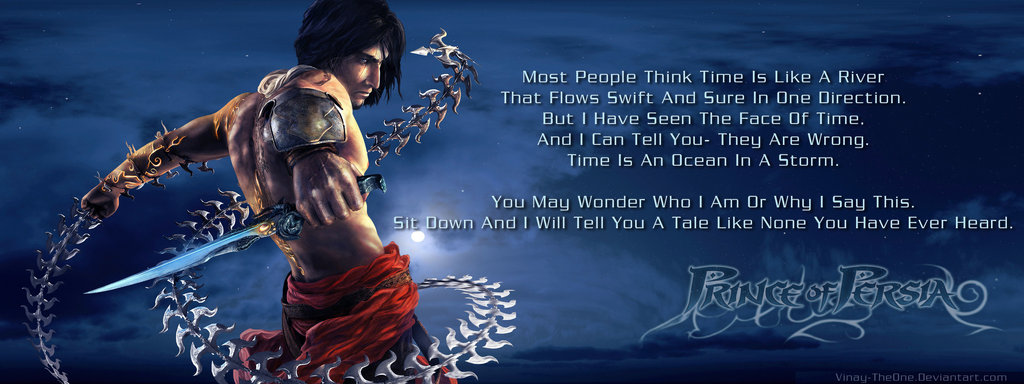
Prince of Persia Quote
A ‘Time Jump’ is when you skip a modest length of time between chapters or books. This can range from a day to a few years depending on the story. Many times there are events that occur during this time and the characters operate a little differently than they did before the jump. This tool gets used for several reasons, which include:
- Moving the main story along to avoid filler sections. These skipped events can be handled in short stories at a later date.
- Altering characters to rejuvenate them to the reader. For example, a positive hero goes through severe loss and is reintroduced as a broken figure.
- Build mystery as you discover what happened to the characters and maybe even set up for a side switch. Heroes can go villain and vice versa.
- Change the world and return to an exploratory mentality.
It’s a fun little tool that can be great for a lengthy series or to skip over traveling sections during an adventure. I’ve used it gradually in my books such as Luke’s remaining time at the academy, the heroes’ last few weeks in Haven, and the passing of months between The Compass Key and Curse of the Dark Wind. Things happened during these moments and characters talk about them, but they really would have been nothing more than a chapter or two of filler. Still, things had to happen during the ‘break’, so it helps to acknowledge this.
Even better, these jumps reveal something to the readers. They are following a living, breathing world with evolving characters. Just because the adventure is over, doesn’t mean the heroes are sitting around waiting for the author to cast them into danger again. They have lives that operate when the big story is not going on, which gives them more to fight for in a way. Luke Callindor is not just a wandering hero, but a warrior who is still training and will take time to help with mundane tasks if he can. Nyx is big into researching when she can get her hands on a library while Delvin Cunningham is still trying to convince her to let him cook for her. They ‘exist’ even when you have closed the book and the ‘Time Jump’ can help bring that to the readers’ attention.
This is not to say that it is a perfect writing tool. As usual, you have to be careful with how you use it. There is a double-edge sword in this. While you can push to big events quickly, you can create too much that happened and some readers will feel like they’re left out of something. For example, some may really want to read about the gambling problem that one of the heroes fell into and is now struggling to get out of. This is where a short story can help, but there are other things to consider.
- Try not to go too big with the missed events. For example, a leader of a resistance movement, who is also the POV character, being unconscious for the biggest battle of the war can easily be met with disappointment. Many readers who are invested don’t want to get that through secondhand accounts.
- Explanations of missed events should be brief and concise. Too much complication can make it sound like a juicy story was skipped.
- Don’t skip explanations either. If Timoran shows up with a missing hand then there should be a point where somebody mentions the event.
I say this about a lot of writing tools, but I think it’s important to say again. You need to find balance between explanations, skipping time, and believable character development if you plan on doing a ‘Time Jump’.
So I open the floor to the audience’s opinion . . . unless I lost everyone during my day off. 🙂




 Legends of Windemere
Pingback: Reblog: Doing the Author Time Jump | Jeanne Owens, author
The time jump is a good tool. In my current WIP, I have a ticking clock, so I can’t jump forward in time. But in another manuscript, I have a portal that forces a time jump on the characters. It might be autumn on one side of the portal and winter on the other. But since only character interacts with it at the beginning of the story, I don’t have to explain much, since once he goes through the portal, the story really starts. I agree, though, that major story events would need to be explained if a time jump occurred.
LikeLike
Cool portal idea. What happens when it naturally goes from autumn to winter or winter to spring?
LikeLike
There are two realms. One realm is a season ahead of the other. So, if you cross over, you need to prepare for that season.
LikeLike
That doesn’t sound too bad. Beats going from summer to winter or vice versa. That would be brutal.
LikeLiked by 1 person
I have frequent time jumps in my mysteries, to move things along. Fillers are killers. I use fluorons to indicate the jump – which is usually only a day or two – because if I don’t it gets really confusing to the reader with regard to where they are in the story.
LikeLiked by 1 person
I jump days when there isn’t anything going on. I sometimes have one ‘traveling’ scene between action scenes to establish character evolutions. I still jump a bit on those. Can’t write down every minute of every day without creating boredom.
LikeLiked by 1 person
Absolutely. It becomes boring filler.
LikeLike
Instead of an outright time jump, maybe I would write a few paragraphs briefly covering the “filler” events, but try to keep building suspense about the main plot. Maybe a character still feels like someone is watching them, or they are bitter sweet about a family event.
LikeLike
That could work.
LikeLike