
Marvel Events
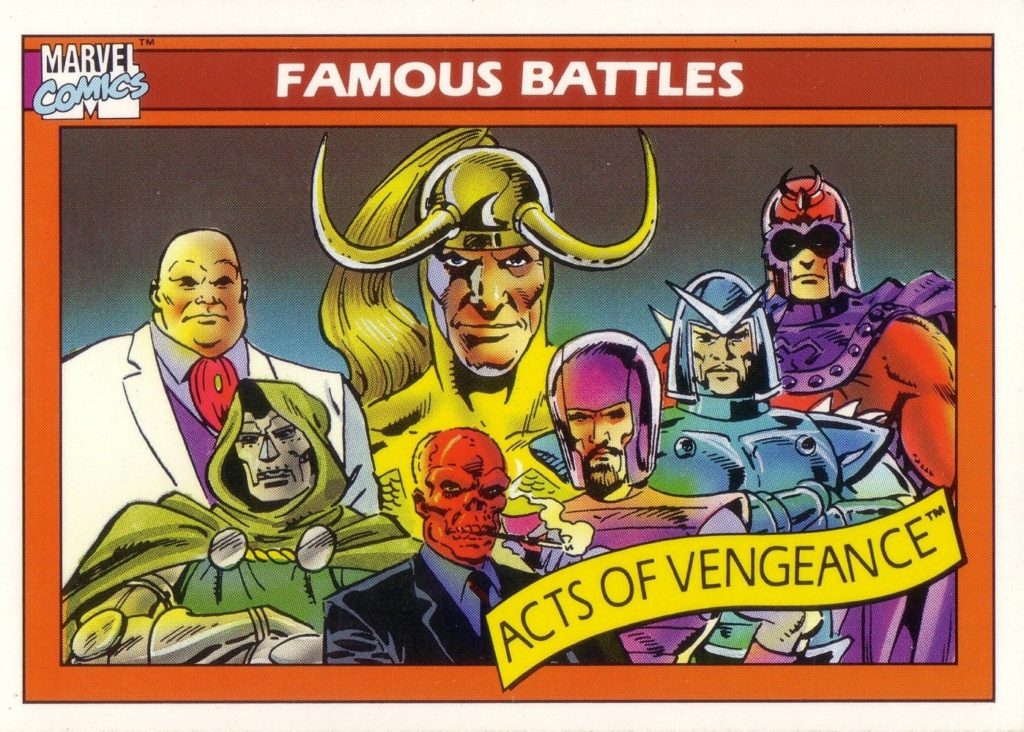
Growing up reading comics introduced me to the ‘Villain Alliance’ pretty quickly. The above group, Sinister Six, Legion of Doom, Hellfire Club, and more. Although, I think Marvel did this more than DC. Makes sense since DC had the Legion of Doom, which seemed fairly effective. That brings me to an issue with people creating Villain Alliances:
Betrayal
Whenever one of these groups comes about, they usually end with the villains turning on each other. This allows the heroes to win even if they weren’t the ones who created the turmoil in the first place. It happens so often that most just wait for the inevitable collapse of the team. Usually it’s the leader revealing he was going to sacrifice the others to begin with or the most vocal critic rallying the others to rebel. I know the heroes have to win somehow, but it’s normally a victory born from the villains giving in to a self-destructive urge.
My issue with this is that it doesn’t always make sense. Having a character of chaos on the team like Loki or Joker can result in fracturing, but then one would wonder why they are there in the first place. They usually have to be the one who really put the team together (Loki) or force themselves on there (Joker). Still, the other villains don’t act like they do when alone. There’s less caution or total paranoia instead of them working towards a single goal. Rarely do they put this aside and agree to turn on each other AFTER the heroes are gone. They also do it at the climactic moment, which makes sense from a story perspective, but not a character one.
I hear people point out that villains tend to be narcissists, egomaniacs, megalomaniacs, and not team players. That’s true, but a desire for victory, especially over a hated enemy, should be able to curb those darker impulses. You see it all the time in human history with evil leaders making alliances, which last until they’re all defeated. I know fiction goes to cartoonish levels at times, but this can hurt the villains’ reputation to the reader since they come off as really stupid. The ‘not a team player’ excuse I see most of all can only do so much to prevent damage.
Maybe I’m seeing this because I think predominantly comics because that does seem to be where this happens the most. Makes sense since those stories can go on for decades and a villain alliance can spice up multiple series. A book series with the same heroes won’t have as many opportunities unless you have different villains for each book. That’s really only for established ones though because non-comic stories can start with a villain alliance, which typically falls apart. Again, this happens so often that many readers pretty much wait for the implosion.
I’ve done two villain alliances in my stories. Legends of Windemere had Baron Kernaghan’s agents, which did include Trinity who would become a hero. I tried to counter that issue by making it clear she was a villain solely to protect her people from her ‘master’. Everyone else stayed loyal to the Baron. War of Nytefall had the Nyte faction led by Xavier Tempest, which was fully loyal. Many of these other characters had their own goals too, but they still worked together. I guess a big difference is that there was a clear hierarchy, which villain team-ups in comics typically don’t have beyond the one who made the team and the others. Lex Luthor being the leader doesn’t mean Sinestro, Black Manta, Brainiac, and Riddler are going to become subservient since they are top level villains themselves.
So, what do other people think about villain alliances?






Have to admit, I haven’t thought about it much. The Good Guy alliances have caught my attention, though.
LikeLiked by 1 person
Those tend to work better.
LikeLike
The personalities don’t conflict so much!
LikeLike
You make a really good point about questioning why a chaos character is added to the mix. In the Justice League animated series, the Joker was the main reason why Batman was able to escape in a two-parter. Even the other team members questioned Joker’s motivations. Yet they allowed him to hang around!
I like a villain team up though. Justice League and Young justice featured some good villain team ups as you mentioned. Though Project Cadmus wasn’t billed as the villains, they often were antagonists to the Justice League and the young justice members. There was also the Vandal Savage/the Light team up with the Reach.
LikeLike
Been awhile, but I thought the Joker joined the team on his own. He wasn’t recruited. Though one still has to wonder why they let him stay.
Feels like DC has better villain team ups. At least more of them.
LikeLiked by 1 person
Yes, he was not recruited. But they let him stay instead of booting him out. So he was still part of the league.
LikeLike
They should have seen his antics coming.
LikeLike
I think they are another tool in the kit, but some thought is required to avoid some of the expected tropes.
LikeLike
True. Very hard to avoid them too.
LikeLiked by 1 person
What’s great about villain team-ups is how intimidating they are. There’s a whole bunch of bad guys/gals! What is their sinister plan?
Like hero team-ups and groups, each individual villain has a following among readers. This will build more audience interest. One mistake I think the companies make is to announce this multi-villain group right out rather than build up to it.
A patient and sneaky group of writers can have the villains acting like they normally do and slowly introduce the connection. So if people follow several titles, they will start to put the clues together. Maybe even before the heroes do. A lot of readers would enjoy the discovery of such a mystery.
As far as villain teams that have been successful, Suicide Squad is what sticks out to me. They weren’t all there on a whim or as back stabbing competitors; they were coerced by Waller and the implants that would kill them. That’s what made them stay in the group, even when there was ill will and back stabbing.
LikeLike
I’ve been torn on Suicide Squad for a while. They’re a team of villains, but are used as heroes. So what does that make them? The bombs kind of prevent the betrayal trope too, which does work.
For some reason, I remember one incarnation of the Sinister Six being gradual. Issue by issue, they were recruited while Spider-Man handled other problems. Then they struck.
LikeLiked by 1 person
In my view, the Suicide Squad members were protagonists, but not heroes. They all clearly held a villainous point of view.
As for the Sinister Six intro, I miss the time when the writers would collaborate like that. These days, the corporate leadership won’t commit to anything more than six issues long, it seems.
LikeLike
I haven’t read American comics in over a decade. It got boring with everything being a huge, series-crossing event. There was something to be said for a single issue story. Felt it helps cleanse the palette between major storylines.
LikeLiked by 1 person
I’m with you on disliking the huge crossovers. They kill (metaphorically) all other momentum for the characters involved.
LikeLike