
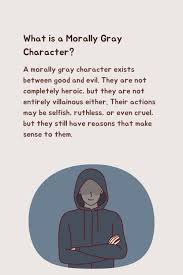
A while back, someone mentioned characters who are morally gray. These are the ones that sit between good and evil. While their actions can be reprehensible, they have good reasons for taking action. Here are some examples I found:
- Boromir was wrong for trying to take the One Ring, but he did it for his country.
- Walter White was wrong to make and sell meth, but he did it to survive.
- Captain Jack Sparrow betrays people, but still helps when the time is right.
- Batman?
- Tyler Durden?
- Loki . . . Does evil things, but he’s hot?
That’s become my problem with the morally gray character. At least in terms of research, I kept running into characters that didn’t fit the bill. All antiheroes seem to fall under this even they are simply in that position due to being the protagonist. Walter White and Tony Soprano would be villains if they weren’t the heroes of their respective series. Batman is clearly morally good even if he’s a vigilante. I think other characters end up being put in this category when they are villains who become popular and they are shifted to make money. Loki, Harley Quinn, and Deadpool were all true villains, but then were switched to what they are now. You can say that comics have very fluid morality for their characters, so you can’t effectively use them as morally gray.
Looking up definitions, being morally gray means that your morality isn’t clear. You are trying to do good things, but your tactics can hurt others. They are always aware of the harm they are causing too. ‘Ends justify the means’ comes into play, which is why characters that are clearly villains are put here. This is probably why antiheroes fall into this mindset a lot as well. Yet, the more I look at how this works, the more I feel like this is simply a sympathetic villain.
I did stumble onto one trait that a true morally gray character has that many people tend to ignore. As stated, the character is aware of the damage they are doing and see it as an acceptable loss. They don’t like it though. There is an inner conflict and guilt, which makes them question their own actions. It’s this turmoil that keeps them in the middle and on the verge of going to either side of the moral compass. I can see this in characters like Boromir, John Wick, and Lady Eboshi (Princess Mononoke). They know what they are doing is wrong, struggle with their actions, and push forward believing their dark actions are for the best. They don’t solidly accept their actions and reveal true guilt at times.
Another interesting take, which can explain Loki, is that a morally gray character is one that simply uses deceit to achieve goals. Some people believe the first morally gray character was Odysseus from ‘Iliad’ and ‘The Odyssey’. This is because he lied and tricked even his allies to achieve his goals. For example, he tricked Achilles into exposing himself and getting recruited. This would lead to Achilles being killed later on. Odysseus also caused the death of his own men through his hubris, which caused him to feel incredible guilt. That hubris one is where I get a little shaky on his standing as a true morally gray character, but that sin is always hard to figure out due to cultural differences. Anyway, this means that a morally gray character could be one who does good things using low-injury methods such as lying and trickery. At least, low immediate injury, which is why they think it’s okay.
So, what do other people think of morally gray characters?






Seems like many of the characters in Greek mythology are morally gray. Sisyphus also is, but wound up punished by the gods for his hubris. I’m working on a book with a character I thought was morally gray. But the definition you provide means he’s pretty much a villain. He’s done a few good things. But that’s about it. Definitely not an antihero like a Han Solo. In another book of the series, a character is morally gray. He’s an opportunist working with a group of people who have murdered people. While he didn’t participate in those murders, he didn’t stop them either.
LikeLike
It really is tough to be morally grey. Morality is so fluid and takes sides that it’s even hard to imagine being in the middle. I’ve had villains do a few good things and lean them towards morally grey, but now I’m seeing it doesn’t really work out.
LikeLiked by 1 person
I think morally gray characters can be very rich how you write about them. Describing motivation for conflicting actions can be really interesting!
LikeLiked by 1 person
It really does come down to motivation.
LikeLiked by 2 people
I just finished watching Tulsa King and am watching Mayor of Kingstown. Both protagonists do immoral acts to sustain a moral outcome. I would think it very difficult to to write a morally gray character consistently since wandering into the immoral behavor too many times takes the gray away.
LikeLike
Those sound like they cover it pretty well.
LikeLiked by 1 person
These make for great characters. I don’t think you can give them rigid fences, though. John Wick didn’t seem to have a lot of second thoughts or remorse. I think those boundaries need to remain a bit fluid.
LikeLike
Good point on John Wick. Though he’s typically killing other killers. That seems to be a loophole that many authors use. Reminds me of Arnold Schwarzenegger’s response to if he killed people in ‘True Lies’:
“Yes, but they were all bad.”
LikeLiked by 1 person
I think a truly morally grey person would be difficult to write. Keeping them from drifting to one side or the other would be very hard.
LikeLike
Agreed. Probably have to fix a lot in edits to get it 100% right.
LikeLike
Strangely enough, I hear of these characters a lot in romances. One of the couple is “morally gray” but often hiding their shady past. Of course, in romances, there’s the idea that their partner in a relationship can “save” the morally gray partner.
LikeLike
I think I’ve heard of that. Weird that they want to save a morally gray character. I’d think that would work better for an immoral one.
LikeLiked by 1 person