
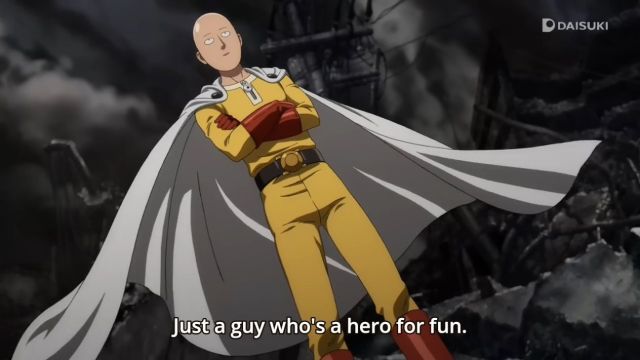
Saitama
So, I was showing my son the anime called ‘One Punch Man’. This is about a guy named Saitama who became so strong that he defeats every enemy with one punch. He lives in a world of monsters, villains, and heroes. Since he couldn’t get a job, he decided to train and become a ‘Hero for Fun’. Then the series and comedy begins. Anyway, his motivation got me thinking about hero types. Let’s start with Saitama.
I don’t think there are a lot of heroes who fall into this category. They certainly don’t stay there for very long. Even Saitama is clearly doing heroics at times to keep people safe and help them out. So, this could be a fairly common newbie motivation. It makes sense in a world of heroes or one where hero stories are popular. A person could focus on the excitement of hero life while ignoring any of the challenges. This would prompt them to start the path because they want that type of life. Any monetary or justice factors don’t come into play for them until they get older.
Now, that excitement and adrenaline rush is really what draws them in. It could also be a desire for a challenge too. The funny thing is that we tend to see this motivations in villains more often than heroes. Even if a hero does amazing things to grasp victory, the excitement and challenge aren’t the focus of their desires. They are by-products that the hero either doesn’t fully acknowledge or wishes to avoid because they tend to come with complications. Some villains, on the other hand, turn to crime for the challenge and thrill of not getting caught. This is probably why a ‘Hero for Fun’ eventually shifts their motivation to something more noble. In the end, the desire simply to have fun and be challenged is fairly selfish.
Does that make this hero a bad person? No because they are still doing good. They might be less likely to consider property damage, but you can still rationalize them making sure people don’t get hurt. There is still a level of empathy and concern in their hearts, which is why they aren’t villains. A hero for fun will take some joy out of saving people because they will get praise and a rush from the ensuing attention. They would also know that letting people die could get them in trouble and stop their fun. Property damage might not factor into this because they’ve probably seen many heroes cause destruction, but they never get the blame. In these kinds of stories, authors just ignore that part of the scenario to allow for heroes to continue having big fights. The hero for fun can thrive in this situation due to there being no penalty for destruction.
As I said before, these types of heroes tend to evolve into doing it for another reason. That doesn’t mean they stop having fun though. Simply put, they mature and put on a different persona. They might still joke around, take risks, or do whatever else made them stand out as a challenge-seeking hero. Yet, they temper this with statements and actions that show a newer sense of responsibility. Maybe they start thinking more carefully before jumping into a fight or try to talk villains out of battles. They no longer come off as a selfish, prideful adrenaline junkie, but a sensible, noble hero.
Another factor that can change them is boredom. Using Saitama as an example, he became a hero for fun and now he defeats everyone with a single punch. A part of the story is that he’s bored and no longer getting a thrill from being a hero. He even feels like he is losing all emotions because nothing is a threat. This mentality reduces their motivation to a shadow of its former self, which means they have to either find a new reason to be a hero or rekindle the fun. The latter would probably be difficult for someone who feels no sense of danger when they are in action, so they are more likely to continue for money or justice. Sometimes, they may even quit and only come out of retirement if they think a challenge has appeared.
I guess this all means that the ‘Hero for Fun’ type is temporary and kind of ephemeral. A character usually can’t stay that way for forever. They eventually have to evolve into a different type or they become stale. Not only for the author or the audience, but for themselves too. They would need to find increasingly exciting challenges in order to continue, but there’s certainly a limit. Inevitably, they will take on a challenge that is so difficult and massive that nothing can top it. After that, they won’t be having the same level of fun, which is the situation Saitama is in.
So, what do you think of the ‘Hero for Fun’ type?




 Legends of Windemere
As I read this post, I thought of the Batman: Brave and the Bold series, particularly that series’ version of Aquaman. He was always singing and talking about how fun it was to punch bad guys. The whole series was fun and lighthearted (though some episodes were a little darker). But I confess that my favorite version of Aquaman is Jason Momoa. 😄😄😄😄
LikeLike
I vaguely remember that series. As for Aquaman, I forgot if he was doing stuff for fun or was just arrogant.
LikeLiked by 1 person
Most of the time On BTBAB he jumped into fights because doing so was fun for him. Sometimes he’d sing about the experience. I recently watched many episodes of the show that I have on DVD. I hadn’t seen them in years.
LikeLike
That definitely was a whacky show.
LikeLike
I have a hard time seeing one of these heroes doing what they do for fun – maybe for accolades, pride, and (gasp) money or power.
LikeLike
Some do it for the thrill or fun. Saitama (guy in picture) did it because he thought it would be fun. That was the basis for him and explained why he’s the strongest hero and nobody knows about him. He didn’t make himself official.
LikeLike
A modest superhero!
LikeLike
It does seem like the approach of an immature person, and the experience of consequences, like accidentally knocking a building down, would surely cause them to grow.
LikeLike
I guess that depends on how reckless they are. It is possible to be a hero for fun and still be cautious.
LikeLike
I have a hard time with this. Doing something for a challenge or fun is hard to separate from being invincible. I think one would make for a better arch than the other.
LikeLike
One Punch Man tackles it with Saitama looking for a challenge. He’s starting to no longer have fun while continuing to be a hero. So there’s a few inner monologues of him worrying that he’s too strong or losing his humanity.
LikeLiked by 1 person
That probably carries it along.
LikeLike