
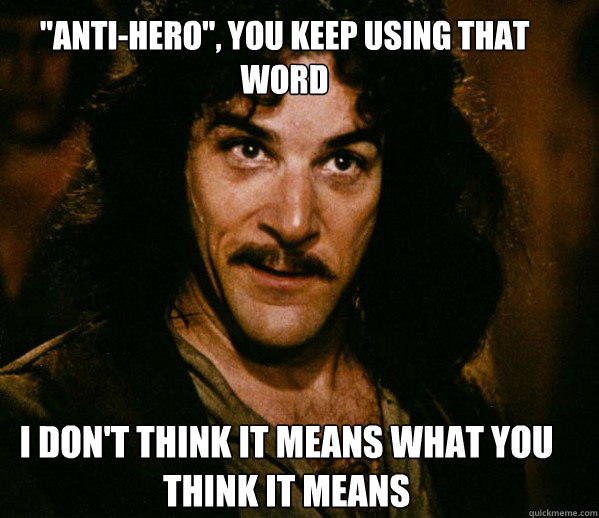
Inigo Montoya
I’ve talked about how difficult it is to have a monstrous hero without going too far to one side. With any luck, I’ve struck the right balance in War of Nytefall, but only time will tell there. So, what are some things to consider?
- Never be afraid to have your monster act like a monster to some extent. I don’t mean go on a rampage, but have moments of being cruel or scaring people. Remember the nature of the beast that you’re working with. This is a crucial part of their powers and personality even if they’re fighting against it. It can also keep the reader wondering if the hero will go back to his or her darker origins.
- Whether you use it or not, world-building of the monster’s history and social standing can help establish the protagonist’s limits in terms of heroism. It also helps the author get an idea of how people will react to the hero. This is easier if the monster is rare or considered a legend like ‘Hellboy’. If they’re a more numerous and organized group like vampires then you should consider a little flushing out.
- Many monsters have weaknesses like silver, sunlight, stakes, etc. Fit these into the story, but don’t overdo their use. There should be a sense of danger for the hero, but this can be pushed to a point where they’re practically neutered. For example, imagine if every criminal had Kryptonite in Metropolis. Superman wouldn’t have as big an impact and the sense of him being an underdog would come off as force.
- If your monstrous hero has a violent streak and tends to leave bodies behind then you need to establish a reason for that not getting them in trouble. Is there an associated team that hides the evidence? Is it a world where such things aren’t that unusual like in fantasy or post-apocalyptic settings? Readers might question how a supposed hero gets away with horrible acts without any repercussions. These are the types that are expected to suffer consequences unlike the villains.
- Social awkwardness of some kind is both common and expected. With the hero coming from a non-human group, they began life with a different mindset towards those they are protecting. It could be prey, inferiors, or hunters, but they might still have some problems mingling with human culture. This can be played for comedy and drama, depending on the mood and tone. You can also work with a variety of issues here like shyness, anxiety, bad manners, no verbal filter, and whatever else we would normally look at oddly if a human did it.
- No eating the other good guys. Simple rule, but you’d be surprised how often people think a monstrous antihero can still eat the good guys.
- Make the reason for the monster being a hero very clear. This can come into conflict with #1, but you need to explain why they refuse to act like the rest of their species. It doesn’t even have to be a secret. Many times, an antihero like this will openly discuss the topic. Humans will be afraid of them and question their true intentions, so they need to be willing to defend themselves.




 Legends of Windemere
I think these suggestions can be used on a whole number of levels and not just with monsters. A good reminder about character building.
LikeLiked by 1 person
Thanks. Guess they are fairly versatile
LikeLiked by 2 people
Yup
LikeLiked by 1 person
An interesting list. I thought number 6 was unexpected.
LikeLiked by 1 person
Most people don’t see it coming. That’s why we made the rule.
LikeLiked by 2 people
A Versatile List! Thanks, Charles. ♥
LikeLike
Thanks. 😁
LikeLike
You’ve got me spinning. You’re on the verge of an anti-antihero. Or would that be a counter anti-hero? A counter antihero mole embedded in a hero organization…
LikeLike
An anti-villain?
LikeLiked by 1 person
Reblogged this on Chris The Story Reading Ape's Blog and commented:
Great tips from Charles 👍😃
LikeLike
Thanks for the reblog.
LikeLiked by 1 person
My pleasure, Charles – Great tips 👍😃
LikeLike
Great tips! And yes, I think of Hellboy, but also some Pokémon, who have been known to kill their trainers (according to their Pokédex entries).
LikeLike
Sometimes I think those entries are for the adults and the real pokemon aren’t that bad.
LikeLiked by 1 person
Great list… but isn’t there any leeway for eating the good guys?
LikeLike
Sorry, but eating your allies is specifically for villains. It’s a line that you can’t really come back from.
LikeLiked by 1 person
Reblogged this on Claire Plaisted – Indie Author and commented:
Great writing advice for growing your own monster characters
LikeLike
Thanks. 😁
LikeLike
Reblogged this on Author Don Massenzio and commented:
Check out this helpful post from the Legends of Windemere blog with seven tips to writing monstrous heroes
LikeLike
Thanks. 🙂
LikeLiked by 1 person
You’re welcome
LikeLike
Reblogged this on Viv Drewa – The Owl Lady.
LikeLike
Thanks for the reblog.
LikeLike
I think about this sometimes, in terms of video games like Dragon Age. You always collect a group of companions, and some of the companions are pretty sketchy. For instance, there’s always an assassin and a rogue or pirate. Honestly, would my noble warrior or mage want to spend time with pirates and assassins?
But the setting is such that everyone goes around armed, and our characters are accustomed to seeing rough justice dealt out. It’s just something I ponder between sessions.
LikeLike
I have seen some noble characters written in a way that they will work with pirates and assassins for the greater good. There’s the promise of taking care of them once the shared threat is done though.
LikeLiked by 1 person
Hmmm. Using people and then killing them? Not so noble. Would be a good question to face at the end of a story, though.
Can you change an assassin to be someone better? Then they might be worth sparing. Or would you dispose of them and try to hide your own involvement with such a person?
Also could be setup for future stories, since the assassin would now be an enemy if you tried to kill them and failed.
LikeLike
One thing I’ve noticed in fantasy is that a lot of ‘noble’ characters aren’t nearly as noble as they claim to be. They still see those who are even remotely dark as expendable and even subhuman, which doesn’t affect their own sense of righteousness.
An assassin could be made to be better if they’re going after ‘evil’ targets. One person’s assassin is another person’s heroic sniper/spy. I like playing with the grey areas when I use characters like this for more than battle fodder.
LikeLiked by 1 person
On “noble” heroes not being noble, I feel this may be an indirect product of the current US political climate, where those we look to for leadership go to such pains to appear “noble” and then it turns out they have some kind of dirty secret. I’m thinking of Richard Nixon here, but I’m sure people on all sides of the political spectrum could point out a figure from the opposite side who tried to seem “noble” and had skeletons in their closet.
LikeLike
Possibly. Yet, I do remember a lot of mythological heroes being noble, but heavily flawed. Hercules is a good example where he was treated as a noble hero, but he had a lot of rage. The nobility came more from his desire to do good and uphold the laws. Yet, he could be pushed to a point where even he broke them by accident.
LikeLike
Reblogged this on Die Erste Eslarner Zeitung – Aus und über Eslarn, sowie die bayerisch-tschechische Region!.
LikeLike
Thanks for the reblog.
LikeLike
Pingback: Writing Links 3/19/18 – Where Genres Collide
Great post, Charles! I’m working with an antihero right now, so this post could not have come at a better time. It’s very helpful. Thank you!
LikeLike
You’re welcome. Glad to hear it’s helpful. 😊
LikeLike
This has been so helpful in my understanding of how to shape characters. Keep up the great work!
LikeLike
Thanks. Glad you enjoyed it. 🙂
LikeLike