
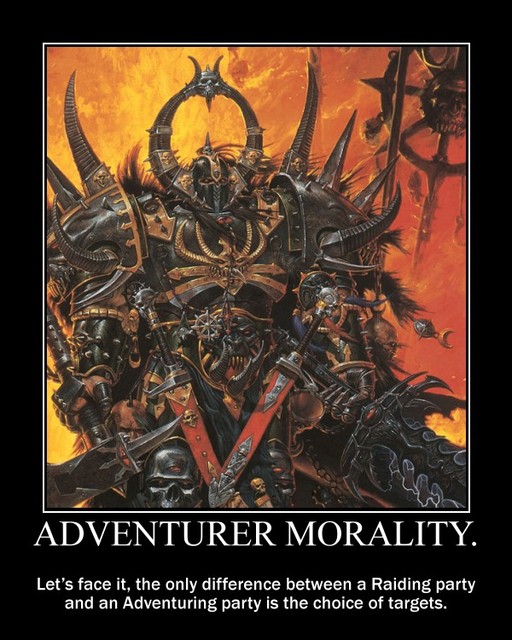
Yahoo Image Search
This one might be quicker than the rest because I can’t think of any clear examples. It mostly stems from a few responses I’ve gotten about my books and discussions I have had about heroes. It seems there are readers who want a character who is tough, noble, brave, and has no qualms about killing people. The slightest transgression results in this hero attacking and then they go back to claiming to be pure or noble. Not even because that is their persona, but they’re written that way. This is different from the Antihero because those tend to either be conscious of their hypocrisy or never claimed to be noble. The Psycho Hero is different too because they’re established as violent and enjoy the chaos that they cause.
So this list might be more about how to avoid writing a noble hero who can’t hold onto his/her own morality. Again, not that they’re tricked or pushed to go against their code, but they do it without question or even realizing it.
- If your hero talks about how life is precious then make them show grief about killing. It brings more weight to their beliefs and creates consistency. Otherwise, you think the author isn’t paying attention to what they’re doing.
- Create an honor code for a noble character even if you don’t explain it in the book. You should also STICK TO THE HONOR CODE! If your character says ‘I don’t fight women’ then don’t have them throw down with a female warrior in the next chapter. If she’s disguised and her gender is revealed then this hero should suddenly go on the defensive and try to get out of the fight. Suddenly adding, ‘unless she fights me first’ is a cop out and can only be done within the same scene. Otherwise, people might think the author hasn’t read their own book.
- If you do have a character who counters his own moral code then have other characters call him out on it. Don’t just have the other heroes shrug and ignore the fact that a Paladin of the Magic Goddess just set fire to an ancient magical tapestry. In that specific case, the Magic Goddess might want to revoke his status since those types of deities are all about preserving magic. In other words, don’t let the other characters give these inconsistent jerks a pass. Otherwise, people might think they’re just as stupid as the badly written hero.
- Remember that there are laws in a world that isn’t plunged into anarchy or simply a wilderness region. This means that killing is still illegal. There is leeway that can be made, but you need to be careful. Even if a hero murders the pickpocket that tried to rob him, there still needs to be some explanation to the guard or someone telling the reader that this is okay. Also, if the hero butchers a person for spilling his or her drink and is not arrested then it’s strange when any other characters are punished or hated for violent crimes. So keep the meaningless violence to a minimum or with explanation if you MUST use it. Otherwise, people will think the world is shoddy and the author merely wants to satisfy a blood lust.
Anybody think of any other tips to avoid a Hypocritical Hero?




 Legends of Windemere
Wonderful post – but here’s the thought that entered my mind while reading it: “Why do we insist on consistency of character from authors when the real world is full of people who engage in behavior that is not in keeping with their stated ‘moral code’ and we, if we wish to, make up a story to explain why to ourselves to fill in the blanks?”
🙂
I often think of Tefilio Ruiz’s course, “The Terror of History” where he opens with the premise that as soon as we evolved enough to realize what a chaotic, unpredictable world we lived in and our own mortality, that we started making up ‘rules’ to calm the terror induced by the realization of our own fragility – justice, science, the arts – all nice little ‘worlds’ in which to delude ourselves into thinking there is order and meaning – …..
Yes, I really did get all this out of your post! LOL Thanks Charles, your post had so much meaning for me this morning! 🙂
LikeLike
I think because a character in a story is living something beyond the ‘norm’ of life. A person who is morally inconsistent in the real world doesn’t make a very good story. They’re unreliable, unpredictable, and many people will call them out on their actions if they influence the world around them.
In the world of a fictional hero, they need some stability to make it through a ‘unique’ situation. If they’re constantly inconsistent then the reader might not like them or feel like the author is simply doing whatever they want. For example, think about what happened due to the ending of ‘Man of Steel’. People are still complaining that Superman the Boy Scout caused so much destruction and killed during his final battle. It makes people wonder what the point of the moral code was in the first place and weakens the hero just like it would a person in real life.
I guess what I’m saying is that while people are inconsistent in the real world, it isn’t like we applaud them for it. They get called hypocrites and lose face, which removes them from the idea of a hero.
LikeLike
I agree with all your reasoning – except for I find that often, socially accepted mannerisms mean real world inconsistencies are ignored or explained away rather than condemned or questioned – at least to the person’s face 🙂
It intrigues me about my own inconsistencies – perhaps it’s just a coping mechanism – I view the hypocrites in life and say, “it just is” – I watch a movie and think, “Lord, they could have picked a thousand different endings than that one…” 🙂 I guess I just find it interesting that we require so much more of our entertainment (movies, books, etc.) than we do of real life – –
It occurred to me that, for myself, I hold movie/book characters to a higher standard of consistency because I’m so often confused about the wide divide between what people say and what they do in real life – in fantasy land, there is some hope that if I demand for things to make sense, it can be so….
– hmmmm… much food for self-analyzation this a.m. – – 🙂
LikeLike
Depends on the scope, I guess. Small inconsistencies will get ignored because they do no major harm to others. Heroes that fall tend to be a hypocrite on a grander scale like killing, stealing, spousal loyalty, etc. In the real world, we tend to let those hypocrites have it.
Though fiction tends to be idealized and people prefer it that way whether they realize it or not. We use it for escapism and to relax, so seeing pieces of the real world that annoys use can undo that magic. There are even those who take immoral actions of characters as the author supporting them in the real world or being guilty themselves. That would probably be escaping too much or bringing too much back to reality.
LikeLike
True. 🙂 as always love our conversations. And saves me paying a therapist. Lol.
LikeLike
I like working the occasional hypocrite hero into my works; I find it gives the tale a touch of reality, because people are rarely rigid in their moral codes, as TamrahJo pointed out. But, yeah, as you said, there are certain ways to handle them. I think the easiest one is having other characters make note of it, calling them out, reflecting on it in their inner monologues, letting it spark a seed of distrust or caution about the hero, especially as that’s probably the most common reaction in real life. This guy says he’s all about not killing, then ruthlessly stabs someone to death? Yeah, might give him a little more berth going on in. This girl says she doesn’t like thieves, then takes some of the gold in this room we’re in? Yeah, gonna watch my stuff around her. It can create some really good dynamics between the characters…One particular character comes to mind, where two people in the party are constantly seeing him do things outside his supposed morality, but another person never sees it, so he trusts this guy explicitely, and the others are like, “Um, no. Are you blind or something?” It can be a lot of fun.
LikeLike
It can certainly be used for breaking up a group when you have those who don’t see the issues. Even ones who witness it happen and manage to rationalize the events.
I’m actually reminded of a ‘story’ I was supposed to work on with someone in college. This was supposed to run in the paper and it was an utter disaster. The guy created a story where you followed a Paladin who claimed to be a beacon of good. Every short excerpt had this guy doing some of the most horrible things like murdering a village, killing children, and I think I walked away when he set an old woman on fire or something. It was over the top and there was no character to point it out. I think the guy was big into anti-Christian themes, which might have been part of it. All I know is that he found it funny, I found it disturbing, and we parted ways.
LikeLike
I think breaking the honor code is a fact of life in these stories. It’s part of the character struggle and growth. It’s even better when neither choice is a good one…. I don’t fight women, but those Amazons are destroying my Legion and every beat of my heart equals another death.
After the hero chooses, the struggle with his action can be awesome. Did he run, fight, order the Legion to retreat, wait too long to act? Maybe he fought and lost, the story becomes one of his hermitage.
LikeLike
That first example reminds me of a character from Fullmetal Alchemist. Greed the Homunculus never fought women and claimed to never lie. He stuck to that until the end when he made his one lie to do a selfless act. Yet that code defined him better than some of the other villains.
This does bring up an interesting question: Does a hero always have to break their code? It sounds rather jaded and pessimistic for us to think that a hero with a code MUST break it because it is an inevitability. Almost as if the idea that a person can hold onto a code in the face of everything is more ‘wrong’ than the alternative.
LikeLike
I don’t think anything is required except for a good story. I wouldn’t hesitate to have someone break a rigid code, then struggle with the aftermath.
Someone who upholds the code, and suffers because of it can also make a good story. Kind of like a palace guard who saves a despot, then watches his family suffer as things go downhill.
LikeLike
Those do make good stories. I think what I was getting at is that I hear more people complaining when a character retains their code even in the face of suffering. Readers say it’s ‘stupid’ and ‘unbelievable’ when this happens.
For example, I once wrote a story where the main hero is trying to help others and has no interest in power. He learns that he could easily win a fight by sacrificing a friend to enhance his own strength. The friend is even willing. The character refuses and takes on the more challenging battle. He won, but I had a lot of people who read it and called the hero a moron.
I guess what I’m getting at is that moral codes in fiction seem to be made to be broken these days. Most stories have this happen too. Yet on the off chance that they stay intact, you get a lot of vocal readers that hate it even if it’s still a good story. Basically they say that the breaking of the code would have made the adventure easier and point at the refused path as a plot hole.
LikeLike
You can’t make everyone happy. Societies, fraternities, codes, and such were powerful things at one time. There really were martyrs who died for codes and beliefs.
That’s hard to sell to today’s humans. It becomes a balancing act between historical realism, and commercial viability. I suppose I’d go with the commercial path, unless I could really sell it.
When Obi Wan sacrificed himself to Darth Vader, I thought he was an idiot. I still don’t see how he was more help to Luke as a spirit Jedi than being there in person.
In my current WIP, an MD character is going to have to struggle with her oath. Haven’t decided if she’s going to break it, or just fold it a bit. (Same story with the anti hero we talked about yesterday.)
LikeLike
Because striking him down only made him stronger. Vader couldn’t kill a ghost and Obi Wan was able to visit Luke with more ease. It might have also helped hone Luke’s force abilities simply by talking to him.
Honestly, something about today being more about broken codes and beliefs makes me kind of feel sorry for humanity. Almost like we’ve become a species where our core beliefs are nothing more than flights of fancy.
LikeLike
Maybe you’ve just found your next story? One character can change the world. Show us all how upholding a code, despite great personal anguish is the correct outcome.
Women weep at his grave, but children all want to be like him. Change begins with those children.
LikeLike
Uh . . . I kind of have one or two in my current series. Not that over-dramatic, but one that has an honor code and holds to it even in the face of personal grief. Windemere works very differently, so such a person isn’t as uncommon as in our world.
LikeLiked by 1 person
This is really good advice for any Genre. Nice job.
LikeLike
Thanks. Definitely a challenge to write.
LikeLike
Really great post! 🙂
LikeLike
Thanks. Hoping it brought in a few extra people to see the Thunderclap campaign too. 🙂
LikeLike
Hopefully. I know I said it in the comment on that post (the Thunderclap one), but I’m super curious about that.
I hope it all works out!
LikeLike
Thanks. Fingers crossed.
LikeLike
I agree, this is like having your cake and eating it too. Either the hero is noble and live that way, and you show how hard it is to keep their lofty standards, or eventually they have to be brought to justice for their crimes. Although you could have fun with a villain hiding their true nature and only showing cruelty when no one is looking.
Check out Gobin Hero, the first of Jim C. Hines’s Goblin series, for a human knight who speaks as if he is of high moral character while using the non-human characters as cannon-fodder.
LikeLike
That sounds like a fun character type. Makes me think of Zapp Branigan from Futurama, but not incredibly stupid.
LikeLike
Well, he was so self-centered he kind of did act stupid.
LikeLike