Star Trek
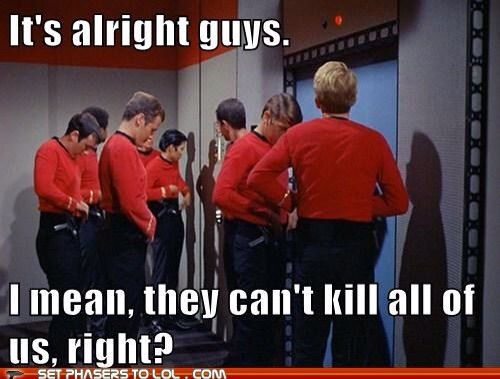
Little did those red shirts know, they were standing in front of the airlock instead of the elevator. Oops!
Seriously though, character deaths have been a phantom looming over my head since the beginning of Legends of Windemere. Due to the plot that involves destiny and showing that previous champion groups were undone by death, I couldn’t really do anything to my main heroes. So, I’ve been terrorizing the supporting cast with a few really big deaths scattered about. Ritual of the Lost Lamb had the most, which was a tough book for me to get through. This hesitation has been called a weakness by some because they feel fantasy needs a high body count with the main heroes always on the chopping block. Needless to say, I disagree with this being the only way. If it works for your story then reap away until you have to by a new scythe. Just don’t expect everyone to write that kind of story.
My personal belief on character deaths is that they need to be memorable, but you can eliminate that if death is more common than using ‘the’ in a sentence. People will stop connecting to your characters because they’re expecting them to die. You create distance between the reader and story, which makes it more difficult to draw them along as events progress. Think about how jump scares in horror movies work for a bit, but you will run into a point where the audience doesn’t react. The music, camera angle, or something gives them a warning. This can happen with character deaths too. You see a character in trouble and you no longer wonder if they’ll survive. You assume they’re as good as dead and already step away. So, you do have to be careful with the killing.
Aside from it being memorable, there needs to be a purpose for the death instead of shock value. Does their demise push another character to do better or hinder another’s chance to push ahead? Was it a sacrifice or an accident? How will the other characters handle the death? All important questions that come back to purpose and importance. If a hero dies and nobody cares then the reader won’t either. If an ally sacrifices himself to open a plot door, which is immediately locked or ignored then it’s an obvious waste. Killing for the sake of killing only makes the reader consider that the stakes are higher, but they might not consider the deaths memorable. It can almost become part of the background.

Yahoo Image Search
All this being said . . . *gets off soapbox* . . . I had to unleash the Reaper on this final book because it was the end. I saw no way to explain all of the champions pulling off a victory and remaining unscathed. The Baron is scares the gods, which means he has the power to kill once he takes things seriously. I already established in The Compass Key that at least one champion was slated to die in the battle. There were plans that involved various combinations of deaths and injuries that I didn’t finalize until the final writing. Was it hard to decide on who to kill off? Of course, because I also had a future prepared for each one in case I decided to let them live. Even the Baron has a living and dead path that I decided on since it’s always been a possibility to end on a downer.
Maybe I overthink this part of the story, but death is an important piece of life. It’s the only certainty and we have very little control over it in reality, but we are the masters of it when we write fiction. As weird as it sounds, I consider that I’m acting like a God of Death for my characters during this time. Not the good or benevolent kind that simply harvests when it’s time, but the one that decides it’s time to go. Yeah, that does sound a little egotistical. Still, you can’t deny that death is typically the end for a character. Their story is done and they have reached the end of their evolution. Even if they show up as a ghost or vision, they won’t grow any more. No more dreams to reach for either. It’s a sad fate to place a character into, which is why I don’t take it lightly
For anyone thinking that resurrection is possible, you are right. Only problem there is that making it easy to revive the dead means death has no impact. It has to at least be something you work hard to achieve or come with so many risks that it isn’t any wonder people don’t do it all the time. For example, resurrection in Windemere requires a powerful priest or priestess as well as a person with an extremely close connection to the deceased. They have to know the dead in and out to bring their spirit over and help it bond to the body. Any doubt or mistake will lead to an undead being born and a backlash that can kill the living involved, which is why it isn’t done very often.
So, those are my thoughts on character deaths. I’m finally in a position where I’ve had to take out some of my heavy hitters. What do you think about this topic? How easily do you kill off your characters?



 on Just Publishing Advice: