
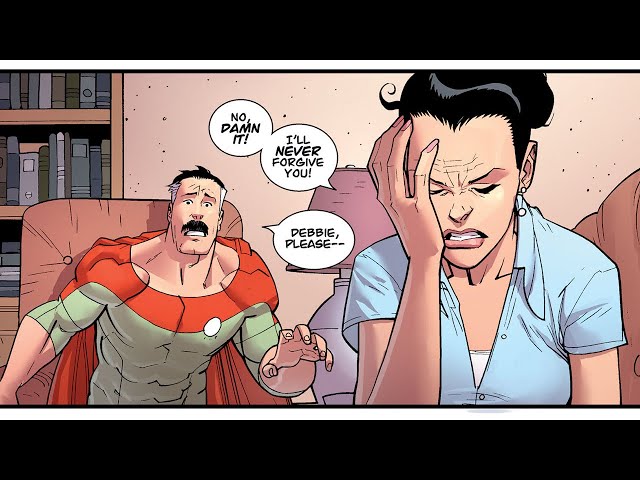
Omniman from ‘Invincible”
Now, I don’t remember the character that made me wonder about this topic. It can fall into various categories with high body counts:
- Former supervillain
- Hero who was a soldier
- Monster that gains humanity
- Serial killer who gets a second chance
To be fair, the categories can keep going. The central point is that you have a character who lived a life of violence. It was either before or during the story, but they reach a point where they feel remorse for their actions. This sets them on a path of redemption, which may require some forgiveness. The question of if they even deserve it comes up because their past actions are fairly heinous. It doesn’t only cause the other characters to decide on forgiveness, but the audience too.
I feel like that’s where things can fall apart. While an author can have a hero find a reason to forgive a remorseful former villain, audiences aren’t easily manipulated. Many people, especially these days, will refuse to forgive a villain who hasn’t given a reason for why they were killing. Soldiers who only killed other soldiers will find it easier to gain redemption than a serial killer who murdered innocent people. Having a hero forgive them can derail the entire story too because people will see them as weak or the overall story being stretched.
A factor here is also if the audience sees the violence or simply hears about it. If it happens prior to the story, there’s a distance that helps with garnering sympathy. One only knows the former killer who seeks redemption instead of the person that took lives. Even if they say they enjoyed the act at the time, we don’t get the full picture. There isn’t a description of their face or voice reveling in the deaths. The overall brutality of their actions are missing as well. It becomes harder to forgive if you see all of that because you wonder if that is the real person and this one is a facade.
Forgiveness isn’t permanent either. After all, this doesn’t mean the other characters and audience forget what happened. Any slip can push this former killer back to the beginning because trust will be lost. If it happens enough, they may just go back to their former habits since they feel incapable of changing. Honestly, one can see how this would happen in real life too. Continue making a person feel like their worst self and that’s how they’re going to be. So, an author has to be careful in having these characters commit any level of violence. Perhaps one can think of them as an addict who needs to avoid or minimize exposure to what they were obsessed with.
Personally, I like the idea of a killer gaining forgiveness, but there is a limit. If they killed hundreds of people for fun then that’s a hard redemption to pull off. While it wasn’t that big a number, Lloyd Tenay in Crossing Bedlam touched on a bit of redemption, but only with Cassidy. To be fair, he kept killing because he was now in a world ruled by violence and nobody really remembered his crimes. So, you can create a ‘redemption’ by having them face those who commit even greater atrocities.
Beyond that scenario, I think you do need to consider the reason for a character being so violent. If they did it for fun or out of boredom, you aren’t going to get very far. Forgiveness is easier if you have it be a war, survival, not knowing any better, or other situations that don’t revolve around their own enjoyment. People will feel like they didn’t want to kill, but HAD to do it. One can muster forgiveness for that because they come off as a victim as well.







This is an interesting topic. I think there is a difference between forgiveness and consequences. A person with a violent past can be forgiven, yes. But he or she might still face the consequences of his/her actions. A person can be verbally abusive and still not safe to be around even if forgiven.
I’ve seen readers react to some YA novels where the bad boy “hero” was verbally and sometimes even physically abusive to the heroine. Yet because he was so hot, all was easily forgiven by the heroine. Forgiveness came across as cheap and unearned, rather than costly.
LikeLike
I’ve heard that YA trope is pretty bad. Though I’ve seen it in real life. I think forgiveness also had a hurdle when it comes to personal opinion on consequences. Everyone has their own thoughts on what a punishment should be, so you’re bound to upset someone.
LikeLiked by 1 person
Very true. Case in point: an author made some remarks in a recently published book that upset many authors, who took to social media. Weeks later, that author still has not been forgiven. His apologetic remarks afterward were dismissed as insincere. So, some readers, as you mentioned, might not believe that a person is deserving of forgiveness.
LikeLike
That seems to happen a lot. Any attempt at any apology is met with an accusation of insincerity.
LikeLiked by 1 person
I’d like to think that every bad person deserved forgiveness and a second chance, but some people are so evil that they are beyond redemption. Could I forgive Ted Bundy? Jeffrey Dahlmer? Hitler? I wonder at the parents who forgive their child’s killer. Would I be able to? I hope I never have to find out.
LikeLiked by 1 person
I’ve read that parents who forgive their child’s killer do it more for themselves. It helps with closure and releasing the pain.
LikeLike
This is an interesting topic. I wonder if there are some real world research options. Those who ate their fellow passengers high in the Andes come to mind. I wonder how the rest of their lives played out. They might not have been killers but that tends to color the rest of your life.
LikeLike
Tough one. They were pushed to their limits and beyond for survival. I think that differs from killing out of fun or to hurt others.
LikeLiked by 1 person
I think the test is HAD to kill not wanting to kill which is the line for realistic forgiveness.
LikeLike
True. Though, I think another line to consider is if they were killing ‘bad guys’. That’s always a wrinkle because it brings in morality.
LikeLiked by 1 person
True
LikeLike