
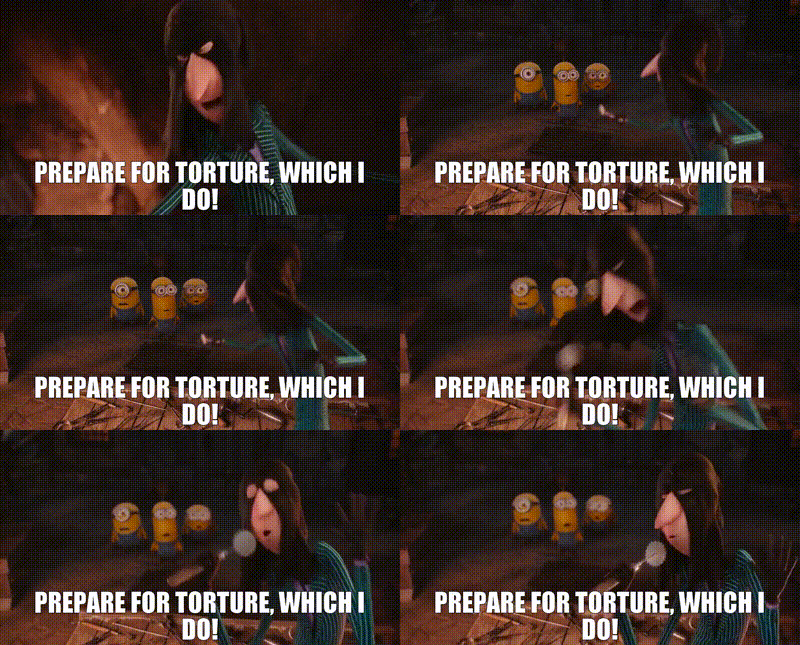
Minions!
I’m sure most people can think of a story where the heroes are captured and about to be tortured. Sometimes they don’t escape in time, so pain gets inflicted. I did that several times in my two series. Didn’t even think twice though, which now strikes me as odd since torture is horrible. Yet, it’s so common in fiction.
There are three reasons that I can think of for this:
- The villain is shown to be ruthless and evil. Most people see torture as one of the worst things you can do, so it solidifies the villain’s reputation. It’s makes cheering for them much more difficult because you have to rationalize these actions. So, authors can do this later in a series if they feel like the villain is becoming more popular than the hero while still being evil.
- A hero who withstands torture gets a boost to their toughness. Even if they were proven to be durable and strong before, the readers now see that they can hold up to extreme pain. Think about how we feel about real soldiers who were captured, tortured, and survived without breaking. They are rightfully called heroes and gain respect. So, a watered down version of this happens for the hero.
- The opposite can happen as well if you want your hero to break or a supporting character to ‘betray’ without turning villain. For the hero, you now have a recovery arc while they try to regain their courage. It helps if they’ve become so strong and brave that you can’t reasonable write them losing. Now, they’re back to the start. With the supporting character, they may have already been seen as weaker, so them giving in to torture isn’t surprising. It garners sympathy though and allows the villain to get an advantage without sacrificing another character.
So, there is definitely a use for torture in terms of story and character development. It’s still a difficult tool to use because it can be triggering. People who have trouble seeing others in pain might have a hard time with such scenes or turn off to the book entirely. I think this makes the use of torture a gamble and should be considered very carefully before being added. There are other ways to have a villain come off as evil without going this route.
As stated, I’ve used torture before in my books. The champions in Legends of Windemere seemed to find themselves in such situations a lot. Probably the roughest torture scene I wrote was with Luke Callindor, which made me feel gross afterwards. I still stand by it because I needed him to go through a trauma for the rest of his story to make sense, but it’s rough. Taught me that empathy for my characters could make such things tricky, so I had to turn it off for a bit.
So, what do other people think about the use of these scenes? I know many won’t want to go near them, especially if you don’t like specific genres.




 Legends of Windemere
While I don’t relish reading torture scenes, I have seen them used in books and movies (Seems like James Bond is capture and tortured a lot.) I’ve also seen depictions or discussions of torture in nonfiction works like documentaries. They showcase the evil. Samurai Jack, one of my favorite TV characters, was tortured a lot by Aku.
LikeLike
James Bond definitely comes off as having a card where he gets a free vodka martini after every 10th torture session. It’s interesting for people to complain or have issues with torture being used in nonfiction though. Such actions happened all through history and still go on today. It really shouldn’t be pushed aside and forgotten, but being gratuitous could be an issue.
LikeLiked by 1 person
Gratuitous torture is a factor. I’ve heard some movie reviewers describe some movies as “torture porn.” But if a story is about a person who survived a prisoner of war camp, some scenes are expected.
LikeLike
I feel uncomfortable reading about extreme pain and I’m not a fan of gore, but I’m not actually triggered by it. The kids in my WIP are threatened with torture by malicious spirits, but they manage to escape before it happens. I’m hoping it’s not going to trigger my readers – it seems hard to avoid triggering people sometimes.
LikeLike
Triggering people seems fairly easy these days. It isn’t only gore, sex, and extreme violence like decades ago. Authors have to be careful with language and how characters emotionally treat each other now.
LikeLiked by 1 person
It’s gone a bit far, I think. A book in which everyone was nice to each other all the time would be really boring.
LikeLike
Works for kids books, I guess.
LikeLiked by 1 person
I have read some horrific torture scenes and prefer scenes whee the torture is implied.
LikeLike
Implied is the safest way to go. I try to do that unless I want to demonstrate how evil the characters are.
LikeLiked by 2 people
Good use of torture.
LikeLike
I love to read historical fiction and often run into scenes of torture that are gruesome. I have to skip over them – I find it hard to believe that anyone could inflict such horrible pain on another human being. Better to have it implied or skip over it to after the torture.
LikeLike
Sad thing is that people would totally harm another in even worse ways than authors conjure up.
LikeLike
And that is absolutely true.
LikeLike
I wrote one years ago where my antihero performed some creative dentistry on a fellow. I have a new character who could take a similar path eventually.
LikeLike
How did readers react to it?
LikeLiked by 1 person
Readers loved the guy and I still get occasional comments about him.
LikeLike
That’s good.
LikeLiked by 1 person
Like you said, torture can be used to show that the villain is really evil, and it can be used to put the tortured characters through a change. I think it also gives readers (those who aren’t repulsed) an adrenaline hit that some writers seem to think the readers want.
LikeLike
I know some readers who would get that adrenaline hit. Part of it is them distancing themselves from the act while staying immersed. A desire and expectation for the victim to survive seems to pay a part too.
LikeLiked by 1 person