
Futurama
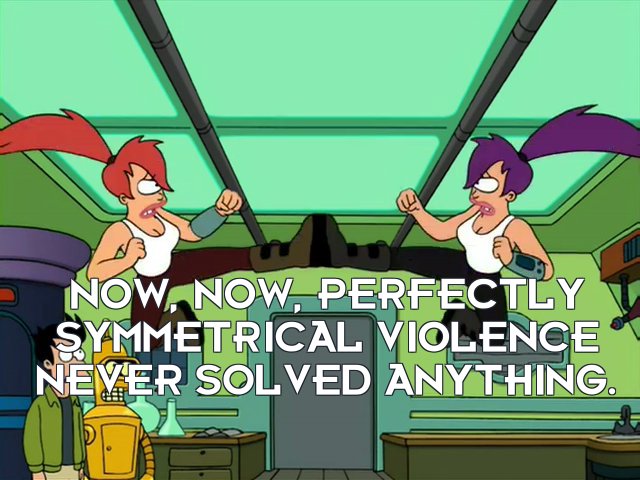
Now, this is different from a character fighting their evil twin or a clone. In that scenario, the combatants are identical in most, if not every, way. A mirror match differs in that they characters are opposites in some fashion. Could be appearance, but usually includes powers and behavior as well. So, how does this work in fiction?
This tends to be found primarily in fantasy and science-fiction, but it can pop up in other genres. The concept revolves around the character facing their dark side. It touches on the idea of a person facing their inner demons, but giving them a more corporeal form. I find this to be rather blunt and on the nose, which works out for some readers. After all, you can get overwhelmed by the general concept and miss the meaning. Not that you have to make is so obvious.
I’ve found that this is done in one of two ways:
- The mirror character is created somehow over the course of the story and turns into a challenge for the original. It can either be the main villain or a short-term enemy designed to make them face some weaknesses. This mirror character can be lacking in personality and urgency since they are used almost entirely as a plot device instead of a three dimensional entity.
- An individual character appears or is around from the beginning. They just happen to be the opposite of the hero in powers and personality. I see this a lot in comics as far as personality goes. Makes for a great archenemy. They can be seen as their own person as well since they weren’t ‘born’ from the hero. You can add more nuance to their behavior as well without losing the general connections.
One thing I’ve noticed is that the mirror match doesn’t always go with different powers and abilities. I know I said this is an aspect, but you can run into an issue. For example, if the hero is super strong and durable, you can’t have a villain who is super weak and fragile. I mean, you kind of get that in ‘Unbreakable’ where Bruce Willis is indestructible and Samuel L. Jackson is easily hurt. Still, this is a rare situation since most authors try to avoid such wide power gaps. People go more for secondary powers or personalities, which still gets the job done.
In fact, I would say that the characters having opposite personalities is more important than the powers. This is where the mirror match has its strengths. You can see how a person with the same abilities, skills, and powers would operate if they had the opposite personality. For the characters themselves, the hero can get a glimpse of how they would be if they fall from grace. The villain can actually develop a sense of jealousy since they are mostly the same, but the hero is beloved. It creates so much emotional and psychological turmoil that you can have a lot of fun with the concept.
For myself, I kind of did this in War of Nytefall: Savagery where Alastyre and Clyde faced off. Both are incredibly powerful and violent, but Alastyre is more of an open monster than Clyde. This was done primarily to create a big challenge for our heroes, but it also showed what Clyde could become if he lost all of his humanity. This didn’t always come off as clear during the story, which is my own fault. I tried to leave it up to the reader to notice. I’m going to have a similar situation with Sin when I get to his series, so I plan on making the emotional side of things more overt.
So, what do people think of this mirror match concept?




 Legends of Windemere
Your post reminded me that I have read a book with a mirror match. Can’t think of the name of it, but it was a page turner.
LikeLiked by 1 person
Glad it was done well. Hard to pull off.
LikeLike
It was a crime thriller..
LikeLike
I think the mirror match makes the story a lot stronger and certainly more exciting. We are always waiting to see how the so called opposites can better the other.
LikeLiked by 1 person
Keeps the fights even too.
LikeLiked by 2 people
😊
LikeLike
Interesting concept that I haven’t given a ton of thought to. Thanks for this.
LikeLiked by 1 person
You’re welcome.
LikeLiked by 1 person
I’ve never used it, but I’m reminded of A Wizard of Earthsea, where the main character, Ged, unleashed a dark, shadow version of himself. He was compelled to battle it. I’ve seen that concept in other works.
LikeLike
That reminds me of Dark Link fights in Legend of Zelda.
LikeLiked by 1 person
I ran into this in a Starfinder game once. Everyone in the group had to face their double, with the exact powers and appearance. It sounds dramatic but… Nobody fought their mirror image. Our whole group knew who our strongest, most dangerous member was. We ganged up on that duplicate right away!
This also reminds me of the folkloric doppelganger, an evil magical creature with identical appearance to the original. With the doppelganger, its goal was to semi-vampirically drain the life from its victim, and eventually take their place in the world.
LikeLiked by 1 person
I remember a few doppelgänger legends. My favorite was how just seeing it meant you would die. Didn’t take your place or anything.
Sounds like the mirror match concept didn’t go like the DM expected.
LikeLiked by 1 person
Well, we are a pretty experienced group. I’m sure other players went after their doubles, or had some other strategy.
LikeLike