
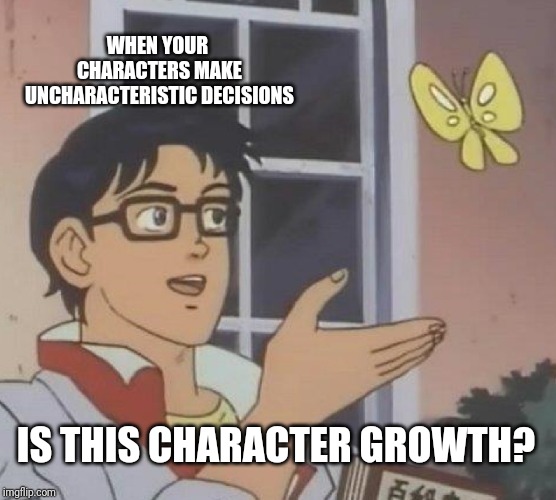
The above question does come up when you see a character acting in a way that they really shouldn’t. For some authors, this could be growth in that a risk is being taken. Yet, that doesn’t always come off correctly. What are some ways that you can have this make sense and show growth?
- If this is an action they would have taken when younger, you will be having them move backwards. Keep this in mind because it will be noticeable. This tip is more about the core of the potential issue. Remember that you are pushing development in reverse to hopefully move the plot.
- The problem with an ‘uncharacteristic’ decision is that it snaps readers out of the story and may turn them against the character. Establish conditions that can explain why they are not acting as smart or mature as they should be. There could be a time constraint that makes them panic or they are working under incomplete information, which leads to the decision.
- While it isn’t the best idea, you can explain why they took such actions after the fact. It could be a conversation with other characters who have the same concerns as the readers. This draws people back into the story since their questions are going to be answered. It also means their confusion and shock were created on purpose instead of an accident.
- Avoid having these characters make the same faulty decision multiple times. This comes off as sloppy and that the character has no consistency. People will see them acting mature unless the plot needs them to forget they have a functional brain. So, a mistake should be done, analyzed, and learned from to avoid it happening again.
- The villains need to be careful about making uncharacteristic mistakes as well. One that is cunning and careful won’t make obviously stupid decisions. They will not take any risks either. This is why many villains are given bloating egos and a sense of superiority, which blinds them to the possibility of a mistake. For example . . . Every friggin’ James Bond villain.
- A way to set up an uncharacteristic decision is to have someone slowly convince the character to do it. This explains why they are going to do something that they normally wouldn’t do. It also shifts part of the blame for the incident to the one who pushed for the decision. Yeah, the character still take action, but they come off as being manipulated or at least strongly coerced.
- Having them go ‘My Bad!’ doesn’t solve anything.




 Legends of Windemere
Spot on advice, Charles, and even though readers may not describe the problem and solutions as eloquently as you’ve shown in this post, many stop reading. Thanks for helping us find solutions to the problem.
LikeLike
True. Some people stop without knowing what turned them off. It’s just a sense that a story ruining mistake was made.
LikeLiked by 1 person
Well said, Charles. Nothing worse than an out of the blue action with no rhyme or reason.
LikeLiked by 1 person
It’s downright maddening.
LikeLiked by 1 person
It is.
LikeLike
These are good tips and well worth considering.
LikeLike
Thanks.
LikeLiked by 1 person
Very good points.
LikeLike
Thanks.
LikeLike