
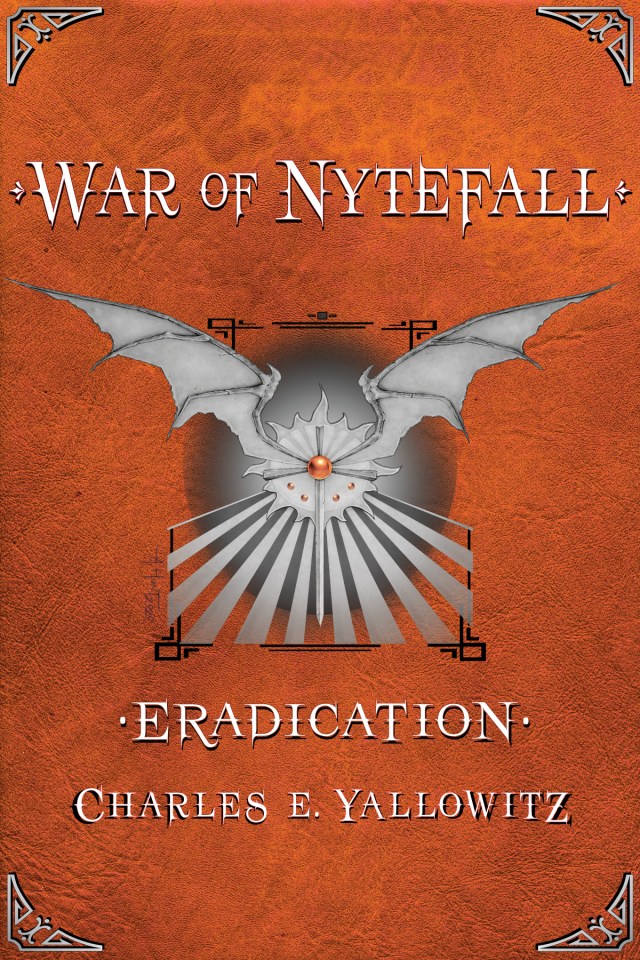
Cover Art by Alison Hunt
Eradication is probably the hardest book to really go into details about. It isn’t that it’s complicated or confusing. The crazy plans of various villains in War of Nytefall are in every other volume. This one is actually fairly straightforward. So, we’ll see what I can do without using spoilers.
The vampire civil war has been on a two year truce, which has given Clyde and Mab time to enjoy their relationship. Now, the Dawn Fangs have a problem with a Duragian priest named Leo Kandrel. He is wielding a weapon called the Fist of Durag, which is a powerful sun magic weapon. It’s being used to destroy Dawn Fangs, so they are facing both exposure and extermination as Leo’s army grows. One of the worries is that the rumors of it being strong enough to kill Clyde is true, which means he could be defenseless against this enemy. Part of his time buried underground is revealed since the Fist of Durag was created in the same accident. The story also ends with the Dawn Fangs suffering two major losses.
A major plot point is that early on it’s revealed that Mab is pregnant. She tries to keep it a secret after Lost telepathically gleans it and Chastity just knows. With a big battle on the horizon, Mab doesn’t want Clyde to be distracted. Makes sense, but it also means she is routinely diving into combat to keep up appearances. Not a smart move since Dawn Fangs aren’t immune to miscarriages and other birth problems. This is another aspect that shows they can be very human even with their monstrous abilities. In fact, I felt that this gave the species a level of vulnerability that you don’t typically see in immortals.
Eradication did allow me to highlight more of the Dawn Fang team since I had most of Xavier’s people stay out of the situation. After all, the threat was primarily to Clyde, so why bother getting involved before one side takes out the other? Anyway, I got to use Bob and Luther more often as well as establishing Lost as a Vengeance Hound. This made up for Mab and Titus overshadowing the rest during the previous volume. Those two are still involved, but they were no longer sucking the energy from every scene. Definitely learned how to balance such a massive cast with this book.
As for the main villain, Leo Kandrel kept changing personalities on me. I never had the tightest grasp of him even when doing his character bio and seeing what tidbits would appear. Sometimes he would be confident and sure of himself, but then he would be on the verge of panicking. His wisdom and cunning weren’t consistent, which I realized depended on his stress levels. This is what led me to questioning if Leo Kandrel was in charge or the Fist of Durag was calling the shots. I liked how this made his fluidity part of his mystery and even had me guessing as I kept adding clues for both answers. He’s still the first villain to deliver a major blow to Clyde’s side though. So, the squirmy priest has that going for him.
What would I change in Eradication? This comes down to the one thing I was trying to push, but failed. I wanted Clyde to be more scared of the Fist of Durag than he was. It was an unknown weapon that might be the one thing that could truly kill him. I wanted Clyde to be afraid for his life, but I had made him both confident and cautious at this point. He wasn’t emotional enough for what I wanted to do and I didn’t try very hard. Makes sense since I established that he was careful with his emotions to make sure he doesn’t lose control and go full monster. My own character development arc undid my plan for this book, which is why I could only give him moments of doubt. Part of me wonders if I should have shed the whole issue and left him utterly confident.
Question time!
- Should fiction, including fantasy, broach sensitive, personal topics?
- Why do you think people get sucked into cults?
- If you could say one object is your weakness, what would it be?




 Legends of Windemere
LikeLike
1. Fiction can definitely be therapeutic. Probably done more than we realize.
2. Interesting theory. Also how a cult member openly approached you because you looked lost.
LikeLiked by 1 person
With regard to #1, I think fiction and fantasy can include personal and touchy subjects if the author wishes to include them and can do so in an affecting way. I agree this can be therapeutic.
2. I think people get sucked into cults because they are missing a sense of belonging in their lives – lack of supportive family, lack of confidence, lack of any sense of community. The support and acceptance they feel will make them agree to many things they might not agree to if they were not part of the cult.
3. Editing. I will do almost anything to avoid it.
LikeLiked by 1 person
Very good points on #2.
LikeLiked by 1 person
Including sensitive personal subjects is a personal choice. There is no reason not to, and it could make the story better. Cults tend to offer something a person is missing. It’s likely different for everyone, but also a common thread. I have so many doubts I wouldn’t know where to start.
LikeLike
You have doubts about where you should start talking about doubts. Thats rough.
LikeLiked by 1 person
How interesting to tread the line of whether the Fist is in charge or the one who bears it. This is something authors might not think about as they casually flash around some ancient relic.
LikeLike
My mind kept going back to ‘The One Ring’ from LOTR. It had some sentience and corrupted its wearer. There were times it seemed like it controlled them too. Always thought that was a nice twist. Plenty of D&D relics do that in games. Not enough in fiction.
Never thought of someone broaching a sensitive topic for spiteful reasons. Guess doing it to get people upset wouldn’t be good in any way.
LikeLiked by 1 person
You could intend to upset people so they would think about the issue. Ie: with the war in Gaza, you would want them to think about whether the civilian casualties are justified.
In the fantasy domain, Stormbringer in the Elric series is a good example of an artifact sword that killed people Elric didn’t want it to.
LikeLike
Upsetting people seems to backfire these days. I don’t see many getting upset and thinking about the issue that triggered them. They fixate on their own emotions and pull into their bubble. Then they lash out at the source because they don’t like how they feel.
LikeLiked by 1 person
Authors do have to think about the backlash, unfortunately.
LikeLike