
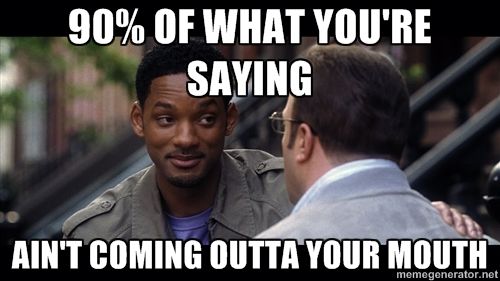
Guess this is from ‘Hitch’?
I’m always surprised by the amount of people who forget that non-verbal communication is more potent than verbal. As authors, we can easily forget this because we work with words and think of their power. We focus so much on the ‘perfect’ words to use to carry our stories that we can get tunnel vision. So, we don’t necessarily include the other aspects of communication when writing. This can make a scene stiff and bland because the reader might imagine all of the characters being wooden. Not the way we want to go and it’s easily overlooked.
Nonverbal communication is essential because it can trigger responses from people without them knowing why. Eye rolls, crossed arms, sharp voice tone, and the like will make a person become defensive. Smiles, gentle touches, soft voice tone, and a relaxed posture will put someone at ease. It is a power that all humans have over each other, but not everyone understands or controls. Once we are in an emotional state, we tend to let nonverbal communication go wild too. Another reason an author might not remember to utilize these categories.
There are apparently five types of nonverbal communication, but the fifth is physical appearance. I won’t be touching on that one since character descriptions are typically done and cover this. The others are what we can forget.
Haptics or Touch
This is any physical contact made between characters. Punches and slaps are obvious ones since they denote anger. We don’t really think twice about these, but there are less violent ones that get the same treatment. I’m talking about romance here. Caressing a cheek, hugs, kisses, and holding hands show love and affection. These can be done in a less romantic method between parent and child to show tenderness and care. We all know how these touches feel or should feel, so we can relate. There are others that we might overlook as well. For example, I use shaking hands and touches to the shoulder to reveal comradery. People take these for granted in real life since the emotional reactions are almost instinctive.
An important aspect for haptics is duration too. The length of contact can tell a reader the depth of the connection. A small pat to the shoulder can mean ‘good job’ between two people. A longer one may mean ‘I am here for you in your time of need’ without any words being said. Kissing is another example since we have pecks on the cheek, quick ones to the lips, and full-on tonsil hockey. Each one has its own meaning.
Finally, not touching can mean things as well. This makes this aspect of nonverbal communication unique. If a person refuses to touch another then it could mean hatred, fear, disgust, or even anger. This shows that not doing something in a given situation can communicate an idea just as much, if not more so, than doing it.
Voice
When writing a dialogue, you can adjust your tags to show the tone. Yells, screams, whispers, coos, exclaims, mentions, and the rest of these words can go a long way in showing emotions. In reality, we hear this aspect from the volume and tone of a person’s voice. It can make us react to what is being said more than the words themselves. A sharp tone can hurt even if it’s being done with a compliment since that could be perceived as sarcasm.
Type of voice can be helpful too. We react more positively to those who have a naturally soft and calming voice. Those with more of a rasp or growl can put us on edge. This cannot always be controlled by the speaker too. It’s why voice tone cannot be solely depended on until you get to know a person. Once you discern their natural timber and tone, you can figure out when there are changes to their mood.
Body Language and Gestures
This covers a lot of ground. Posture, arm movements, space from people, firmness of handshake, and general physical demeanor fall under this category. The thing is that we all know about body language and gestures. We are taught about this from a young age such as sitting up straight and no hands in pockets during conversations. It’s stated as good manners, which are to make a person friendlier in appearance and not cause others to feel distressed.
A challenge here is that various gestures and body languages mean different things in different cultures. Some people are okay with wide arm movements or a lot of gesturing with the hands. That is normal to them. Others can be reserved and see such things as rude or aggressive. Authors have to pay attention to this possibility and add other nonverbal cues to body language to clarify what they mean. For example, a character who swings his arms while explaining something can be shown as excited by giving them a wide grin.
Facial Expressions
Finally, we have facial expressions. This includes eye contact since those are part of the face. Similar to body language, we tend to have an innate understanding of this, but don’t always add it to our stories. Part of this could be due to us not always noticing when a facial expression triggers us. We always recognize smiles and frowns, but subtle variations can bypass our senses to set off our instincts. A smirk can make one uncomfortable even if they don’t realize it’s that instead of a smile. This is a big reason why nonverbal communication is so essential to our species, but not talked about or taught like one would expect.
A lot comes from the eyes too. The length and solidness of contact can be the difference between intimidation and romance. Avoiding eye contact is a sign of nervousness, shame, or inferiority. I think this aspect of nonverbal communication can be very useful since we hear about it in regards to animals. Don’t stare into the eyes of a predator or they may see it as a challenge. Stare into a prey animal and they might freeze to see if you’re going to try to eat it. Probably isn’t that different when doing the same with humans.




 Legends of Windemere
I remember how you used the shoulder pat between characters in scenes. 😊Good topic!
In a video on the making of Dune 2, the director mentioned “eye acting.” He kept dialogue to a minimum to focus on the nonverbals—the movement of the eyes and other gestures to indicate emotion. One of my favorite scenes in that movie had hardly any dialogue. Yet the emotions each character in the scene felt (fear, desperation, exhilaration) were easily understood. An eyeroll in Puss and Boots: The Last Wish showed exactly how a character felt without her having to say anything.
LikeLike
Very cool. Makes me think of silent movies too.
LikeLiked by 1 person
Yes! I remember how well emotion was conveyed in the silent film, The Artist (2011).
LikeLike
Excellent points!
LikeLiked by 1 person
Thanks.
LikeLike
Terrific, Charles.
LikeLike
Thanks.
LikeLike
Good stuff, Charles.
LikeLike
Thanks.
LikeLike
In the healthcare environment, we often “overlook” the non-verbal aspect of our communication!
In my blog: empowerpaediatricpatients.blog this aspect comes into focus!
LikeLike
I feel like the aspect gets ignored in education too. Part of it could be having to handle 25-30 kids at once. Takes time and focus to fully get nonverbal cues.
LikeLike