
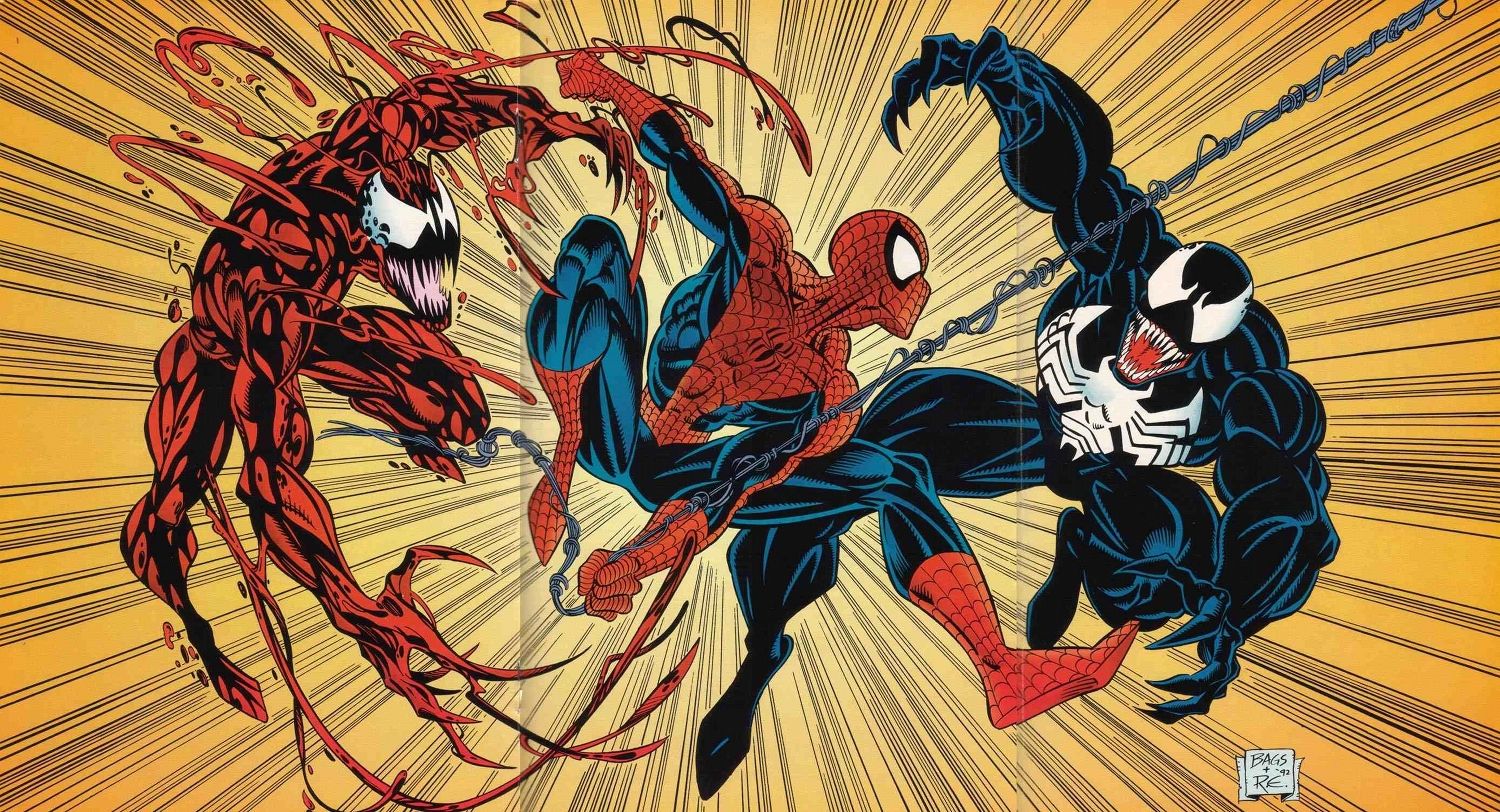
Spider-Man, Venom, and Carnage from Marvel Comics
There are some villains that are very close to being heroes or simply consider themselves heroes. A good example is Venom who used lethal methods to get to Spider-Man, who he considered a bad guy. Eventually, he went the anti-hero route and then I stopped paying attention because there were nearly a dozen symbiotes running around. Still, one could see how Venom was able to do what he did and still think himself as a hero.
This has me thinking about a few of my villains and why they’re categorized as such. The Lich, the Hellfire Elf, and Stephen are evil even though two of those guys have some redeeming qualities. None of them consider themselves heroes. Yet, Queen Trinity does because she fights for her people even if it means doing bad. There’s an interesting mentality to this because she’s aware of what she does. Not every villain that borders on hero or thinks they are one have this level of awareness. Still, this does lead me to compare Trinity to someone like Nyx who fights for her loved ones. What makes one a hero and one a villain even though they strive for similar goals? Another comparison could be looking at SHIELD and Hydra, both of which want to protect humanity.
It’s the methods that make them different. I really began thinking of this when watching ‘Once Upon a Time’ and seeing how every character wanted their happy ending. The heroes, typically, went with the purer route that didn’t hurt others. Except for the villains who always had that ‘deserved it’ thing. Never go for what you want at the expense of others unless they’re evil, I guess. On the other side of the coin, the villains will sacrifice others, lie, steal, and kill to get what they want. They might not see a problem with this because they claim a means to an end that benefits all. Most times this is to create a new world order that is really a hellish villain-scape. I guess there’s a level of blindness or blissful ignorance for a villain even if they don’t openly act like it.
This is still an idea that I’m toying with as I create villains for other series. Even darker heroes like a whimsical serial killer that travels with others after anarchy reigns. The desires are sinister, but there has to be something in the methods that keeps such a character on the side of the good guys. Not as easy as I used to think.



 Legends of Windemere
Definitely not easy. The Jesuits are much maligned for their notorious phrase, “the end justifies the means.” It sums up nicely whether someone’s a hero or a villain. There was a great DS9 episode, where Sisko gets off his chest a Federation-sponsored assassination; don’t know if you’ve watched that. In Galactica, the same topic is handled differently, when Adama refuses to commit crimes to save humanity, wondering, “if we do that, we’re no better than them, so what’s the point of saving us?” (I’m paraphrasing, since it’s from memory, but you get the drift).
LikeLike
I watched a lot of DS9, but it’s been years. Don’t remember that exact episode. It’s kind of funny how fictional characters seem to get the ‘don’t fall to your enemy’s level’ more than real people.
LikeLiked by 1 person
Lol – I guess it’s easier to be high-minded when it’s not your own a$$ on the line, but a character’s 😀
LikeLike
True. We do seem to want our fictional heroes more noble and perfect than reality.
LikeLiked by 1 person
Gives us something to aspire to. Isn’t that part of fiction’s appeal?
LikeLike
That and escapism. At least for me.
LikeLiked by 1 person
Plus a safe place to explore ideas.
LikeLike
“What makes one a hero and one a villain even though they strive for similar goals?” Great question. And in regard to your villainous characters, I have seen their redeeming qualities. 🙂 I agree that many villains don’t think of themselves as villains. They seem themselves as heroes for a cause. Others just know they’re straight up villains, because they’re fighting for their own enrichment.
I’m working on antagonists who have a moral code. I like antagonists who are likable individuals though they wouldn’t hesitate to kill the hero.
LikeLike
Trying to think of a good example of a moral antagonist. Though most times their code is highly twisted.
LikeLike
Thanos?
LikeLike
Not sure about him. Comic book characters are tough in general because a new writer might remove that code. Like Venom who would kill only those who are ‘evil’ or in his way with Spider-Man. Then an author will take him and he’s almost as bad as Carnage.
LikeLiked by 1 person
True. Some authors have their own agendas.
LikeLike
Hmmm, I’ve never considered Hydra as wishing to protect humanity. More like dominate!
LikeLike
The speech by Zola in Winter Soldier. He mentions that they wanted to guide humanity to their next stage of evolution, but they did it wrong the first time. They attempted it by force and it failed. So they set up a system from within SHIELD to create paranoia within the populace, which would cause them to willingly give up their freedom for the illusion of safety. So while they have the methods of a villain, their intentions are, in their minds, for the good of humanity.
LikeLiked by 1 person
Um… No. That’s semantics. Perhaps the sort of excuse villains might use to convince themselves or others that they aren’t evil. Domination through force or domination through deception still benefit the dominators, not the victims. Hydra might have a good line of bull, but the group’s intention is evil, as are their methods.
LikeLike