
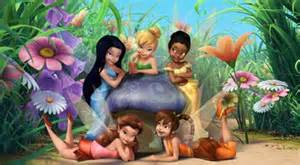
Tinkerbell and Friends
Family.
It’s a strange topic that doesn’t get brought a lot in Fantasy discussions. Sure, you talk about the family of characters in a book that deals with political intrigue and revenge killings. Yet, you still talk about them as a character and not the actual dynamic of that family. Sibling rivalry gets brought up as a plot device, but you rarely see the rest of the family and the rivalry tends to be in full swing by the time the reader arrives. So, what do you do if you want to include family without it being a rivalry or all politics?
For some authors, you go with incest. I’ll get that out of the way and leave it here where it won’t be touched on again.
You can make two characters related and have them act like family members. Siblings will squabble, but back each other up. Older family members will be protective and some arguing about being overprotective can occur. Realize that the sibling rivalry and hatred between family members that can be used a major conflict is an exaggeration of the normal versions. Tone it down to a point where the characters aren’t out to kill each other and it can work for character development.
One can realize that there are other types of families too, especially in fantasy. Here are some examples:
- Friends as Family– A common one is having your main characters bond to a point where they are practically family. They can even call each other brother and sister while showcasing the interactions typically found in families. Teasing, arguing, friendly rivalries, and other small side events can cement the bond between your characters.
- The Clan or Tribe– Used a lot with gypsies and barbarian and non-human species, this is really the idea of a close extended family. People are blood related in these groups, but there are other characters that are not related by blood. Those non-blood related are still treated like family, which is key for this. Now, this is easier to use when the clan or tribe are the focal point. If they are merely the grouping that the character came from then you use it to color that character’s social aptitude. They may be scared of outsiders or amazingly accepting of everyone. It depends on the culture you make for the clan or tribe.
- Build Your Own– This is for you necromancers and mad scientists. It isn’t unheard of for a villain to work with a ‘family’ of resurrected ancestors or constructs. An anti-hero can use this too, but we’ll focus on villain. Remember that villains can have families and some might be inclined to kill and rebuild their actual family. It’s straightforward and the main villain can show any level of insanity that he or she wants toward their non-quite-living relations.
- Orphan– Honorable mention since it’s been done a lot and you don’t need me to explain it.
A key point in writing with family involved, but not central is that you let them act naturally. Don’t force the family thing down the throat of the reader. They’ll figure it out when you have the characters call each other by familial names (mom, dad, sis, bro, etc.) and if they act naturally. You don’t have to be over the top with this. An occasional overprotective act or defiance can get you further than ‘I hate you, brother, and I’ll kill you with this magic sword’ scenes.
Some examples that just came to me: Fullmetal Alchemist (us against the world bond), The Ranger’s Apprentice (Halt & Will are not related, but their bond is amazingly well-written), and The Wiggin children of Ender’s Game (rivalry and love).



 Legends of Windemere
My husband loves Fullmetal Alchemist.
LikeLike
It’s a great manga and anime. Need to catch the newest one some day.
LikeLike
Really interesting. I suppose we are all used to just thinking about our main characters and sub-characters and it is definitely worth considering their family and the link. Great post thank you. 🙂
LikeLike
Thanks. I thought about this when I saw how some of my main characters call each other brother and sister without being related. Just kind of happened.
LikeLike
A lot of my fantasy series is based around family ties/bonds. Hell, the first novel in it is called Bloodlines!
By far my favourite “family” connection though is between two demigods who have a sibling rivalry that matches that of my own with my sister. We verbally abuse each other endlessly, often going a bit beyond our light-hearted intentions, but ultimately we have each other’s backs more than anyone else. The like it even more with these two demigods because their actual lives as humans were separated by centuries.
LikeLike
That’s a sibling rivalry that sounds more realistic than the ‘I want to kill you’ type. Those are always so extreme and contrived.
LikeLike
The first book has one of those with the main character’s brother wanting to kill him, but it’s quickly revealed that he’s being mind-controlled. 😉
LikeLike
Good reason. I hate the ones where it’s revealed the feud is over something stupid like a childhood squabble over a toy.
LikeLike
You ate the last ice-pop. I must kill you! But first I’ll start with all your friends and family. Hell, I’ll dominate the world while I’m at it.
LikeLike
Gotta love that ‘rational’ escalation. Although if it was the last grape or cherry ice-pop, I can understand.
LikeLike
Well then do I have bad news for you…
LikeLike
They never fight over the lime or orange.
LikeLike
They’re my go-to flavours. Perhaps we should become brothers, it seems a logical arrangement.
LikeLike
Eh, we could just skip to the rivalry which is what everyone wants.
LikeLike
Don’t tell me what to do, fool! A rivalry is only worth having if there is a hope of both sides fairing well, when we all know that I am the far superior one. Father told me and my army of minions concur. Oh, and did I mention you’re adopted and father loves our sister more than you?
LikeLike
Actually it was written in the will.
LikeLike
Love Fullmetal Alchemist!! I also think of Avatar. “Team Avatar” is like a family (and involves actual siblings). I like to write about characters who become like family to each other, because this aspect is true in my life. Though I have a family, I don’t see them often. My friends are like family.
LikeLike
I think the same way. Forgot about Avatar too. Going old school, you have Thundercats and a lot of ensemble cartoons where they are like family.
LikeLike
Most of the major characters in my series are a family. A few related by blood, some by adoption, there’s at least one marital bond in there…Actually, if one relationship in the series had gone a bit further, there might have been a second marital bond, as well: one between an antagonist’s father and a main character’s mother. Which come to think of it, is something that can come about in the editing stage…
LikeLike
I think I hear an author’s gears turning. 😉
LikeLike
Damn right! Or it could be a short story in that world, for now. Either one could be fun to work with.
LikeLike
I love the family structures/camaraderie in fantasy and ‘ensemble’ type stories. I’m the youngest of 5, but I’m the youngest by quite a few years, so the sibling rivalry thing never resonated with me.
In my own work, I have orphans creating their own family and then finding themselves in the middle of a clan, and how that alters the dynamics of already-established relationships. It’s a bright point for their overall ‘history.’
LikeLike
I do the orphan thing in my stories. I did notice that only three of my six heroes still have living family. Sort of. So I have to pay attention to family at times.
LikeLike
I have a scene in Cannibal Hearts in which James, who always believed that he has no living relatives, discovers that he has a sister. Rather than have it be a huge, life-changing event, it really doesn’t make any difference to him. He’s always been a loner, he’s comfortable that way, and the fact that someone shares his DNA is pretty much irrelevant to his life. (His comment is, “I hope she doesn’t lose a kidney–she’ll come after mine.”)
His reaction really bothers Godiva, who grew up in a close family and still deeply regrets that she can no longer see them since her body has changed to the point that they would no longer recognize her. She was expecting him to make a big deal about having a sister and when he shrugs it off she doesn’t quite know what to make of it.
Family means different things to different people. When you add in characters who aren’t human, it gets even more complex. I have always imagined goblins, for example, tending towards litters rather than single births, like cats and dogs. (There’s got to be some reason there are always hordes of them, right?) So a goblin character might have a dozen siblings, which could make the family unit the most important relationship in his life, but could just as easily make it easy for him to turn his back on his family and leave the tribe. (“There were so many of us kids I don’t think my folks ever noticed I was gone.”)
Then there are non-human methods of reproduction. In Heinlein’s “Double Star” there’s a through-away line about Martians being “conjugate-brother, a relationship so close that we can’t imagine it, since we don’t reproduce by fission.” The idea is that instead of giving birth, Martians split, like amoebas, and the two halves of the original Martian retain all the same memories up until the time of the split. Family lines, lines of descent, are therefore of supreme importance in the Martian culture.
On the other hand, we have Edger Rice Burroughs’ Martians, the green ones, at least, that come from eggs and are all hatched together in communal hatcheries so that the young have no idea who their parents are–the family loyalty is transferred to the tribe as a whole. (Which is why the bit about Tars Tarkas identifying his daughter as his is such a huge drama.)
Anyway, the point is that speculative fiction gives us the chance to change the rules of the world and see what happens. We can play “what if” with human relationships, and family is a big part of what makes us who we are. The relationship between a necromancer and her undead creations is similar to a mother and her children, but not exactly, and it’s that “not exactly” part where the fun is, in my opinion.
LikeLike
It is fun to twist the importance of family in the non-human cultures. Using goblins, I wondered about the horde thing, but also noticed that they were getting slaughtered in every fantasy book. So, I thought they reproduced like rabbits and had a strong family bound because they’re so fragile. They need to stick together to survive.
I like the clash of family focus that you mention for your book. Not every person has the same attachment to their family, so it can be a great plot conflict for character development.
LikeLike
One thing I haven’t seen too much in Fantasy is solo children. As I am an only child, I’m not able to relate with the experiences that people who have siblings had growing up. And in reverse, those who have siblings are not able to relate, generally, with those who grew up as an only child.
One thing I have noticed: the mentality of only child vs. sibling children. I’ve compared this between those I know who were the only child to those I know who are sibling’d. Those with siblings tend to have a more community-oriented mind, whereas the only child becomes the sole focus of parents, thus are more likely to care for and fend for themselves to a greater degree than those who have siblings.
LikeLike
Luke Callindor in Legends of Windemere is an only child. Beyond that, I’m stumped. Would Percy Jackson count? It does bring out a different mentality in them.
LikeLike
I didn’t think of Percy Jackson, oddly enough.
LikeLike
I think the hero of Earthsea and the daughter in Inkspell were only children too. Though, I’m really struggling to find ones. Very surprising.
LikeLike
Wait…how could I forget: Mr. Potter, our new celebrity?
He was technically an only child.
LikeLike
Didn’t know if we were counting orphans. There are a lot of those.
LikeLike
True. Though, I wonder if Harry actually was an orphan when accounting for the ghosts of his parents still being able to communicate with him. Sadly, ghosts are not usually thought of as still-living parents. In a way.
LikeLike
I thought they didn’t show up until after he learned magic. It’s really a grey area.
LikeLike
Yeah, it is. Just like the bets taken on if Harry would die or live. The ending complicated the bets that one bookie had to repay everyone (or something like that).
LikeLike
Never knew they had bets on that. Shouldn’t be surprised.
LikeLike
I think they were mostly in the UK.
LikeLike
I was an orphan and being so caused me to not be very close to my five sisters. Yet, I have a very strong sense of family ties where my cousins, children and grandparents are concerned. I think the fantasy genre is a good one to explore those sorts of bonds (or lack of them), as there is adventure which takes them out of the realm of reality.
LikeLike
Fantasy definitely opens up a variety of family groups that you can’t find in reality.
LikeLike
BTW, do you read The Order Of The Stick? The current storyline is about a father and his two sons, and is surprisingly deep for a webcomic.
http://www.giantitp.com/comics/oots0913.html
LikeLike
I used to read it back in college and fell very far behind. I’m surprised it’s still going after so long. I’ll have to give it a look.
LikeLike
wonderful article, Charles, some good points to consider. thanks for sharing 🙂
LikeLike
You’re welcome. Glad to hear from you.
LikeLike
Pingback: On Families in my stories | The Write Stuff