
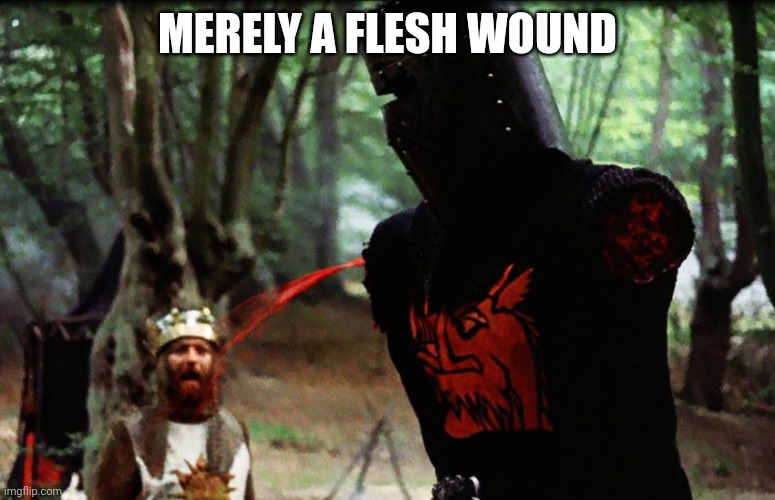
Black Knight from Monty Python
I make mistakes in this arena a lot, but I thankfully get rid of most of them when I do editing runs. It’s something I very conscious of because I write a lot of action scenes. So, I have to really be aware of physical injuries as I move along. I mean of the characters and not myself. *shudders at memories of 2025*
A physical injury is very important, especially in action scenes. We might be used to seeing heroes continue on with severe injuries, but that requires the audience to suspend a lot of disbelief. It seems to be easier with visual mediums too. We can see how bad the wound is and how the hero is pushing on, so we rationalize it. Books require the reader to imagine stuff, which can’t always go in the right direction. A reader is more likely to question how a character is moving around after suffering a major injury because they aren’t seeing the physical cues of adrenaline and grit.
That doesn’t excuse visual medium entirely too. Walking around with a gaping hole in the stomach is common in action movies. Characters will get stabbed or shot in the shoulder, but still have full use of their arm. Leg injuries don’t hamper jumping or speed. It can get ridiculous enough that you lose some people, especially if the villains and supporting characters don’t get the same superhuman abilities. This is why it’s very important for anyone telling a story to remember what happens to their characters. Forgetting an injury can make or break things.
This isn’t even something that is solely about action scenes. Any injury that is noted should have an impact. If a person gets a papercut then they should get a bandage and have some minor restrictions on that finger. It doesn’t have to last longer than that scene, but you have it happen for a reason. Not wanting to deal with the aftermath probably means you shouldn’t have it happen in the first place. After all, a reader may come along and wonder about the inclusion if nothing comes of it. That’s if an editor or beta reader doesn’t catch it first.
It does get annoying to remember physical injuries because you want to keep the momentum and action going. Yet, each one should weaken and wear down your hero to some extent. This becomes an issue when you’re having it be one fight after another, which is another reason why authors should include downtimes. Aside from letting the tension dissipate and avoid oversaturation, it gives you an opportunity to have your characters get medical attention. This doesn’t have to eliminate the injuries entirely, but enough can be done to explain how the hero is still able to operate at a high level. For example, the first John Wick movie had him doing a lot while injured, but there was also a scene where a doctor tended to him. He was also given medication that would allow him to keep fighting, but his stitches would rip. This allowed him to fight at full strength without any questions.
An alternative that I’ve seen is that the heroes simply don’t get hurt. This gets applause in some situations, but not by everyone. The longer your hero goes without getting hurt, the less interested the audience becomes. There’s not threat of death or failure. If such things do happen then it doesn’t make sense since they avoided all previous injuries. The only time this works is if the character has invulnerability. At least then it would be some kind of shock.
The funny thing is that it really isn’t as hard as one would imagine. As I said at the beginning, I usually fix things up with edits. When writing an action scene, I initially focus on getting the general flow of events down. The injuries are including and force some changes in the moment such as change of momentum. Big ones I remember and they have an immediate influence over the rest of the fight. Once I have everything set up, I wait until it’s time to edit and make adjustments. Thankfully, you get better at doing this in the moment as you write more action scenes with injuries. There still tends to be some polishing such as realizing a jump can’t be done with an arrow in the thigh or a character just headbutted someone wearing a full helmet.
So, how do other authors work with physical injuries in stories? It doesn’t have to be action scenes, but just in general.




 Legends of Windemere
I’ve tried to be as real as possible with injuries and their effects. But I sort of have to, since my protagonist is a nurse. I am currently reading a book in which the hero gets sliced and diced but keeps on ticking!
LikeLiked by 1 person
I hope the hero has a power that explains that situation. Those with regeneration tend to get away with this.
LikeLike
He sort of does, and except for one instance, the injuries were non-life threatening knife slices. But by now (this is a series) his body must be crisscrossed with scars!
LikeLike
I am amazed how MCs simply move on despite grievous injuries. I read a lot of Westerns. These heroes can be shot, stabbed, wrenched, and thrown off a cliff and still prevail in a fight. Amazing.
LikeLiked by 2 people
I’m not that experienced with westerns, but I noticed that. Seemed to be part of the genre. Frontier toughness?
LikeLiked by 1 person
You have a great model for your struggle in that there Monty Python scene 🙂
LikeLiked by 1 person
Thanks.
LikeLike
What an interesting topic! I remember an interview with Christopher Lee (on the LoTR movie DVDs) in which he advised Peter Jackson on what a person would sound like after being stabbed. (I think this was based on his wartime experience.)
I wrote some fight scenes in which a character was injured with a knife or shot with an arrow. I had to do some reason on these injuries for realism. And no, I didn’t stab anyone or shoot someone with an arrow. 😊
LikeLike
I think injuries are fairly easy to figure out. Just have to imagine pain in that body part.
LikeLike
This is the beauty of fantasy, supernatural, or science fiction. We can let characters hobble through the scene, then get them healed up for the next one.
LikeLike
True. Though they need to act injured until healed.
LikeLiked by 1 person
I don’t write much action, but when my hero dislocated his shoulder for example, I asked my doctor sister how painful it would be and how easy to put back in!
LikeLike
I’ve heard most authors get that injury wrong. Usually with the popping back in.
LikeLiked by 1 person
I haven’t written a story with an injury, yet. You make some excellent points that are worth remembering.
LikeLike
Interesting. I always thought you had injuries depicted in your first trilogy. Guess I misremembered that.
LikeLike
No you are right. I was thinking in the context of a fight. When John Cannon was shot he went down.
LikeLike
If I have a character injured, it becomes part of the story until a reasonable time for healing. For instance, one time a group of characters were drugged, and they woke up very woozy in a way that lasted for the rest of the day (in story).
LikeLike
Pretty much how it has to go. No reason to have them injured of it isn’t going to have an impact. I will admit I have a habit of forgetting injuries after a battle though. More that I don’t have a good sense of healing time.
LikeLike