
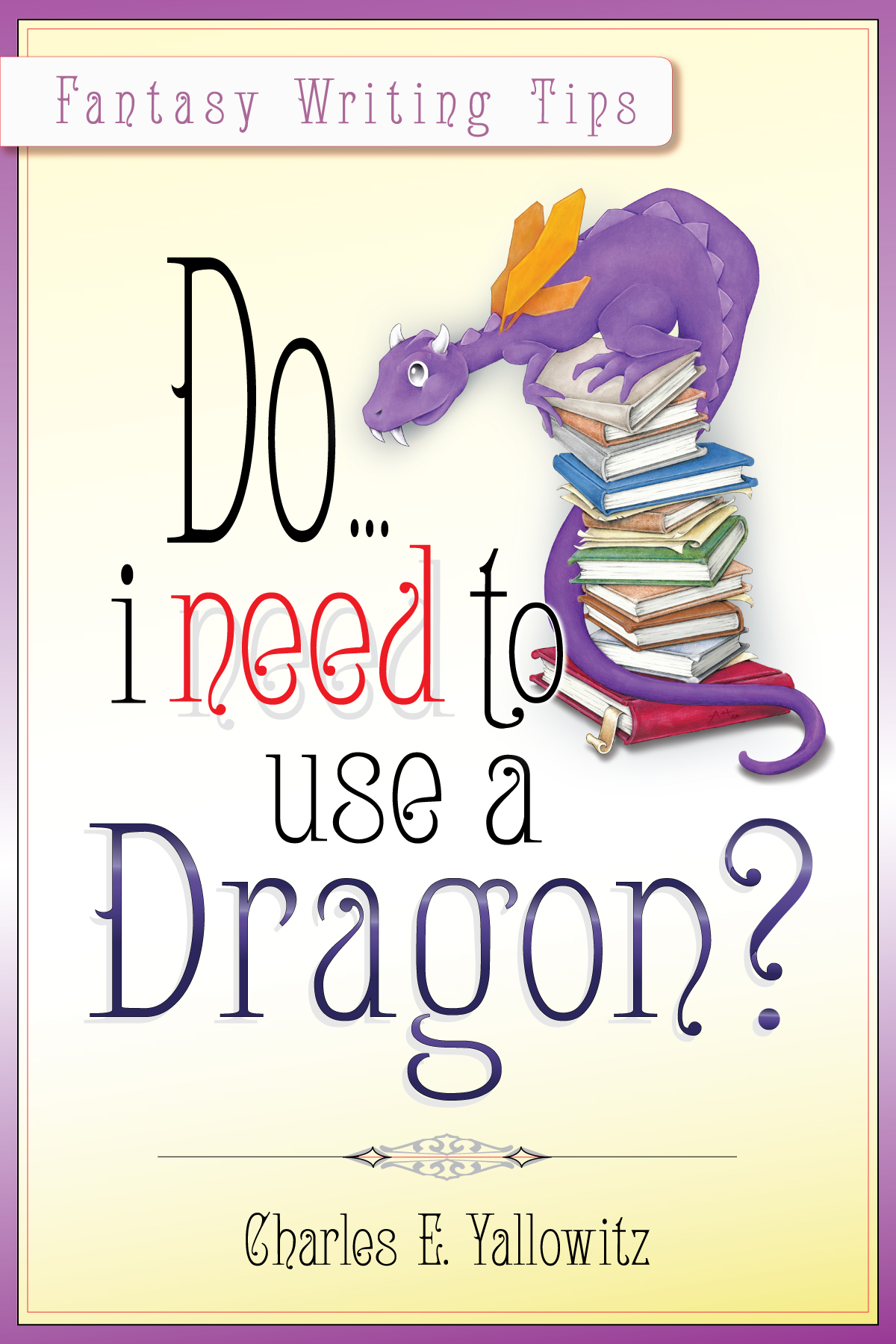
Cover by Alison Hunt
This is an excerpt from one of the World parts in Do I Need to Use a Dragon? I would even say it could be one of the topics that gets the biggest reaction. Though, I can’t say I’m surprised.
At the start of Beginning of a Hero, I touched on a cliché of fantasy because I didn’t know any better. A character is in a tavern and is hit on by an elf while a bunch of dwarves tease him for the encounter. Why did I do this? All because I was much younger and I never thought about going away from the overused cliché of elves and dwarves hating each other. It would be years later that I looked at the scene, which still worked for what I needed, and wondered why I took such a path. This racial feud never popped up anywhere else. In fact, I had a half-elf running a school where one of her senior staff was a dwarf who was one of her dearest and oldest friends. This relationship made the earlier scene even stranger unless one sees it as a bunch of drunks teasing a stranger being hit on by a woman. I went on to realize how often fantasy goes with the multiple races hating or distrusting each other. Why is this?
For one thing, fantasy has many racial traditions authors and readers accept without thinking about them. Elves hate dwarves, orcs are always evil bandits, humans are always seen with some disdain, and all vampires are monstrous killers. This brings uniformity between worlds, but it also shows a level of unoriginality when it comes to interspecies relations. It isn’t surprising though because this is a very sociopolitical area, which is easiest to do if you have everyone hate each other.
Personally, I think we gravitate towards this for more reasons than it being a fantasy tradition. We see plenty of hatred and distrust in reality, which doesn’t have the wide variety of species like fiction. It’s all humans here and we can be downright toxic to each other for many reasons that end in -ism or -phobic. So, an author and readers may not find a world where everyone gets along as believable because that isn’t how civilizations work on Earth. If a human hates other humans for something like skin color, then one wouldn’t expect our species could be friends with a pointy-eared, nearly immortal elf.
Of course, this idea isn’t always consistent in worlds where such animosity exists. The proof is that you have half-breeds. This set piece is typically done with two specific races and humans. You have a long tradition of half-elves because an elf and a human either fell in love or had a one-night stand to produce a child. The second type are half-orcs, which are usually made by a human being raped. Both half-breeds are treated as outsiders to both worlds, but half-elves tend to be accepted more by civilization. These two cases show us both sides of the interspecies relationships. Half-orcs conceived this way demonstrate an idea that different races cannot truly coexist without conflict. Half-elves show there can be love and unity between different races even if there is distrust. This makes the interspecies relationship issue more complicated. You can’t show that groups despise each other and then have tons of half-elves born from actual couples. A limited amount could work, especially if it’s a forbidden love thing, but then they’d be treated negatively. This is a big thing to consider if you want to go with the traditional bad blood between species. You could effectively eliminate the possibility of half-breeds if you go too far.
Authors who use this world-building tool may argue this is the only or best way to create tension in a story. They aren’t wrong. If your story involves a group of heroes who come from different species then interspecies issues is a useful character evolution tool. They will have to get over their biases and pre-conceived beliefs in order to work with their new friends and claim victory. This doesn’t mean it is necessary or without risks.




 Legends of Windemere
Good post! Shows like Star Trek: The Next Generation,, Star Trek: Deep Space Nine and book series like Legends of Windemere, Discworld, and Lord of the Rings showcase these types of misunderstandings.
LikeLike
Too bad reality doesn’t work like those worlds.
LikeLiked by 1 person
If only. 😔
LikeLike
I think the racist conflicts tend to ramp up the energy. What is nice is to see those who are supposed to hate each other actually help each other.
LikeLiked by 1 person
True. Though I find people throw racism in with very little set up. Sometimes it makes no sense for groups to hate each other outside of a political figure manipulating people to hate each other.
LikeLiked by 1 person
Yeah, there needs to be more to the hatred.
LikeLike
Yes there has to be a deep seated reason.
LikeLike
Nice topic. Racism is real and in a broad world it will exist. Whether that becomes part of the story or not is up to the author. It can make some great stories, but it can also come across as lazy. I’ve used it before and probably will again.
LikeLike
Seems rather strange that we say racism will always exist.
LikeLiked by 1 person