
Posted on March 25, 2013, I do have more to say on this. Now, the topic is how my heroes are unaware of what the villains are doing. I’m sure it was meant as an insult now, but I do make good points as to why it works for my first series. I also think having heroes immediately know exactly what the villain is planning without being told doesn’t feel natural. It reduces their chances of mistakes, but that also means the story will be a lot more linear and straightforward. There aren’t any red herrings or misunderstandings that will lead to character building events. Instead, a hero knowing exactly what is going on will head straight from point to point with no interest in waiting. I mean, why give the villain more time to prepare if you know exactly what they are doing and even where they are hiding? Not much of a story to me.
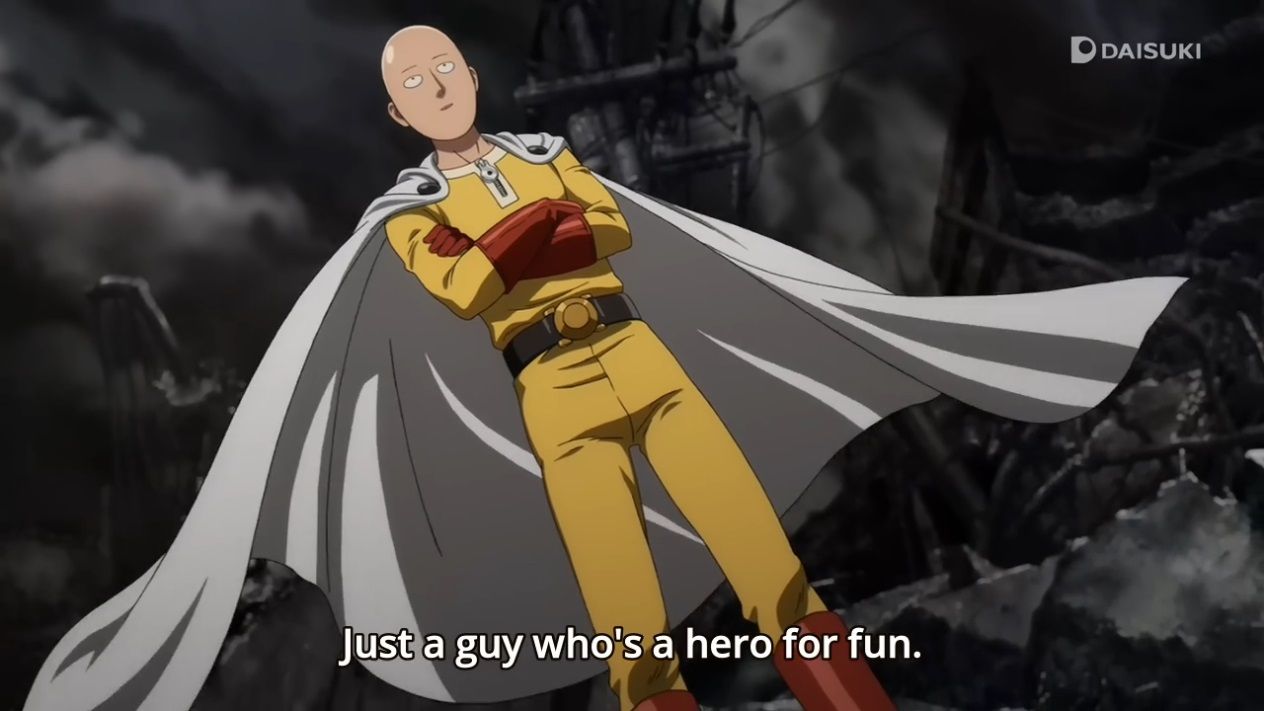
Saitama
This is part of my most recent book review: “The bad guys are really bad and the good guys are unaware.”
At first, I didn’t know what to make of the statement and I’m not much closer to figuring it out. It makes me smile, so I know it isn’t an insult. That being said, I’m not sure my heroes are taking it in stride. Though, the truth is that they are rather unaware throughout the book. It isn’t that they’re stupid or oblivious, but they really stepped into the villains’ plans at the eleventh hour. They’re scrambling to get some type of advantage before the big ending. Yes, Luke is an untested hero who truly has no idea what he’s doing and not much of a mind for strategy. I guess this comes off as stupid at times, but we all have stupid moments.
This quote got me thinking about heroes and how there are so many that appear to know exactly what is going on. The villain stole a magic item? The hero or an ally knows what ritual they are going to do at what time and in which city. I guess this is an aspect of heroes with more experience than mine, but I have to admit that it does get a little tiring when the heroes never a ‘what is that evil bastard up to’ moment. I definitely couldn’t let Luke, Nimby, Fritz, or Aedyn know what is going on. Nimby, Fritz, and Aedyn aren’t adventurers and rather specific in their knowledge. Luke is fresh-faced and working off young bravado, so having him discern the Lich’s plans feels rather stretched. It’d make it hard to believe he was inexperienced.
So, what do people think of heroes that seem to be blindly reacting to the villain for most of a book instead of being proactive? For that matter, is there such a thing as too perfect a hero?






I can’t help thinking of how Batman uses his detective skills to figure out what’s going on. He looks for clues and then analyzes the details. On episodes of Batman: The Animated Series (I was watching a review of one episode, so Batman is fresh in my mind), Batman used his computer to aid his detective work. And he is someone who has access to great resources. Yet he still has to work to determine what’s going on. If a hero immediately knows what’s going on, I don’t have any tension at all. But when he or she has to put forth effort to get up to speed, there’s tension because he/she might go in the wrong direction.
LikeLike
They definitely put a lot of tension and discovery into those 24 minute episodes. Good example.
LikeLiked by 1 person
I remember another episode where Batman and Batgirl were looking for Killer Croc and Baby Doll in the sewers–a three day search! Nothing came easy in that episode.
LikeLike
I think a certain amount of reaction to the villain is fine but there comes a time when the hero has to figure it out and jump ahead of the the villain’s moves. Too perfect a hero? Yeah I think such a character would be boring.
LikeLiked by 1 person
It’s always tough to figure out the jump ahead moment. Too late or too soon can both come off as contrived. Heroes really have it rough.
LikeLiked by 1 person
They do for sure. 😀
LikeLike
I think there is an issue in both case. I am writing a couple of naive characters right now, but they need to get some kind of jump on the bad guys.
LikeLiked by 1 person
My main character in my next series is naive and not the type to get the jump on anyone. I’ve found it can still work if they have a level of unpredictability or just an odd way of seeing the world. It results in the villains being thrown off at crucial moments.
LikeLiked by 1 person
I like it.
LikeLike
For me, I guess the clueless factor depends on how long the protagonists remain clueless. At first, sure, things could be coincidental. An inexperienced character can miss the connections. But the longer it goes on, the more this seems iffy. Your character or group has to have that moment of “oh, this is not by accident.” Then they can engage and try to track things down.
Someone used the example of Batman, but he’s an experienced adventurer and his whole purpose is to ferret out the villains. So he would never be clueless like that.
LikeLike
I was thinking about the Batman example and it made me realize another factor. People tend to ignore the intelligence of the villain. For example, Batman’s experience could be minimized or negated by the Joker who is just as experienced. This means an author has to figure out if the hero is smarter than the villain or a mistake needs to occur. I guess this is also a reason I have a slight issue with Batman types. It isn’t fun if they’re so much smarter than even a genius villain.
LikeLiked by 1 person