
This went live on January 2, 2013 and it comes off as fairly naive. I seem so simplistic in my view on villains and what makes one good. Not sure why I lacked any nuance, especially since I had to have been working on making Queen Trinity a 3-dimensional bad guy. Guess this shows how much I changed because I don’t think I can agree with big chunks of this post. Then again, I seem to mention a lot of Saturday Morning cartoon villains in this post. It’s also funny how you can see that I’m on the verge of changing my opinion by the end thanks to Baron Kernaghan.
Google Image Search
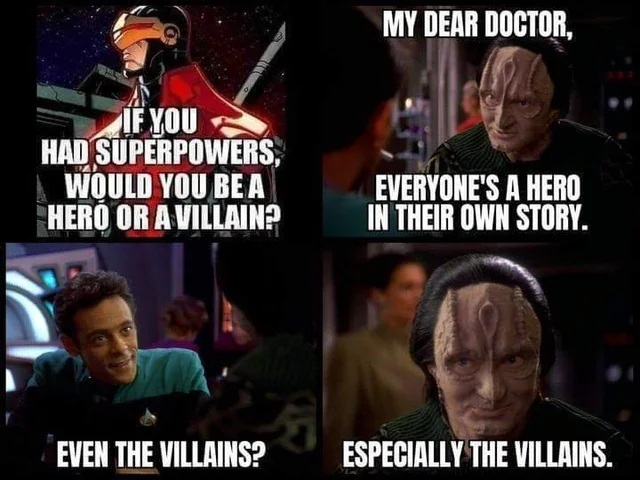
I read a post about the characteristics of heroes and it got me thinking about the other side of the equation. How do you write a good villain? I always had more interest in villains than heroes because I realized that a hero has nothing to do without a villain. I guess you can say that a hero is only as good as his villain or rogues gallery. Many villains even go on to be more famous than their heroic counterparts. For example, most people think Darth Vader when you mention Star Wars before they think of Luke Skywalker. Lex Luthor and Doctor Doom seem to have more respect than Superman and Mr. Fantastic. I think this proves that while an audience is not supposed to like the villain, there is something about a good bad guy that can drive a person’s interest more than a good hero.
So, what actually makes a good villain? I can list off attributes, but most villains possess most of them. Even a villain that is as inept as Mum-ra is evil, mean, dastardly, and cruel. Thinking about it, most cartoon villains seem to have a level of ineptness that they lose if they go into another medium. Cobra Commander was effective in the comics, but he was a buffoon in the cartoon. At least, I thought he was and I always wondered why Destro never shot him in his sleep. Though given how nobody could hit anything in that show, I wouldn’t be surprised if he tried it every night. Anyway, this really makes me wonder how a villain can be considered a good or bad character in terms of quality. Is a villainous laugh necessary or can they get away with a banshee scream of rage whenever they’re upset? Do the better villains have to be able to fight when cornered or can a great villain be a manipulator with not combat skills? Maybe it even comes down to personal choice.
I’m going to say that my opinion of a villain is dependent on his or her actions. A villain has to do bad things and show very little, if any, remorse about his or her actions. Darth Vader killed his own men throughout Empire Strikes Back, which always cemented his evilness to me. Frieza killing Krillin (not sure why the high-pitched bastard waiting so long to do a one-shot kill) was a defining moment of Dragonball Z. These are actions that you can look at and say ‘that is one cold-hearted, evil bastard. I guess a great villain needs at least one scene where you can say without a doubt that they are the villain and have to be taken down. You need that event to make the audience cheer for the villain’s defeat instead of being apathetic to their fate or even rooting for them. It’s something that needs to be done with subtlety because I have seen a lot of villains who came off as heavy-handed. The movie or show basically shouts, ‘This is the villain! Do not cheer for this character!’ Yet, the villains didn’t really do anything for me to be turn against them. Best example of a poor villain for me is from the movie Brave that I just watched. I loved Merida, but I couldn’t figure out who the villain was supposed to be. The ‘villain’ shows up in the final hour for a big fight and I was left wondering if I was supposed to care that this ‘villain’ just got defeated. It hadn’t really been a factor for the entire movie, so there was no scene that cemented it as the bad guy and no build up to the defeat. It just showed up near the end and needed to be defeated.
All of my examples have been movie or cartoons because it is easier to show a villain as evil than telling a person that a character is evil. You can do the same scenes to prove that they don’t care about their pawns, but I think there is something more that you need for a literary villain. It isn’t enough to have them act evil, but they have to feel evil. Sneers, hisses, threatening words, and evil forms of laughter are good methods as long as you don’t overdo them. For the fantasy genre, it always helps to have your villains in a dungeon or necromantic lab. I guess being surrounded by dead bodies is a time-tested method of declaring, ‘This character is evil!’ I like to write villains because they tend to have the more colorful dialog, but I still don’t think I have a good grasp on what makes them evil. The Lich in my story is obviously evil because he’s a rotting necromancer who summons demons, but his allies that show up in later stories don’t have the same look of horror. The big villain is actually attractive, so I’m having a challenge trying to demonstrate that he’s evil. He’s actually starting to become one of those villains that is polite and charming, which is a total change from the Lich’s stereotypical villainy.
So, what do you think makes a great villain?




 Legends of Windemere
A good villain to me is someone who has at least one or two redeeming qualities so I might kinda, sorta, like them. A villain who is completely evil is not interesting!
LikeLiked by 1 person
I hear this a lot. Funny thing is that I also hear people complaining that villains aren’t evil enough.
LikeLiked by 2 people
I can’t help thinking of the scene in Goldfinger where James Bond says, “Do you expect me to talk?” The villain, Auric Goldfinger, says, “No, Mr. Bond, I expect you to die.” That’s what I think of when I think of a villain. Some people nowadays might complain that he seems one-dimensional. But I don’t mind because you know where he stands.
Lately, I’ve heard people complain about Marvel villains as not being very strong. Some also complain about villains who seem too well-rounded to the point of seeming like anti-heroes. I thought Killmonger was effective in Black Panther. While his goals were understandable, he was still unabashedly the villain. There was no team up with the superhero at the end.
I like a villain who doesn’t think of himself or herself as a villain, but who believes his/her cause is right. I also agree with noelleg44 about the redeeming qualities.
LikeLiked by 1 person
There does seem to be a trend of villains being closer to anti-heroes. Flip the pov to them and the movie works from the opposite side. My current issue with MCU and comic book villains in general is that they are coming off as cookie cutter. They all seem to have the same personality, but the heroes do too.
Bond villains are great. They can be so over the top, but there’s a charm along with the menacing presence. You know they’re bad guys even if they have some good qualities.
LikeLiked by 1 person
I also like the fact that the Bond villains are different and over the top. That was part of the fun of escapist movies. They inspired so many other villains like the Despicable Me villains Gru goes up against, Syndrome, Dr. Evil, Megamind, and others. (Okay, everyone I named might be viewed as silly, but they were still fun to me.) I also think of the villains in the Indiana Jones movies.
LikeLike
You don’t see many like that these days.
LikeLiked by 1 person
I really enjoyed reading this—it’s always so interesting to see someone revisit their earlier work with honesty and a clear sense of growth. I could definitely see how your thinking around villains has evolved. The way you pointed out that a villain needs a defining moment—something that makes the audience feel their evil—really stuck with me. I totally agree that it’s not enough to just tell us someone is bad. We need to see it, and more importantly, feel the impact of it.
Your examples like Vader and Frieza were spot on. Those moments were more than just plot twists—they shaped how we emotionally responded to the story. And I loved what you said about how villains in animation often come off as incompetent, but become much more serious when put into different media. That shift is really fascinating.
Also, your reflections on the Lich were great. I think it’s such a common challenge—once a villain starts to become interesting and charismatic, it’s hard to keep them “evil” in a simple way. But maybe that’s a good thing. The best villains often make us question things a little, or even sympathize against our better judgment.
Would love to see how you’d write Queen Trinity now, with all this perspective. I bet she’d be a much more layered and compelling character.
LikeLiked by 1 person
Thanks. The funny part is that I would go in to make Queen Trinity a really good character after this post. I ended up junking most of my original idea and had her be the villain to slide into a full redemption arc. That might be another ‘risk’ when you make the bad guy more relatable. You could push them out of the antagonist role. I know several rpg video games where you get to recruit the initial big bad. ‘Chronotrigger’ comes to mind.
LikeLike
Good stuff. That defining scene is still important, but if you can make the readers consider their point of view they gain a lot of depth.
LikeLike
Very true. Thanks.
LikeLiked by 1 person
Brave is an interesting example. That whole movie really was about family misunderstandings and Merida coming of age. There didn’t really need to be a “villain” at all once she learned to understand her mother.
LikeLike
I forget that movie’s plot, but you’re right. I don’t remember an actual villain. ‘Inside Out’ is another one.
LikeLiked by 1 person