
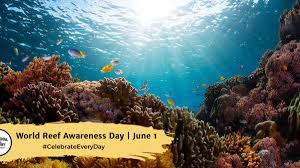
Coral reefs are very important ecosystems, which have been in danger due to pollution and climate change for a long time. So, today is used to bring awareness to how essential they are and the threat they are under. Best to just list some facts:
- A reef is a large, living structure created by coral polyps. The polyps leave their skeletons behind, which forms the reef.
- Coral reefs support approximately 25% of all marine life.
- Their colors come from zooxanthellae (algae) living within the coral tissue along with chromoproteins and fluorescent pigments created from the color. This is why dead coral is bleached white since it can no longer produce the latter two or support he algae. Coral bleaching is caused by stress.
- Many fish depend on coral reefs for food, which means humans who eat the fish depend on these environments as well.
- They exist in shallow, clear water because they require sunlight.
- If a reef gets too hot, the coral will get rid of the algae, which causes bleaching and the eventual death of the reef.
- These structures act as storm buffers and reduce erosion of nearby islands. This is done by slowing down the flow of water.
- Coral reefs began forming nearly 240 million years ago.
- They clean the water that they live in.
- There are more than 800 species of hard coral, which form reefs.
- The Great Barrier Reef is the largest reef system on Earth and can be seen from space.
- Coral is considered an indicator species. This means that their health will indicate the overall health of the environment. Strong coral means good ecosystem while sick coral means bad.
- Climate change makes water more acidic and warmer, which increases the occurrence of coral bleaching.
- Runoff, seeping, and other forms of water pollution kill corals.
- Overfishing can eliminate the species that help maintain the coral reefs.
- Destructive fishing (dynamiting and cyanide) along with reckless boating can physically damage the reef. Massive corals grow 0.3-2 centimeters per year while branching corals grow 10 centimeters in that time. It takes around 10,000 years for a reef to form, so any damage is devastating.
Here’s 11 hours of reef and ocean footage.





 Legends of Windemere
Wonderful stuff today.
LikeLike
Thanks.
LikeLiked by 1 person
I saw a film made I believe in the Philippines, where the natives have cordoned off large sections of their adjacent sea forbidding fishing and the results have been spectacular. My grandson used to sit and watch an aquarium film for hours when he was little. So soothing and peaceful.
LikeLiked by 1 person
Not sure if it was the documentary, but I once saw YouTube videos about that. Definitely a good move. Leaving an area untouched means it will naturally heal.
LikeLiked by 1 person
The results were nothing short of spectacular.
LikeLike
Hopefully more countries and communities will realise just how important our oceans are.
LikeLike
Unfortunately, communities that aren’t near the ocean tend to not care at all.
LikeLiked by 1 person
Quite peaceful. I was watching the fish and hit my forehead on the keyboard.
LikeLike
Hate when that happens.
LikeLiked by 1 person
Me too.
LikeLike
😂😂
LikeLiked by 1 person
😀
LikeLike
Dead sea, dead land (including us).
I once wrote a post pointing out how it’s not only the increase in heat we need to worry about. Burning fossil fuels releases carbon dioxide, yes, but it’s because oxygen is used in the chemical reaction. This oxygen comes from the air, of course. So maybe we should consider not only the carbon dioxide increase, but also the depletion of oxygen levels.
One person responded that she wasn’t worried about that, because the scientists would sort it, or human bodies would adapt. (Turns out she’s a Trump supporter.)
Anyway, I think most people who aren’t knowledgeable about the oceans think in a similar way.
LikeLike
Believe I’ve read articles about that issue. The more co2, the less 02 in the atmosphere. As far as our bodies adapting . . . Mutations that allow for adapting don’t work that fast. It it did, no species would go extinct. I’m sure hearing that had you stunned.
LikeLike
Some of the most incredible habitats on Earth.
LikeLiked by 1 person
And essential to our world’s survival.
LikeLiked by 1 person