
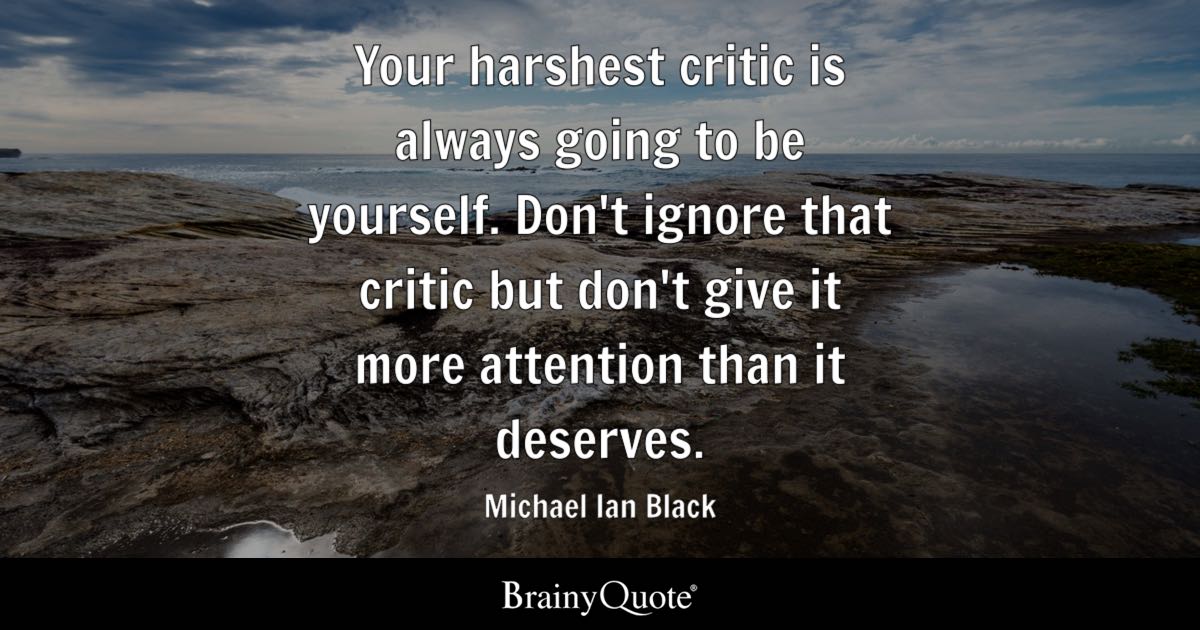
I’m really hard on myself. Think a lot of people can say this about themselves as well. It’s extra tough to handle the inner critic when it comes to art. Yet, one has to be their own cheerleader as well. We are the final say in what our art will look like, which makes us the best critic as well as the worst. So, how does this work exactly?
Be Your Own Cheerleader
I’m going to start with the positive side first. We need to have hope, faith, or whatever you want to call it in ourselves. Once we give up on ourselves, the game is over. So, our inner critic needs to be positive to keep us going even if it’s telling us how we made a mistake. I believe all authors run into this voice when editing. You need to fix things without feeling like the entire project is a mess. Think people used to say that you need to junk 85% of your first draft to make it good, which is kind of extreme. It still shows that one can be critical and keep pushing forward as long as they feel that all of the changes are for the best.
This can be dangerous though. Being too positive can make an author egotistical to the point where they won’t listen to outside opinions. As much as we aim to be our own cheerleader, we need others to support us. It’s not a solo show even if we believe it because we need editors, publicists, readers, reviewers, publishers, and more. So, a person needs to remain open to other opinions. Listening solely to the positive critic inside to avoid negativity will block you off from this.
I’m Trash!
This is the abyss that will lead to utter failure. Your inner critic can’t muster any positive thoughts on your creations. It isn’t being tempered by a cheerleader, so you’re destroying everything you make. Nothing is good enough. Every word is a mistake. You end up going back to the drawing board all the time. At this point, the inner critic is the equivalent of an Internet troll determined to make you quit. It’ll vanish as soon as you do so and swear to never try again. One could say this voice is born from depression, anxiety, or doubt. No matter what, it’s pretty nasty.
Though, it isn’t entirely useless as long as it’s kept on a leash. We do need to admit when we’ve made mistakes. An author needs to be able to ditch bad ideas instead of pushing forward with something they hate. Sometimes, you have to put aside something that you like, but isn’t working out. Not a full quit, but shelving it to work on projects with more gravitas. The ‘negativity’ here isn’t at full strength, so it helps one come to the conclusion that it’s time to move on or make really big changes.
Balance is Key
For anyone who has been following my blog for years, they probably knew this would be coming. I’m always talking about balance because that’s what one needs. Odd coming from someone who is repeatedly unbalanced, but it’s easier to preach this than put it into action. My mentality aside, the trick with the inner critic is to make it be cheerleader and party pooper. Maybe it’s the cheerleader who is at the bottom of the pyramid and not happy about it. Give them an attitude where they are positive, but have no problem tearing something down if they hate it. That way, you keep going while making changes and casting aside things that really don’t work.




 Legends of Windemere
Thanks, Charles, for the inspiration to change, the step leading to opportunities.
LikeLiked by 1 person
You’re welcome.
LikeLiked by 2 people
You bring up the importance of balance. At times one has to swing hard from one side to the other to come back to balance. I think at times we forget that.
LikeLiked by 1 person
Now I’m imagining a swing careening out of control. Think I need to lie down from that imagery. 😵💫
LikeLiked by 1 person
Ha ha ha. Sorry about that.
LikeLike
Well said! Balance is key. That goes for critiques as well. Some comments are helpful, even if the criticism hurts at times. Others are not. An advisor gave me a great piece of advice: If a critique does not leave you excited to work on a story, ignore it. That might sound pat. But it has saved me hours of pain and second-guessing. Everyone who offers a critique is not doing so in your best interests. But some of the best advice I’ve received in my writing came from someone who was honest about my foibles, but also who believed in me as a writer.
LikeLike
That’s an interesting way to look at critiques. What do you do if the critique simply makes you angry?
LikeLiked by 1 person
I have had some that did. I ignored those.
LikeLike
I think we can all relate to this one.
LikeLike
Definitely
LikeLiked by 1 person
You hit the mark with ‘balance is the key.’ True for your own criticism and true for life in general!
LikeLiked by 1 person
Thanks. I should have a banner made about balance.
LikeLike
I was once asked how I managed two kids and a home and a career. The same answer – balance. I think of it like balls – if you’re juggling three, only two are in the air at a time!
LikeLike
And the balls seem to randomly be on fire or get replaced with chainsaws. That might just be my life though.
LikeLike
Very interesting visual!
LikeLike
The cheerleader pushes you to finish your project and take joy in the making of it. But you have to switch to the inner critic while doing revisions, and it spurs you to improve. So to me they each have their own place in the process.
LikeLike
For me, it depends on how good those two are at their job. Some people have inner cheerleaders who make them ignore all types of growth. Others have critics that flat out sabotage them.
LikeLiked by 1 person