
This post originally went live on April 17, 2024.
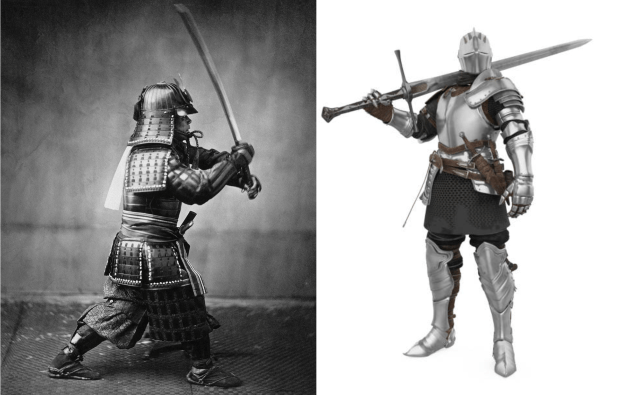
Google Image Search
Saying ‘versus’ isn’t correct. Yet, I do see many people trying to claim that one type is superior to the other. Becomes a whole ‘knight vs samurai’ thing at times. Meanwhile, I’m sitting here owning both styles of swords. I still want to do a short post since some people might think a sword is just a sword. Many are surprised to learn that each one has its own strengths and weaknesses.
Curved Blades
Let’s start with blades such as scimitars and katana. These weapons have a backwards curve, which helps with slashing and cutting. A warrior can deliver a blow across an enemy who has none to light armor. These wounds are deep and the movement results in the blade cutting through a bigger area. For example, a slash starting at the right shoulder can go all the way to the left hip with enough power. Heavy armor can be a problem since the force isn’t hitting a single point to penetrate.
Curved blades were especially useful when it came to cavalry. Needing less accuracy than a stabbing weapon, it’s supposedly easier to wield from atop a moving horse. Being a weapon that depends on momentum, the speed and power from a charge can add to the slashing damage. Some people believed this would mean less training necessary for cavalry when compared to a knight.
They are also easier to draw and work better in large army situations where there are plenty of targets.
Straight Blades
Longswords and rapiers can cut, but their strength is in stabbing and piercing. They can be used with more accuracy since you’re aiming a straight thrust. This allows for hitting gaps in defenses and even breaking armor since all of the power is being focused on a single point. With chainmail being the most popular during Medieval Europe, this piercing power was essential.
Straight blades are better for small group fights and duels, which was what you found in the regions they were used. A defensive reason for this is because they are better for blocking. The straight blade deflects a blow with very little chance of the opponent sliding along and into you. A curved blade has a chance of directly the blocked weapon towards your body if you aren’t carefully.
In General
Everyone who is into swords has their own preferences in opinions. Mine is that I like both and see a use for each type. I’m sure there is plenty more information out there than the basics I wrote here. So, what do you think?




 Legends of Windemere
An interesting find: I am reading a book where a man is killed by a nut pick stuck through the back into a kidney!
LikeLiked by 1 person
That sounds painful.
LikeLike
As written, the victim hardly felt it, and died from bleeding internally rather than externally!
LikeLike
I remember this post. It was helpful for me. As I mentioned before, this is why my characters (so far) aren’t using swords. But if that changes, I have your post as a reference guide. 😄
LikeLike
Thankfully, swords are fairly easy to research.
LikeLiked by 1 person
I can see why this was in the top five. Enjoyed it again.
LikeLike
Thanks.
LikeLiked by 1 person
😊
LikeLike
An interesting post. Especially the bit about curved blades being used with cavalry.
I remember this post, but forgot that bit.
LikeLike
Thanks. The cavalry fact was a new one on me too.
LikeLiked by 1 person
Still a useful post. No wonder it was popular.
LikeLiked by 1 person
Thanks.
LikeLike