
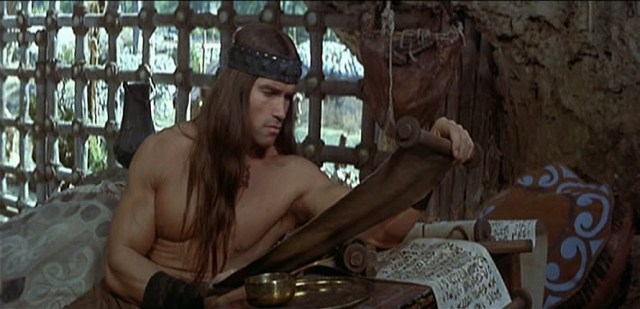
Conan the Student
This stems from something decades ago. When making some 3rd Edition Dungeons & Dragons characters with players, one was asking why his barbarian wasn’t allowed to start with reading and writing. He had to use points to give himself these skills that everyone else had. I let him get the skills as long as we explained how he had them, which was pretty simple. Since then, I’ve never taken a basic skill away from a character unless it was important to their development or the main plot. Yet, there is still something to ponder in here.
There are plenty of skills that we take for granted. Reading, writing, basic math, walking, hygiene, and more. For many, it’s baffling that anyone would become an adult without these skills. We probably forget how hard it was to learn them when we were children. It could also be a learning disorder or no opportunity. The latter is the reasoning behind D&D barbarians not knowing two of most basic skills. Still not a fan of that, but you can see the logic. It gives them an obstacle they can’t berserk their way out of too.
Now, while I do understand why certain skills may be removed from characters, I don’t agree that it should be done to entire groups. Yes, the barbarians being a ‘primitive’ society could mean no reading or writing. On the other hand, we have seen real-world ‘primitive’ cultures still have these skills, but in their own language. Barbarians aren’t typically isolated from societies too, so cultural diffusion is bound to come about. I think saying an entire group lacks reading and writing skills is denoting them as stupid and almost lesser. It would make sense for a group to not know how to fish, hunt, or bathe regularly. Plenty of human societies have had that throughout history. Yet, reading, writing, and basic math have existed for centuries on some level.
This is where the taking things for granted come into play as well. The author may take all of their ‘basic’ skills and use them as the foundation for characters. Any who don’t have them are seen as lacking or uneducated. This can give them a chance for growth as person, which is a good thing. It can also denote a clear segregation in society where you have a poverty class who can’t learn the basics to success. Not that they won’t, but they can’t. This is usually only done with conscious effort for good reason since, again, the author is unwittingly assuming all people have their skills. We all do this on some level too, so nobody should feel called out.
I do have an issue when the skill isn’t really basic and is found in an area that doesn’t make any sense. For example, I’ve read stories where a character knows how to fish, but they come from a desert or mountainous area. The terrain of their homeland lacks bodies of water necessary for fishing to be necessary. No explanation is given and they have no issue with the skill. Now, I live on what could be called an island and fishing is a thing even though the charter boats are expensive. I’ve gone a few times and still have no real skill in it. So, I find it hard to believe a character who grew up without access to oceans, lakes, and rivers will be an expert fisherman without an explanation. My assumption here is that the author knows how to fish or knows nothing about it, so they put it on their list of basic skills.
Guess that’s another part of taking skills for granted. We see some used so often in stories that we forget they can be difficult to learn. If it isn’t noted as difficult, we don’t treat it as such. So, we get to our own story and slap it on everyone without doing the proper research. Oops. On the plus side, your average reader might not notice this issue and it’s usually pointed out by those who worked hard to acquire the skill. Even then, they might not think it worth making a public fuss over. Still, it is best to step back and consider if a skill is part of a basic set or even slightly more advanced.
So, what do you think of adding or taking away skills we can deem as basic?




 Legends of Windemere
I find it so interesting that you wrote this post. I plan to write one on a similar subject, but for a different reason. If I post it, I will link to your post. You raise some good points about skills we take for granted and skills an author may know versus whether a character in a specific environment would actually know. I took for granted the ability to read and write until I was tasked with helping an adult who couldn’t read or write to learn to do both.
I always wonder how characters use weapons without any explanation as to how they learned to do so. They just grab a sword and instantly know how to use it. I can pick up a sword but my ignorance of how to properly use it would be frightening to anyone around me. I wonder if the issue is that people take shortcuts. They don’t want to have to explain the how, because maybe they aren’t sure themselves or don’t want to take the time to do so.
LikeLike
Weapon usage without training is ridiculous. A lot of movies do this when they have the chosen one thing. ‘Matrix’ did it better with Neo still needing to learn the basics.
LikeLiked by 1 person
I’m glad in the first movie they took a lot of time to show him the ropes. And Trinity went along to help him. Plus when she did something in the Matrix (like flying a helicopter), they at least explained why she was able to do so (because the information was downloaded into her–something that could only happen in the matrix).
LikeLike
I think it would be entertaining to see characters acquire skills. I have to agree that having a skill with no apparent reason (like your fishing example) to have it is off-putting.
LikeLike
It really raises some questions too.
LikeLiked by 1 person
I agree
LikeLike
You make some good points, Charles. However, I have characters learning skills. In my soon to be published novella, a prequel to The Wolves of Vimar series, Kimi is taught how to fight with a knife by her lover.
And Fero, in the main series, comes from a desert region, and at one point says he wants to learn how to fish and sail a boat.
I hadn’t thought about it, but it seems obvious that people need to learn skills.
LikeLike
Establishing how or the interest in learning works. It’s really the only way to explain how characters gain certain skills.
LikeLiked by 1 person
I generally give my characters skills that prove useful, but I don’t take time to detail how they got these abilities. I never consciously thought about taking skills away, but am neck deep in a possible trilogy that features a couple of amputees.
LikeLike
That sounds like an interesting story. Involves relearning skills.
LikeLiked by 1 person
Ditto to L. Marie. It has baffled me when a character has an automatic skill. But lack of a skill can make for and interesting character – lack of social skills, lack of curiosity, etc.
LikeLike
Creates a big chance for growth.
LikeLike
Absolutely! Good comment!
LikeLike
Perhaps this “illiterate barbarians” trope springs from our inherent bias against cultures in history that we consider as lesser. They come from a previous time in history, so they must be backward and inferior.
People often talk about Medieval people not knowing how to read or write, but as I understand it, that wasn’t true. Certain knowledge was reserved for the upper class, but ordinary people still could read and write in their local languages, and they could do math.
Who taught them? Their moms. (An interesting reflection, as I know we both work in education.)
Another example is in medicine. People may assume that characters have no scientific or medical knowledge at all, when they are just trained in different traditions. The assumption is that they were operating on the basis of superstition rather than generational knowledge passed from their elders.
LikeLiked by 1 person
A lot of knowledge was passed down even after writing was invented. Family and cultural lore always have a verbal component. With the barbarians, the term started in Ancient Greece and was used to describe those who didn’t speak Greek. It meant ‘babbler’. Funny thing is it wasn’t a truly derogatory term until maybe the Middle Ages when it switched to mean uncultured people. Even funnier is that the most famous barbarian of fiction was actually intelligent and could read and write.
LikeLiked by 1 person