
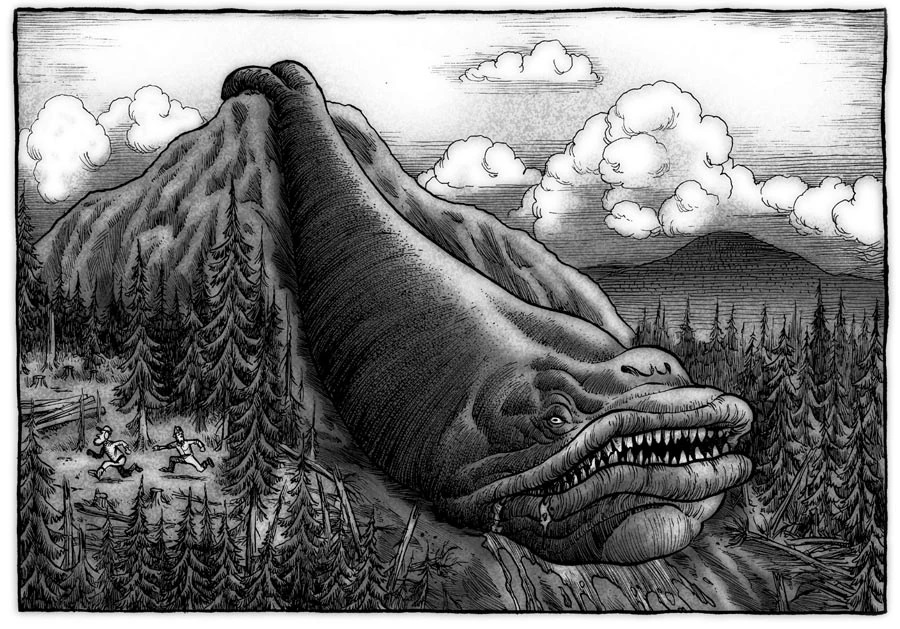
Slide-Rock Bolter
That thing definitely looks scary. Also, it’s really big and in the open, which makes one wonder how it’s a mystery. Where did this thing come from?
First, let’s go over what it looks like. Clearly, the Slide-Rock Bolter is huge, especially the head and mouth. Yet, it has tiny eyes. The tail is split and hooked, which it uses to grip onto the top of a slanted mountain. Even though it’s found on land, it resembles a giant fish or eel. Not sure what in the area could have inspired the lore, but what it does is rather frightening.
The Slide-Rock Bolter comes from lumberjack lore in the 19th and 20th century. It is specifically found in the Colorado mountains around slanted mountains, which it uses as perches. After hooking onto a steep slope, it would wait for a few days. Then, it would let go and slide towards another mountain where it would latch on to get ready to go again. It’s mouth would be left open to release a slick grease, which made it build up speed and go even faster with each second. With it’s mouth open, the Slide-Rock Bolter would devour everything in its path from people to trees.
A story talks about a park ranger who found a way to kill the Slide-Rock Bolter messing with his area. He set up a fake tourist filled with explosives and put them in a spot that the creature would notice. The monster took the bait and blew up along with half the buildings of the nearby town of Rico. This place was known for mining, which could mean that the creature was blamed for a mine explosion.
That’s actually why the Slide-Rock Bolter might have appeared in legends too. During the time it appeared in lore, more people were starting to move into the Rocky Mountain regions and explore. Tourists would go missing and it was easier to blame a mysterious beast than anything else, especially if there was a high number. You also had avalanches and mudslides that occurred, which is why the Slide-Rock Bolter goes down steep slopes and takes out everything. If people weren’t there to see the event, but only find the aftermath, they might think it’s a monster.
Can you think of any other natural disasters that are blamed on legendary beasts?





 Legends of Windemere
Another cryptid I’ve never heard of!
I wonder if the Yeti get blamed for avalanches.
LikeLike
I don’t think they’re in the same region. Sasquatch maybe?
LikeLiked by 1 person
That’s what I was trying to think of. Yes Sasquatch.
LikeLike
Aren’t Yeti and Sasquatch the same creature, just living in different continents?
LikeLike
Not really. While they live in different regions and are similar, they are considered different. Kind of like how a gorilla and chimp are both apes, but not the same creatures.
LikeLiked by 1 person
Certainly one I’ve never heard of, but I can imagine if people came across a huge landslide or saw one happening it would seem there was something living. Perhaps we could blame a monster for our cliff falls round Britain’s coast!
LikeLike
Be surprised if there wasn’t already a monster for that.
LikeLiked by 1 person
I’ve not heard of one, but it is surprising there isn’t one.
LikeLiked by 1 person
This is a very strange monster indeed. I can see how it would be invented to explain mud slides. I can’t think of another monster used to explain natural disasters. (Well maybe sea monsters to explain missing ships)
LikeLike
I’ve heard about monsters that are connected to thunderstorms.
LikeLiked by 1 person
Goodness.
LikeLike
Never heard of this one, but it makes perfect sense with people trying to explain deadly mudslides or avalanches.
LikeLike
Good point. Natural disasters make for good lore sources.
LikeLiked by 1 person
I’ve been on slide rocks in the alpine mountains. They are scary and can move without notice. I can see how someone might come up with this guy. I thought there was something like a giant catfish that was blames for tsunamis in some legend.
LikeLike
Never heard of slide rocks before. They do sound scary.
LikeLiked by 1 person
I can see, from the picture , that a mud slide could look like a giant creature. Or a giant creature look like a mud slide.
Mud slides do destroy everything in sight.
LikeLike
True. I guess seeing it from a distance, especially at night, could create such an illusion.
LikeLiked by 1 person
That is an impressive beast! And yes, landslides are terrifyingly destructive.
As for other natural disasters, the Greeks had a legend of Charybdis, who personified a whirlpool in the Strait of Messina (between the “toe” of Italy and the island of Sicily.
LikeLike
I always wondered if Charybdis was the inspiration for the Sarlac pit.
LikeLiked by 1 person