
Google Image Search
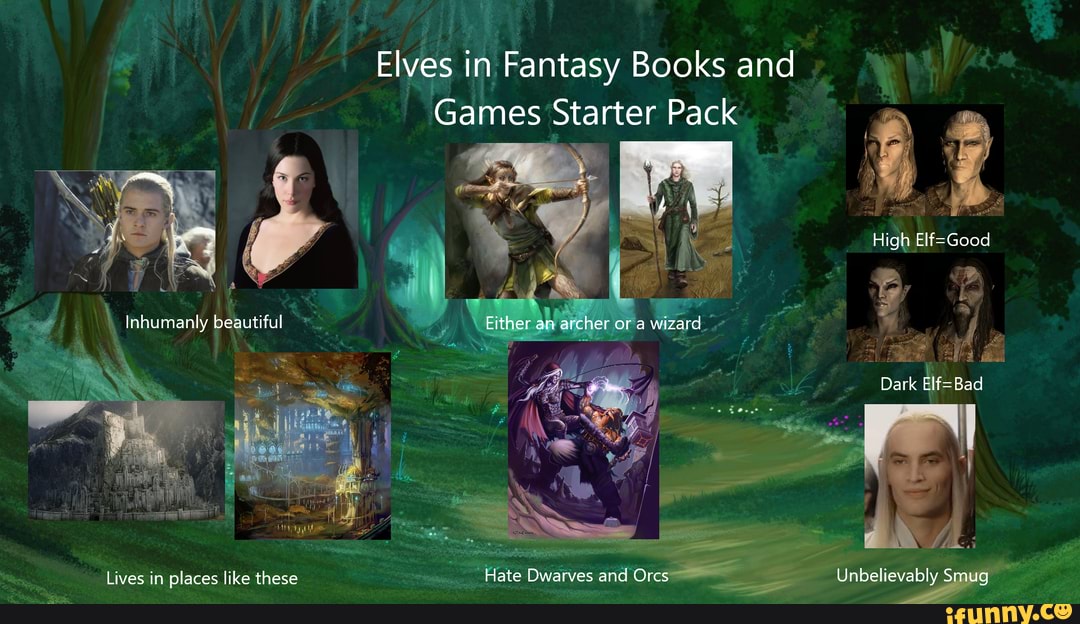
I was thinking about fantasy stereotypes a while back. Naturally, my mind went to elves and how they are typically depicted the same way in fantasy. The above meme notes a lot of what people think, which primarily comes from Tolkien. He set the standard that we use, so most authors don’t want to stray from it. I’m not going to talk about reinventing elves though. Easy to do if you try and many have done it successfully. So, what are the stereotypes?
- Elves are always depicted as beautiful and elegant. Their hair used to be only blonde, but that was expanded while retaining the beauty. They are typically seen as the most beautiful of the species. This is combined with a natural refinement and grace, which makes them nobility even if they aren’t actually nobles.
- They always live in forests and in tune with nature. I think this stems from the elves before Tolkien being more like a type of fairy. Coming from Britain, they probably went with the most common biome. That would be forests, which is where elves tend to be dropped even today. It leads to them having amazing cities in the trees with barriers that prevent outsiders.
- Masters of magic as the meme says. It isn’t like humans who study hard and get a few spells when young. Elves tend to come in with more power because they are able to spend centuries studying. Some worlds even have it that the elves were the ones who first had magic and taught it to humans. It makes them closer to the source, which is why they are considered magical creatures more often than other fantasy species.
- Elves are masters at archery . . . It’s all because of Legolas. Some might be good with swords, but you’ll find your non-protagonist elves tend to be archers. This is connected to the habit of giving them enhanced senses and reflexes. The forest homeland explains why they are so good at making bows and arrows too.
- Elves are agile and sometimes even superhumanly strong. Stemming from their reputation as being superior, they tend to be given better physical abilities than humans. This doesn’t make them muscular and bulky though, which is why authors are more likely to skip the enhanced strength. They will still be the fastest and most agile member of a party if one goes by the traditions. Sometimes, they even break the laws of physics . . . Friggin’ Legolas.
- They have a major sense of superority to other races, which can border on racism for some groups. Yet, the elves aren’t always noted as racist when they start badmouthing other species. Many are shown to be kind and friendly, but the ‘we live alone because everyone else is terrible’ elf society is still written today. I think the reason the racist thing isn’t called out as much is because authors tend to play it off as elves being better, so they aren’t lying. Pretty messed up mentality if you ask me.
- Elves are immortal, but not unkillable. They will always live for centuries, which adds to their sense of superiority. It also makes them emotionally distance themselves from other species to avoid pain or because they see the others as insects. An anime called ‘Frieren’ actually touches on the how the main character (elf) sees the death of her old comrades and how humans experience time. Fairly unique since most fantasy glosses over this issue or uses it to make elves seem more amazing.





 Legends of Windemere
Such a good post. It hits close to home, since some of my characters are elves. 😊I’m trying to avoid having them break the laws of physics ala Legolas in The Hobbit movies. 😊But yes, some of them are smug. 😄 Two other elves come to mind: the Keebler elves and Santa’s elves. 😄
Do you consider the fae to be elves? They were always confusing to me.
LikeLike
Elves are sometimes part of the Fae. Depends on the mythos. Sometimes Fae is used as a fancier name for elves. Other times it’s only for winged fairy types.
LikeLiked by 1 person
Yes to L. Marie. Keebler elves and Santa’s helpers – they have the ears but are completely dissimilar to those of Tolkien. I read Tolkien way before his trilogy and the Hobbit became popular – and I must say his vision of elves stuck with me!
LikeLiked by 1 person
His vision for the elves stuck with me too!
LikeLiked by 1 person
Seen people call Tolkien elves as the romanticized versions.
LikeLiked by 2 people
A very informative post, Charles. I don’t know a lot about elves and this was a great tutorial.
LikeLiked by 1 person
Thanks.
LikeLiked by 1 person
I did work on a middle grade series where Elves were the aggressive invaders, but it fell apart for other reasons.
Seems like you could have an elf adopt a human (or other) family and be their “fairy godmother” through generations.
LikeLike
That’s a good idea. Would the elf dress up with wings and a fancy dress?
LikeLike
They can wear whatever they want.
LikeLike
You’re right about this. They are not us, and they seem pretty damned smug about it. Not too many authors try to change things up. There is Dobby as one example, but his whole thing was mostly background and world building.
LikeLike
Dobby always felt more like a brownie than an elf. The smug elf thing is pretty strange at times. It reeks of symbolizing the pretty, rich, and popular cliques of society hating all others.
LikeLiked by 1 person
I’m afraid my elves tend to meet several of the stereotypes. They are slender and beautiful, and slightly smaller than humans. But they aren’t smug–at least no more than you find in any society. They are long-lived, though, but aren’t necessarily more adept with magic.
Do you think that people have come to expect certain tropes and are unhappy with divergence from what they expect?
LikeLiked by 1 person
I was similar in the beauty part. Kind of. My newest series (if I ever publish) will reveal the truth behind the Windemere elves. They have a dark origin.
I think you have people falling into both camps. Some love traditions. Others want change.
LikeLiked by 1 person