
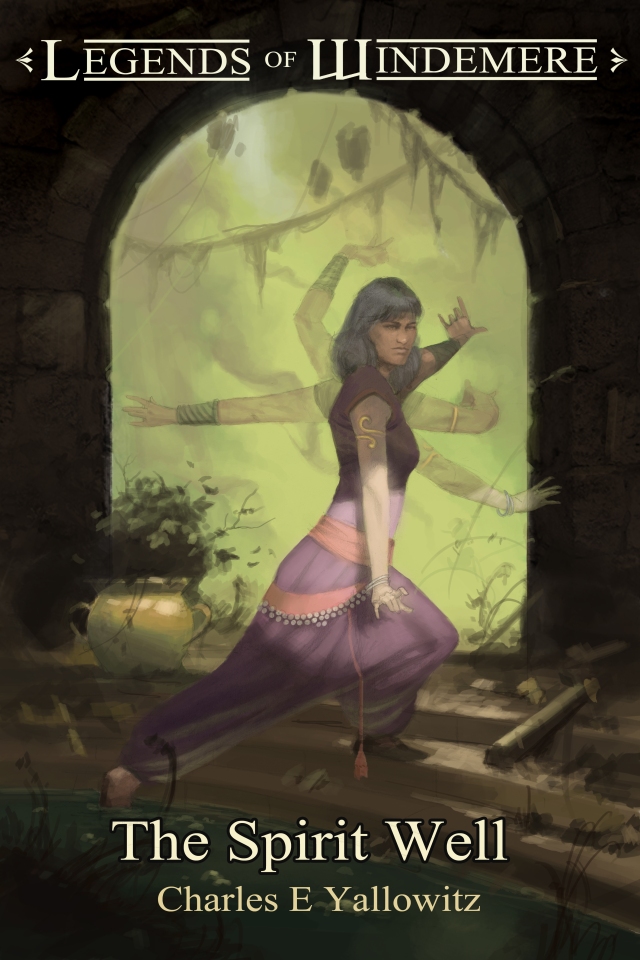
Cover Art by Jason Pedersen
This book finished the champion power center arc of Legends of Windemere. It was a tough one to write too because I needed closure and setting up the final arc. Those types of books always make my head spin, which leads to extra editing. Even the outline got changed up a lot over the years. Then, chunks got altered, tossed, and moved around because scenes didn’t work. I wouldn’t say The Spirit Well was a headache, but I definitely felt like I sweated more on this than many others.
One thing that was an immediate problem was the part where the champions were put into a world where they had finished their quest. The audience knows this is fake, but the champions don’t. So, they are talking about the final battle against Baron Kernaghan and living their lives. Sounds like fun, but I also had this concept set up for the previous book and the final book. I felt pretty stupid on that one, which is why I had to take a week going over the three to see which one should get the scene. Thankfully, I hadn’t already written Charms of the Feykin because it certainly works better in The Spirit Well given the story.
It was nice to focus on Dariana as well. Since she showed up about halfway through the series, she didn’t get many big events. It wasn’t as bad as Delvin, but she ended up becoming the forgotten champion once he got his own book. I’d always meant to have her finally get the spotlight here, but now it felt even more important. Her personality, history, dreams, and secrets had to come out over the course of this book. It had to be done without it being rushed or crammed in, which is why I spent a lot of time in the outline stage. This book needed pacing for the reveals and I really hope I managed to pull it off.
Even though this book was published in 2016, I find it hard to talk about the details. I don’t really know if spoilers is a big thing here. Yet, there was a lot of surprises and twists that happened in The Spirit Well. More than I originally expected since I kept seeing better paths to where I wanted the story to go. That also means I can’t think of anything I would do differently. I tried to be as meticulous as possible since there was a lot riding on this story flowing and reaching the right ending. I had to rewrite the last few lines multiple times to make it feel perfect too. Haven’t done that for many books and I think this was the first one that I really had to work on. Too bad it didn’t result in me being a natural at writing endings because I still struggle and question myself.
So, enjoy some questions:
- How important is loyalty among friends?
- Do you prefer heroes to get happy, sad, or middle endings?
- If saving the world meant you would die or be cursed, would you still do it?





 Legends of Windemere
No loyalty = no friendship, Charles. Being a friend can take work but is worth it.
I love happy endings.
Given my advanced age, dying the save the world would be no big deal.
LikeLiked by 1 person
Interesting third answer. Never thought of age being a factor.
LikeLike
LikeLike
Good point on the acquaintances. Loyalty really could be the difference between that and friends.
LikeLiked by 1 person
LikeLiked by 1 person
Good answers.
LikeLike
Thanks.
LikeLike
1) How important is loyalty among friends? Loyalty is sort of assumed, although it’s easy to take that for granted. It’s even okay if your friend questions what you’re doing. But ultimately if they weren’t loyal, I would regard them as more of an acquaintance than a friend.
2) Do you prefer heroes to get happy, sad, or middle endings? The ending must be satisfying and fit the story. Generally I prefer a happy ending but can accept a bittersweet ending if it fits the story. What I don’t like are arbitrarily sad endings that come out of nowhere.
3) If saving the world meant you would die or be cursed, would you still do it? Not gonna lie — it would depend on the nature of the death/curse.
LikeLike
You’re right that loyalty tends to be assumed in a friendship. Doesn’t always work out that way though.
LikeLike
I don’t have many real-world friends, for this reason. People seem to have changed over the decades. I like happy endings, but tend to write happy for now endings. I don’t believe in the ever after part of traditional endings. I don’t like over rewarding my characters either. Saving the world is tough for me. I don’t have enough facts to decide. I’d probably go through with it, but some parts are unknown.
LikeLike
There does seem to be an increase in selfish people these days.
LikeLiked by 1 person
LikeLike
What would you consider a middle ending? I would think it’s one that is left open to the audience or an ending that simply gives closure. With a group of heroes, I would say this works if not every member gets the same kind of ending.
LikeLiked by 1 person
I was unsatisfied with the ending of Wheel of Time. I loved the books, but having Rand ride off into the sunset leaving his lovers with no idea what comes next, seemed to me unsatisfactory. I had spent time wondering which one he’d choose, investing some emotion on them.
Yes, the main story had ended satisfactorily, but this was annoying.
I suppose that’s what I mean by a middling ending. I know some writers like to leave something for the readers to wonder about, but I think that only works if there is the possibility of a sequel. I’ve left unfinished threads in my Wolves of Vimar books, but they are picked up in later books; and when the series is finished, they will be tied up.
LikeLike
Riding off into the sunset seems to be a classic ending. I’ve seen it a lot. I think it’s done to avoid true finality. Many fans use it to create their own continuing adventures, which keeps the series alive.
LikeLiked by 1 person