
Google Image Search
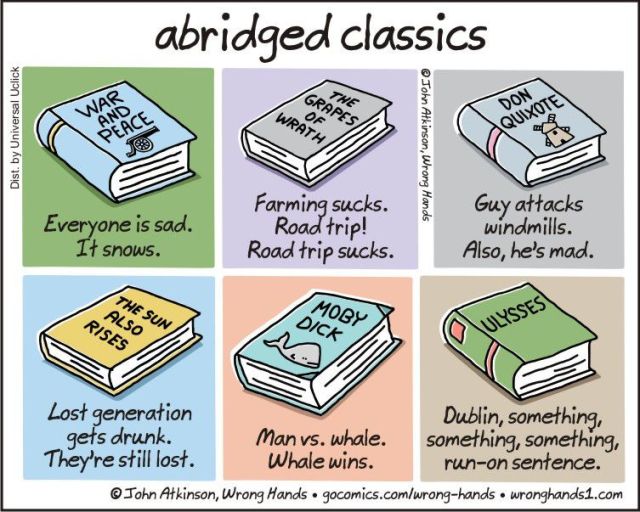
A conversation started at work between two coworkers and I got pulled into it. One person was stating that they didn’t think the classics should be taught any more because it’s hard for students to connect. The language is older and the themes might not come across as they would in a more modern story. He used ‘Catcher in the Rye’ as an example of a book that doesn’t really connect any more. The other coworker talked about how the classics should still be taught because they are designated as such for a reason. You can probably guess the generations/ages of these coworkers. It wasn’t an argument, but a friendly conversation.
I fall in the middle here because I hated some of the classics that we were forced to read in school. ‘Catcher in the Rye’ and ‘The Pearl’ were agonizing to the point where I stopped reading them. ‘Slaughterhouse 5’ was fun, but I don’t remember it anymore. ‘One Flew Over the Cuckoo’s Nest’, ‘To Kill a Mockingbird’ and ‘The Great Gatsby’ were also good reads, but I don’t remember as much as I do from the books I read for fun. ‘Of Mice and Men’ is one of the few that I have good memories of reading, which was surprising. Still, I don’t remember thoroughly enjoying any of the books.
One of the problems with classics is that they’re typically assigned reading instead of students choosing them. So, you already have a sense of a chore, which is made worse when you have to analyze. The classics are infamous for having deep meanings that even the author might not have intended. Some ELA teachers go to town on these books to the point where all sense of enjoyment is driven out of the experience. That doesn’t really help them maintain their use when students who hated them, but love reading end up becoming teachers. Then, you get some teachers who go through the motions of teaching the classics because they’re state requirements. A book that survives in a culture solely by being assigned to students doesn’t help its reputation as anything other than a forced reading.
Recent years have shown that more modern books are being put in place of some classics to give students a look at other cultures. ELA is now used partially to expose students to ideas, lifestyles, and cultures beyond their own. For example, my son read ‘To Kill a Mockingbird’ last year, but also a WWII book called ‘Unbroken’. He’s started reading ‘Of Mice and Men’ this year and will also do ‘Romeo & Juliet’, but he also read some Edgar Allan Poe and other short works. So, there’s definitely a mix of stuff unlike one classic after another when I was in school.
A small aside: Why does William Shakespeare continue to survive in academia? I know much of what we read can be traced back to him and his stories are considered timeless classics. Yet, them being required texts can lead to issues. Teachers have trouble teaching Willie’s works because of the language and the fact that they were supposed to watched on stage instead of read. You have to really make it an interactive lesson, which is difficult when you have students glued to cellphones. Makes me wonder if there will ever be a time that Shakespeare is pushed to college or an elective class after you’re introduced to one of his works in 9th grade.
Getting back to the classics, I think there is a place for them, but your average student won’t really get hooked. They’ll see the books as forced reading from an older age, which they can’t usually understand. Maybe it’s better to have these books as part of elective courses for those who want to read them. Have them listed for extra credit if a student wants to do an analysis on their own. Classics really do come from an older age that modern students don’t always comprehend just like people from that era don’t always get the modern stuff. So, it really doesn’t do any good to force these books on them because they don’t always benefit. Not to the extent that was done when I was school anyway, so maybe having fewer of them in the curriculum is better.
This also creates a future problem from book snobs. You know the people who rattle off the classics they read as if that’s an award-worthy activity? Those types probably make it even harder for others to get into the classics. It gives off the idea that these books are either difficult to read or pretentious. Even worse, a person can go in expecting one type of story and get something else, which could ruin the concept of classics entirely. This really can’t be solved by forcing everyone to read them though. You avoid the future problem of book snobs, but sacrifice or at least endanger a person’s enjoyment of reading these types of stories. Just can’t win at times.
So, what do other people think about students having to read the classics? Should they be retired, put into an elective, continued to be assigned, or something else?




 Legends of Windemere
I have heard people complain about having to read classic books. Many schools have replaced some of the older classic books (before the 1900s) with books written in the mid-twentieth century. Others consider classic books to be anything before twenty-five years ago.
I’m not a teacher or a parent, so I don’t have any real say in the matter. My concern with letting the students choose for themselves what they will read or not read could be an issue, because many might choose what is comfortable for them, rather than be challenged out of their comfort zone at times. Life is not going to always allow them that kind of choice. I’m reminded of people who work with personal trainers. The trainer is there to help the client to reach goals—not keep him or her in a state of comfort.
I didn’t like every classic book that I read. But I learned some things through them about writing.
LikeLiked by 2 people
Independent reading should be a thing to foster an enjoyment of reading. Yet, assigned books might still be needed to teach about plot, theme, and characterization. It helps with critical thinking too. Unfortunately, you need all the students to be on the same book for that to happen. Another issue is the older the classic, the less relatable it can be.
LikeLiked by 2 people
I agree with having independent reading where students can choose a book to discuss. I also think that students could be challenged by classics–perhaps within the last 100 at least years (rather than Shakespeare if they’re balking). However, they need to be prepared to not understand some references to these classic books that are made in pop culture. After all Hollywood still adapts classic books.
LikeLiked by 1 person
I don’t even think students should have to discuss their independent reading book. It feels like they turn off on reading once an assignment is made of it. A tough part now is that many kids need to have a reason to read besides it being assigned. There needs to be something that connects to them, which wasn’t as important when we were in school.
LikeLiked by 2 people
You say that “assigned books might still be needed to teach about plot, theme and characterisation,” but when I was at school (OK, it was a very long time ago) I don’t remember learning anything about plot and theme. Yes, we learned about characterisation, having to write ‘character sketches,’ but that was all.
LikeLiked by 1 person
Plot and theme have been taught starting in middle school since the 80’s. At least around here. I think many teachers find ways to do it without making it obvious too.
LikeLiked by 2 people
I think reading and analysing books of any kind is a bind, if it’s not fun, it’s a drudge. Having said that, books by Dickens, Conan-Doyle, Burroughs (and even old Will Shakespeare) were laying around when I was knee high to a grasshopper, so that’s what I read when I wanted to be entertained and the radio wasn’t interesting enough (no tv available), so reading school assigned books like Oliver Twist and David Copperfield was never a problem.
LikeLiked by 2 people
Early exposure would definitely help. I don’t think kids these days have these types of books laying around. So, it’s almost culture shock to run into them. I remember having trouble with Dickens because of this.
LikeLiked by 2 people
I think the classics should be retained. When I was in school. I found that the interest in a book is mostly guided by the teacher. One type of teacher would assign a book and then have dry discussions around its elements. Another would have us read sections or act out chapters. The latter was a much better experience.
LikeLiked by 2 people
I think that’s another part of the issue too. The teachers coming in now include people who couldn’t relate to the classics. They love reading, but see that modern students won’t respond well to these books even with ‘fun’ assignments. It’s because you still need them to read the book, which requires a connection on some level. Many of the classics don’t do that because they are so far removed.
LikeLiked by 2 people
True,
LikeLiked by 1 person
This is kind of irksome to me, because I’m really tired of the same five books being put forward as “sf classics” when they’re all from ’50s and ’60s. It seems very gate-keeping, a way to stop people reading work that is more contemporary and written by minorities and women instead of dead white men.
But to your point about classics being taught in school, I think those books can be taught in a designated course, like American Classics or British Classics. Which maybe is more college level, I guess. In high school, maybe it would be an AP course. At least the students will have chosen to take that subject.
If you really want to start a heated debate, ask them what books from the last 5 years they think should be taught — and then stand back!
LikeLiked by 1 person
Actually, ELA programs around here try using more recent books that cover minorities. This tends to be more nonfiction though. High school never touched on science fiction or fantasy, so there’s always been a restriction of genre as well. This is another reason I think people grow up to hate reading. The genres you see get turned into movies and shows tend to get ignored.
LikeLiked by 2 people
An interesting question. I don’t think there is a right answer, but I’m sure more modern books could serve just as well. Forced reading turns a lot of kids off to the idea. I don’t think we can avoid that, but a more modern example could teach the human struggle, themes, and character just as well. A lot of it comes down to the instructor, too. Having said that, some of the classics are damned good books, but maybe they should be the elective these days.
LikeLiked by 1 person
Forces reading is definitely a big issue. The only solution I could think of is giving book options. The books would share a theme. They do this with book club groups.
LikeLiked by 2 people
I like that idea.
LikeLiked by 1 person
There is a problem with the ‘classics’. Language. Many pupils simply can’t understand the language of the likes of Shakespeare; nor many references in older books.
I don’t like reading Jane Austin. Many people thing she’s wonderful, but compared with what we are told as writers in today’s world, her writing is terrible. Run-on sentences (some being a long paragraph with no breaks), those long paragraphs, telling rather than showing, omniscient POV, which is not popular today, and passive voice. (From Persuasion: The carriage was about to be waited for.
I admit her stories are excellent, and her characterisation equally good, but reading her books is a chore, to me. I prefer to watch a film or TV version. Having said that, it’s not the case with many books. Often I find the book better than the film version.
When I was at university, we had to study several books, poetry and plays. I loved Under Milk Wood, and also Peter Abelard by Helen Waddell, that we studied, and refused to answer any questions about them in the exam (there was a choice!) because I felt that analysing them took much away from my enjoyment.
I read Henry Fielding’s Tom Jones as an adult. I skipped whole chapters that were not advancing the plot, but were simply description.
So I ask, why are these books held up as so wonderful?
LikeLiked by 1 person
Many of the books used are held up because they touched on themes that were seen as universal. This changes with generations though. For example, ‘Catcher in the Rye’ was big because it touched on teenage angst. Even with my generation, it wasn’t really relatable. As far as language goes, I don’t think people give students enough credit. A classic that is surviving is ‘Of Mice and Men’ since it had themes about racism, poverty, friendship, hard choices, and neurodivergence. Kids can relate to those enough that they adjust to the language.
LikeLiked by 2 people
When I was teaching school leavers (aged 15) in Salford, England, a working class area, the play they were given to study was The Importance of Being Earnest by Oscar Wilde. The set book was a choice between a story about a boy growing up in a village in Africa, or Shane, by Jack Schaefer. I chose Shane as the other was so far outside these children’s experience. At least they were familiar with westerns.
The African book might have expanded their experience, but I could envisage boredom leading to a difficult time with them. They weren’t the most engaged group.
But the Wilde play they had great difficulty with. Completely alien to their lives.
Yes, we should try to widen the experiences of young people, but not at the expense of putting them off. I hated Shakespeare for years after studying him at school.
LikeLiked by 1 person
I wonder if there’s a big difference between how it goes in England and the USA.
LikeLiked by 2 people
What a great discussion! I believe that the classics should be kept – most have unlying themes that are common to humanity and this should probably be stressed and discussed. It’s always better if the teacher can lead a spirited discussion. I had to read a smattering of classics as a teenager and more in college and found some to be really rich reading. Shakespeare? Only if the instructor can interpret but oh so much better if parts can be acted out in class. That was my best class!
Give students credit for being smart and figuring out how the classics relate.
LikeLiked by 1 person
The argument I’ve heard against classics is that there are more modern books with the same themes. They are more relatable to students due to setting.
LikeLiked by 1 person
But there is a benefit to the students seeing that even in the ‘old days’ our problems were the same!
LikeLiked by 1 person
Maybe. I don’t think they care that much since the knowledge doesn’t help them navigate. Many actually take it as meaning society hasn’t improved at all and life will always be problematic.
LikeLiked by 1 person
You make great points here, Charles. I think a mix of both is a good idea. One of the reasons I am a terrible reader is the forced classics.
LikeLike
Thanks. I think a lot of people are like that.
LikeLiked by 1 person
I think so, too.
LikeLike