
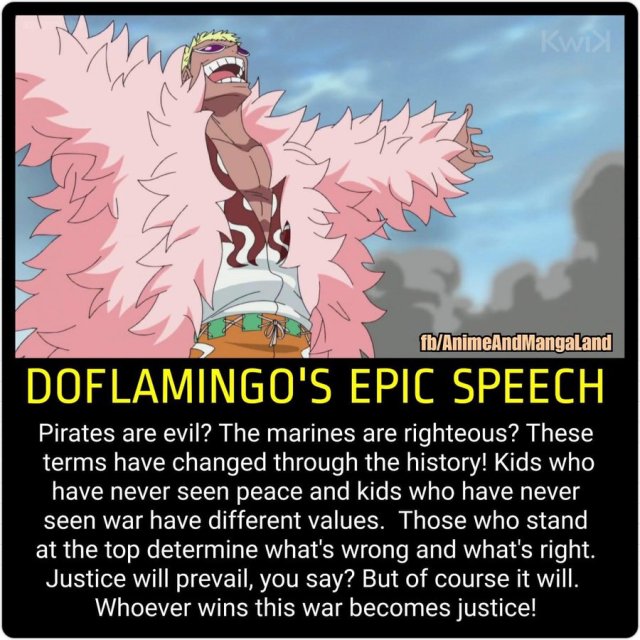
Donquixote Doflamingo from ‘One Piece’
Above is a fairly epic speech from the manga/anime ‘One Piece’. I say fairly because you wouldn’t know it unless you watched or read the series. It is said by one of the more popular villains, Donquixote Doflamingo, during a story arch that involved a big war between the pirates and the marines. He is a pirate, but fights for the marines as one of their Seven Warlords. This gives him an interesting perspective . . . Also, can you say he’s really wrong?
To touch on what Doflamingo is saying, he makes a lot of sense. History shows us that the victors tell the story. They decide on what was right and wrong as well as what people will learn about. Saying that justice will prevail is ridiculous because whoever wins will say that their said was justified. Personally, the part about how a child growing up in peace will have different values and perspectives than one growing up in war hits home. I see so many people talk about what life should be like for those who have lived in different conditions. Empathy and change of perspective aren’t easy to find or come by, which makes Doflamingo’s speech hit a little harder.
All of this brings up the question of having a villain who makes sense. I know people enjoy villains when they are doing evil, but for good reasons. That can be understood since they mean well. Doflamingo doesn’t fall into this category though. Been a while, but I believe he wanted to destroy the world or at least bring down society to prove that he’s right or get revenge. Either way, he works for selfish reasons, but his perspective on how history and justice are decided on by victors garners a lot of agreement. This kind of makes him a ‘beloved’ character regardless of his evil intentions. Makes one wonder if it’s okay to agree with an evil person in some fashion.
I’ve met a few authors who get disturbed by readers relating to or cheering for their villains. Their attempts at making the villains relatable or understandable succeed to the point where a reader might side with them. It makes things difficult when pushing the hero who is supposed to be the favored character. Instead, you have a contingent of fans that are against the good guys and want them to fail. An author might be tempted to give in to this group and switch the story to the bad guys winning, especially if you get a ‘vocal minority’ situation. It’s might easier to handle people liking the villains, but not agreeing with them. You become less likely to redirect your story in their favor or try to hard to ‘evil-ize’ the villain.
With all of that confusion and unexpected cheer, I can see a big reason to have villains who make sense. This would be them talking about society and civilization. A villain who talks about a social injustice that we normally ignore can bring about a conversation among the fans. It can open up minds to what is going on in reality and get one thinking about how we can prevent such a bad guy from appearing. Doflamingo makes sense with his opinion on how justice is determined by the winners and those in power. This means it can be skewed and biased. We see examples of this in our own world, which means we could feasibly have a Doflamingo type show up. For all we know, one already has. Anyway, his speech and opinion gets the conversation going, which is a bonus for many authors.
So, what do you think about villains with understandable messages and worldviews?




 Legends of Windemere
Some of the most insidious villains are the ones who seem the most reasonable. Some are like the heroes of the story—just willing to go one step beyond where the hero would go. This is not a knock against heroes nor is it tacit agreement to what a villain might think to do. I can’t help thinking of Killmonger in Black Panther. He sounded reasonable, but still needed to be stopped. Sometimes people do what they do out of rejection or some other pain (like the Spot in Across the Spider-verse).
LikeLike
Never saw Black Panther since I’ve been burnt out on superhero movies for years. I think Magneto would fall under this too.
LikeLiked by 1 person
Yes, especially in regard to his kids (the most compelling part of X-Men Apocalypse). In fact many of the X-Men could fall on either side of the hero/villain coin, depending on how bitter they feel about their treatment as mutants.
LikeLike
I never actually saw Apocalypse. Was that Quicksilver and Scarlet Witch?
LikeLike
In the movie he just had a daughter who was killed. This movie was an alternate timeline.
LikeLike
Ah, I forgot that Disney mucked around with X-men stuff until Fox gave the franchise back.
LikeLike
I think villains who make sense can be effective if the story is solid enough. You could have an honorable villain who just has a belief that his way is right. He can have a convincing argument for this opinion and yet gets defeated.
LikeLike
Making sense is tricky. Gets even trickier if the villain gets readers to think they’re right.
LikeLiked by 1 person
This reminds me of a phrase I’m hearing a lot around the web: “Two things can be right.” That is, different perspectives can have some elements of veracity, while also being in conflict. To me, this oversimplifies complex situations into an either/or, when in fact there may be way more than two viewpoints and what distinguishes them most is whether any “side” has guiding principles that direct their decision making.
LikeLiked by 1 person
Sadly, I tend to see that phrase being used when someone is trying to defend badmouthing people. Wonder if certain groups are trying to claim the phrase.
LikeLiked by 1 person
I think villains shouldn’t be all evil. No one in the real world is entirely good or entirely evil. And everyone thinks they are justified in what they do.
My villain in The Wolves of Vimar is charming. He is out for revenge for what he perceives as unjust treatment. Which maybe it was!
LikeLike
Not sure if I believe there aren’t 100% evil people out there. I’ve read about and run into some who definitely fit that bill.
LikeLike
This is the best post I’ve read in a long time. You have me thinking, for sure. We have anti-heroes, maybe there’s room for an anti-villain. So many of the big issues from history are all driven by propaganda. Someone who was on the ground might have a different perspective, and a more accurate one. There is a lot of room to play with here.
LikeLike
Definitely can make some fun for readers. Everyone can have their own opinion on which character is right.
LikeLiked by 1 person
I think whatever the reader feels – is completely valid, because it tells me that they will be attached to the character, and if a villain, when they “lose”, can introspect why did the villain lose, I think it speaks nicely about the writer’s character building and developing.
One of my favourite books of all time has the protagonist becoming a villain at the end of part 1. Part 2 never got released, which is a shame, but he in a way stays a villain forever, and it was exactly something I was curious about for book 2. I would really love to read more stories like that, the becoming of villains, seeing through writing what is it that made them a villain. Usually, the case is that we get told a reason by a 3rd party on why the villainy.
LikeLike
Interesting view on it. I’ve seen many villains that talk about the state of the world and are kind of right on how unfair things are. Yet, their way to fix things is through killing, chaos, and causing innocent people to suffer. This is where you get readers who agree with the villain’s reasons, but not their methods.
LikeLiked by 1 person