
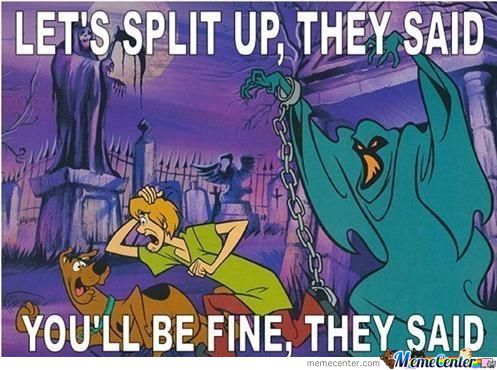
Scooby and Shaggy
In Tribe of the Snow Tiger, the champions are divided into two groups. One goes with Timoran to his homeland and a smaller one goes to the southern jungle. Anyone who finished reading The Mercenary Prince knows the situation. Needless to say, it’s a bit of a mess and headache . . . for the author.
I’ve had to do balancing acts between characters before, but this one was a bit different. The smaller adventure will lead into events for Book 11 instead of closing up with the main story. Not the nicest thing to do to readers, but it was the only way to get both stories told without squishing and rushing. There was always a question about if I should hamper one tale to salvage the other or injure both. A ridiculous question that I thankfully answered with none of the above. I had to develop a few tricks that might come in handy for other authors that find themselves in a similar situation.
- Choose one of the stories to be the focal point. This one will take the lion’s share of the book while the other is used for a ‘break’. It helps to make this decision before writing or you risk blurring the two stories. Yes, that is very much a plotter/planner concept, but it’s really just a ‘this is the real tale’. Keep in mind that this is only when the two stories won’t intersect until the very, very end.
- The smaller story can be used to create tension in the main story and portray time passing. For example, you have a chapter of the big story end with a badly wounded hero trying to limp to a healer. Then you have a chapter of the smaller tale show what the other heroes are doing. It allows you to return to the injured character after they’ve mostly recovered or woken up from the injury. You also leave the smaller story with tension, so it’s a lot like a ping pong game.
- While the bigger story has plenty of time to move along, the smaller one will probably need to be condensed. If you switch tales every chapter then you run the risk of hampering the flow of both. By having the smaller one come up every couple of chapters, you maintain the flow of both. One thing that helps is to have the smaller story chapters have a beginning, middle, pseudo-end each time. They have an obstacle and get over it to the next one at a realistic, but faster rate than those in the main story who have more time.
- Have the heroes mention each other even if they aren’t together. With some stories, you can have them talk, but you don’t need to make it this obvious. Simply revealing that they are concerned about each other can go a long way. It retains the idea that things will come together again and the heroes aren’t separated forever.
- Keep in mind that the smaller tale can end on a cliffhanger because it will lead to something bigger. While the main story is the one that you’re pushing to full closure, the smaller one doesn’t need to go that far. Part of it is to lead into another big adventure for the heroes.
Now, I know this is a dangerous thing to do because there is a current hatred toward cliffhangers. Seems a lot of people don’t want to be left in suspense when it comes to stories. At least a vocal minority. That’s the risk an author has to take in a series when facing a situation like this. The alternative is to cripple one tale and clog the other or simply leave out the smaller story entirely. Personally, I’d find that second option to be awkward when you reach the events the smaller one was aiming for. You have to explain everything that happened off-camera, which can result in info dumps. In the end, a risk will be taken no matter what. Guess all I can really do is brace myself and hope the adventures are gripping.
I did really enjoy creating the Judges.






I don’t write a series, but I can see the wisdom behind this.
LikeLike
Thanks. Even in a solitary book, this could happen in the midway point. Probably on a smaller scale though.
LikeLiked by 1 person
True. Usually you set the cavalry up and watch them ride off. Then people are ready when they ride to the rescue. I like giving them a little something to do better.
LikeLike
Ah, the cavalry. If only they always can in on horses. 😀 The funny thing about this divided heroes is how often it happens. Looking at my DVD collection and book shelf, so I can think of a lot of solitary tales where the midpoint is a division of forces. Seems to be a classic obstacle.
LikeLiked by 1 person
I am sure you will pull it off as you always do.
LikeLike
Fingers crossed.
LikeLiked by 1 person
Ankles too.
LikeLike
Reblogged this on Kate McClelland.
LikeLike
Thanks for the reblog.
LikeLiked by 1 person
Excellent advice Charles. I love cliffhangers, the kind that makes you go, “OMG, noooooo.” what better way to lead onto another book.
LikeLike
I’ve been finding that cliffhangers have a love/hate thing. Some people think they’re great, especially in a series. Others act like it’s done specifically to anger the reader. I do try to give a lot of closure even at the end of a mid-series book. This is one is going to be a bit different though because of the heroes splitting up. Guess with such a long series, I can afford to get experimental.
LikeLiked by 1 person
it is a love hate thing indeed but a good cliffhanger sends me racing to buy the next book.
LikeLike
As long as it’s available. 😉 That’s one of the fears I have doing cliffhangers. People aren’t very patient these days, so I worry that I’ll get hit with a delay and lose readers because of the cliffhanger. Guess that’s the risk we take.
LikeLiked by 1 person
My head is so scrabbled at the moment because I`m editing, sometimes I think too much and edit too much thinking just like you are on the readers thing.
LikeLike
This is really solid advice, Charles. Thank you.
LikeLike
You’re welcome. Glad you enjoyed it. 🙂
LikeLiked by 1 person
Great advice, and particularly pertinent to me. Thanks!
LikeLike
There’s always that part when the group splits up. Seems inevitable in a series or ensemble tales.
LikeLiked by 1 person
Cue Two Towers 🙂
LikeLike
Yeah. Always the middle of trilogy. Empire Strikes Back is another example.
LikeLiked by 1 person