
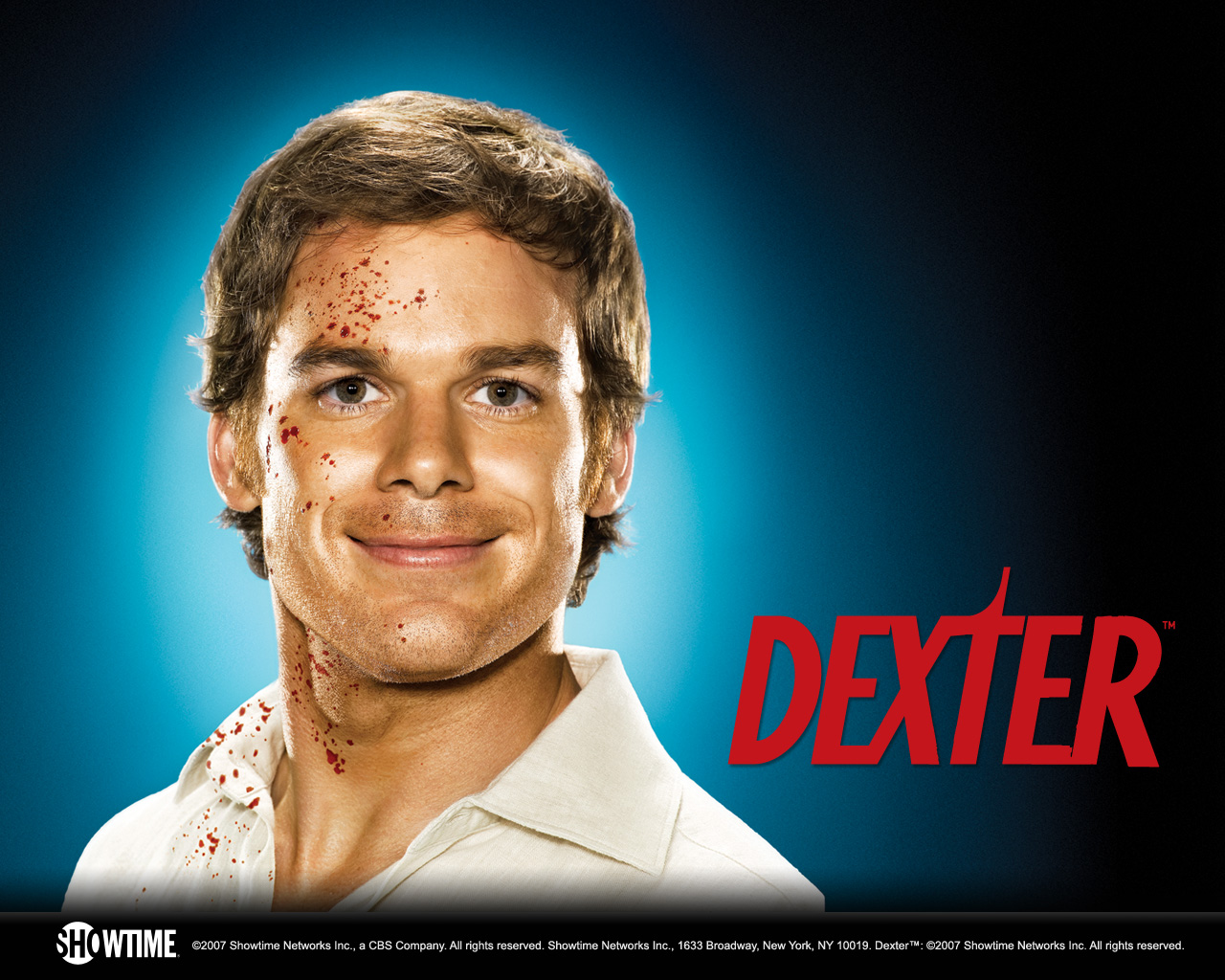
Dexter
Apparently, I did this topic long ago. Found out when I vaguely remembered using the picture above and went hunting. I won’t read it again because it was more on the morality of such a protagonist instead of how to do them.
You would think it’s easy to write a serial killer as a protagonist, but it might have more wrinkles than you realize. Mostly because you need your readers to cheer for the serial killer, so he needs some redeeming qualities. This could be that they only kill bad guys like Punisher, Dexter, and Venom. Maybe they have a loved one and the killing you see in the story is entirely to save that loved one like in Deadpool. These are rationales that we, as non-serial killers (I hope), can understand and connect with. We could see ourselves being driven to a point where we try to kill evil or destroy to saved a loved one. This isn’t mindless slaughter, but slaughter with a purpose and that cushions the blow. The fact that it’s still murder comes into our minds later.
Another factor in the serial killer protagonist is setting. Now, you can do this in any setting if you work through the perception of the killer. Maybe this is an evil character and we’re in their head in order to see how they function. I’m talking first person POV here, which is actually taking me away from the original point of this paragraph. Anyway, you can go the route where this isn’t a redeemable character and the reader becomes fascinated with the idea of the serial killer’s downfall. Will this murderer get caught, killed, or escape the police? It’s tension from the other side of the horror movie if you think about it.
Back to setting . . . shiny . . . I should probably admit that I writing the March posts while suffering from a really bad cold and the medicine that goes along with it. Any-hoo-ba-doo, I’m ready to get to how Lloyd Tenay from Crossing Bedlam works as a protagonist even though he’s a serial killer. I’m going to do this as a list:
- Personality– Lloyd is humorous, wacky, and big in terms of personality. He’s the equivalent of an accident on the side of the road that you have to pay attention to as you go by. Most of the comments I got on teasers and information posts revolved around Lloyd being interesting. This makes him a curiosity because an antagonist serial killer is typically cold, dark, and evil incarnate. They are designed for you to hate while Lloyd is designed to draw people to him.
- Setting– This is probably more important than the former. If Lloyd existed in a normal world then he’d be a bad guy and readers would see him that way. The killing would be illegal and sick even with the pop-culture hinting persona. Yet, when you put him in a world where chaos reigns and survival is the only important thing, the perception of him changes. He’s no longer the ruthless killer on the streets of NYC, but the deadly survivor in the wilds of the Shattered States. Murder in this world, while not legal, isn’t uncommon and most of those who Llody goes after started the fights. Still, the brutality of him fits in this world and makes him a dark protagonist.
Yeah, that was a short list, but those are the two things I found that make a serial killer a protagonist. A small third might be giving them a friend that can help the readers see the good in them. Cassidy doesn’t really fit this bill because she’s a survivor and can be just as ruthless as Lloyd. Still, her existence and relation to Lloyd does act as a bridge for the audience. If one person can call this madman a friend then there has to be something good about him and we’ll look for it. Just as he justifies his killing, we find a way to justify rooting for him.
Now, who wants to buy Lloyd’s Book? Click on the cover. 😀

Cover Art by Jon Hunsinger





 Legends of Windemere
A serial killer makes an interesting hero, since this person constantly teeters on the edge. I can’t help thinking of Hannibal Lecter in Silence of the Lambs and his working relationship with Clarice. (I didn’t see the Hannibal show.) I also think of Red in The Blacklist. Red might not be classified as a serial killer. But he’s not afraid to kill people when it suits his needs.
LikeLike
Hannibal Lecter is an odd one. Never really thought of him as a hero, but I can see how it works in this context. That teetering on the edge part is tough to maintain too. Stay there for too long and the character can become stale.
LikeLiked by 1 person
Very true. The good thing about someone like that is his or her potential for unpredictability. 🙂
LikeLike
A good thing if they’re a good guy at least. 😀
LikeLike
I bought it, and am reading it right now. It’s a lot of fun. In my first experience with this kind of character, he was revenge based. Paul Kersey was played by Charles Bronson in the Deathwish films. They were big hits in their day. I own the DVDs.
LikeLike
Good point. I never really thought of that character as a serial killer since he starts off acting for ‘good’. So I guess a big part of it is how the character is introduced. If they begin killing innocents then it’s harder to paint them as a hero or have them evolve. Some audience members will never forget his past sins.
LikeLiked by 1 person
It’s from a different era, that’s for sure. Part of the salespitch is to get the audience to see things from his perspective. He thought it was for good. A broader public was terrified of him. Write it from the perspective of a homeless person, or a delivery boy and the whole flavor changes.
LikeLike
True. Movies had a different feel and effect back then too. A character who is violently out for revenge is practically a staple these days. I was just a kid when Death Wish came out, so I didn’t get a sense of the public’s reaction. Though I vaguely remember people fearing a rise in vigilantism.
LikeLiked by 1 person
It was a pretty big deal at the time. It wound up being banned in several cities. It got a tough rating because of violence, seems like M or something in that era. The violence is laughable by today’s standards.
LikeLike
It’s amazing how violence has to get ‘worse’ in movies to have any affect. It’s one of the difficulties in using shock events for stories. People become immune and you have to up the ante.
LikeLiked by 1 person
That was kind of the point of talking to my under-the bed- monster a few months back. There has to be more than just the brutality and mess to make a story.
LikeLike
Disturbing thing is how many people only want that mess. I can think of a few shows I was into that abruptly descended into violence and sex when ratings began to falter.
LikeLiked by 1 person
too true.
LikeLike
Serial killers can be hilarious. Dorsey’s Serge and Coleman are never really grossly violent. They kill people, but with scientifically weird ways; using a lobster that filled it’s mouth with magnets instead of rocks (as they do) which set off a contraption rigged to a car crusher with the guys body in the trunk of a car, a model space shuttle that triggered a shot gun pointed at the victim that vibrated during a nearby actual shuttle launch, he hallowed out bodies with liquid nitrogen and dusted another guy with powdered Doritos until the guy died from inhalation poisoning. He gets pretty creative.
LikeLike
Those remind me of those Rube Goldberg machines you see in old cartoons. A bunch of odd set ups that culminate in a final act that usually has an easier method. Wondering if that Doritos one could actually work.
LikeLike
Inhalation aspiration pneumonia will kill you if not treated, but it takes a while. Fumes from burnt cayenne pepper oil would have been faster. That guy suffered a long and painful death. Yes, there is always an easier way.
LikeLike
Makes me think of carbon monoxide too. That cayenne pepper oil version sounds agonizing.
LikeLiked by 1 person
Interesting that you used an image of Michael C. Hall as Dexter for this. I read the Dexter books and didn’t like the serial killer as hero idea, but seeing it on the screen made the idea more plausible.
LikeLike
I actually never read the books or saw the shows, but a lot of friends are really opinionated about which one works better. Most of them are like you and think the show did it better. Maybe this kind of ‘hero’ is better to be seen. In a book, you tend to get a deeper sense of their inner thoughts and that can take away from the sense of being even remotely good.
LikeLiked by 1 person
I often wonder about this. There are so many books and movies about soldiers performing heroic deeds. But the only difference between a serial killer and a soldier is the setting, as that pirate famously pointed out when captured by Alexander. That and the fact that a soldier is supposed to mourn over his victims instead of enjoying the kill. Still, when someone’s shooting at you and you kill them, I can only imagine there’s at least as much joy at having survived the encounter as there is remorse at the taking of a human life.
LikeLike
Never heard that phrase. It’s interesting how much changes when intent is altered. Such a ‘small’ piece of the puzzle, but a cornerstone of a character both in fiction and reality.
LikeLiked by 1 person