
This is from back in April 2013. Not sure what happened to the original picture though.
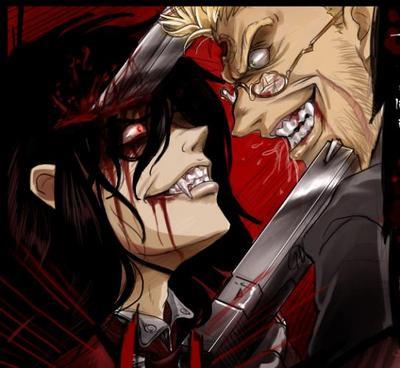
Helsing Characters
This topic has been sitting on my ‘thought post’ list for a long time. I believe I had a genius post for it in January and figured it was so great that it would stay with me as I built up to it. Then, I wandered off to other topics and forgot what I was going to say. Still, I think this is an important topic for writers.
We say ‘good vs. evil’ to make the idea of conflict simplistic, but it is rarely that easy. Yes, the hero is going to save the damsel while the villain is going to lock her in the tower. Hero equals good, villain equals bad. It is the basis of almost every story ever written even if the ‘villain’ is nothing more than self-doubt or other crippling emotions. The ‘evil’ side of the equation is really the obstacle, which is not always as obvious as a roaring dragon or an alien squadron in their death ships. It gets stranger with the good side because this is typically more cut-and-dry as the protagonist. Rarely is there an incident where good is an emotion such as a sudden act of heroism. Villains that do a sudden change of heart fall into this category because the ‘good’ is the positive emotion that transforms them. Best example here is The Grinch and I apologize for anyone that just had Jim Carrey flashbacks.
As an author, you have to design your characters carefully with the conflict in mind. The idea of good vs. evil worked back in the day when stories were used almost exclusively to teach people about morals. Now, there’s more to it than Bad-guy McBad will be defeated by Good-guy Goodstein. (How in the world did Goodstein not set off my spellchecker?) You have various levels of good and evil now. Villains that believe they are doing good and heroes that are one parking ticket away from villainy. You have to figure out how far you are going on both sides with your character and stories. Too far to either side and you could find yourself back to the designing board with a character. For example, say you have a perfect, infallible hero going up against a villain that has a soft spot for children. That perfect hero could be less appealing to the reader because the villain shows depth and draws the reader in. You have to make sure that you keep the moral and emotional investment on the hero if you want to retain the classic ‘good conquers evil, no questions asked’ ending.
On the other side of the equation, it’s easier to get away with a villain that goes around kicking puppies and beating the elderly with live chickens. Total evil seems to always have a place in literature because people are supposed to hate the villain. Yet, you do run into a problem by going all the way to the dark side. A horrible, unredeemable villain can get tiring rather quickly and lose the reader’s interest. This becomes the ‘will you two just fight already?’ scenario. You can’t spend every 3rd chapter section reminding the audience why this guy is evil without it losing its novelty. I offered to read a classmates ‘book’ in college, which was 10 chapters long and the hero was traveling to the villain’s lair. At the beginning of every chapter, the villain did something horrible to an innocent prisoner. It started with a simple stabbing and went up to the point where the villain gut and ate his own daughter. By that point, my dislike of the villain was more of a ‘not this schmuck again’. My time with the hero was less enjoyable because I felt like the guy’s snail pace was costing people their lives. It was a fantasy setting and your enemy just ate his daughter for no given reason. He could wrangle a Pegasus, find a wizard with flight magic, steal a flying carpet, or buy a damn horse. My point here is that if you’re going to drive home the evil side of conflict then spread it out and make it count.
I’ve been very straightforward with good and evil, but they can be non-physical entities. A romance book may have the ‘evil’ side of the conflict be the main character’s lack of self-esteem, which is defeated by the realization that he or she deserves whatever it is that makes them happy. I’ve only dabbled in romance, so I could be wrong here. Any of my romance writing friends can feel free to correct me. I think the trick with this conflict is to focus on the journey through the conflict than the actual emotions. Not so much to ignore them, but they will come through to the reader by using dialogue and specific actions. I have a feeling that’s an entirely different post. I also think I no longer know what I’m talking about and should stop before I make a fool of myself.




 Legends of Windemere
The one thing I try to never do is write from the villain’s POV. 1) I suck at it, and the baddie comes across as an over-acting snot. 2) If you’re in the villain’s head, you know exactly what he’s up to, and that takes away a lot of the suspense. At least, to me.
LikeLike
I guess #2 depends on how far you delve into their minds during the POV. I don’t go far beyond surface thoughts for my villain scenes, so they keep some stuff hidden. It might help that I use present tense, so you have to be in the moment and plans that they haven’t created yet are mystery to all.
LikeLike