

Book 4 of Ranger’s Apprentice
With the looming release of Legends of Windemere: Family of the Tri-Rune, I hit a new area of writing:
BEYOND A TRILOGY!
For those used to long series, this might seem a strange thing to be aware of. Harry Potter, Game of Thrones, Narnia, and so many series go beyond a trilogy. So, this isn’t something rare. Yet, it brings a new dynamic to a series that complicates the entire product. Here is where you get into a tough spot of losing/gaining readers with every later book. The readers that make it this far are invested in the characters, world, and story. I would go so far as to say that this amps up the focus on the author’s abilities because you have to play a short game and long game at the same time. A stable tale for the individual books with subplots and main plots that span the entire series. For example, the destiny of Luke and his love life plot spans all of the books while Nyx fixing the fallout of Hero’s Gate is a 4th book only story. Everything progresses with character development and main plot, but there is a story within the book that gives a sense of temporary closure at the end.
How is a trilogy different than a longer series? Well, you have three parts, which makes things a bit easier for the ‘Plot Wave’. The first book of a series is big on character introductions and you know that most of the main cast will be found here. The world is set and the plot has some closure, but a big feeling of what is to come. For example, Star Wars: A New Hope did all of this and while it had closure, it also showed that the war was still going. The second book introduces new faces on both sides, pushes the main plot more with twists, and ends on a cliffhanger that promises the finale. It’s a bridge book with some leeway in terms of closure. (Empire Strikes Back) The final book closes up all plots and subplots like Return of the Jedi. Just like a stand-alone book, you have Beginning-Middle-End.
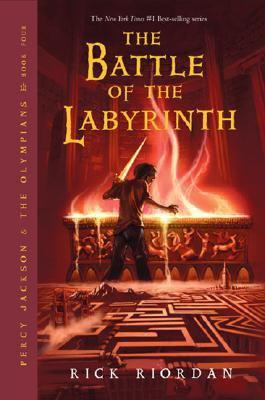
Percy Jackson: Battle of the Labyrinth
Adding a fourth book changes that dynamic because you have to extend the middle. The first book can still be about character introductions, but some of the future main heroes might benefit from being saved for later. The last book still can be all about closure, but you’ll probably have a lot of things to close up by the time you get there. A challenge here is to make every middle book count. They need to avoid feeling like filler and have a point, even if that point is simply character development. This can get very tricky. For example, I have two books in the series that deviate from the main quest. They focus on an intrusive character plot that I can’t go into here. These stories bring several characters to a new level of maturity, but there’s a risk. Without the main plot taking a center stage, some readers may find the books pointless. Others might be angry that their favorite characters aren’t the ones being focused on. An issue in a long series is that favorites are chosen and some readers get annoyed if their preferred hero takes a backseat to others. As I said earlier, going beyond a trilogy has a ton of risk with it.
Here are a few tips if you plan on going for the long series:
- Never doubt your long game. Remember that readers won’t always know what you’re planning, so they’ll have an immediate reaction to your series. It doesn’t matter to them that you know a twist is coming because they aren’t mindreaders. All you can do is hope they trust you and keep chugging along.
- Foreshadowing is your friend. Hard to do if you’re a pantser, but you can add stuff like this during an edit. Series gain re-readability if there are clues to future events in the earlier books.
- Give all main characters subplots of both short term and long term variety. This gives them depth and they can be carried through more than 1-2 books. By short term, I mean a goal for a specific book. By long term, I mean a main goal or obstacle such as a curse, romance, vengeance, etc.
- A book series can remain fresh when you introduce new characters. This can be done in 2 ways. 1) stagger out your main character (both hero & villain) introductions throughout the earlier books. Not all in the opening volume, but maybe get the majority of them out within the first quarter. Cameos count. This allows readers to get a feel for individual characters before others are introduced. 2) New faces among supporting cast in every book that are specific to the contained story. These will help enhance the temporary subplot and flush out the world by creating more inhabitants for the reader to connect to.
- Never be afraid to check what you’ve written to avoid plot holes. This includes physical descriptions of characters.
- RETAIN YOUR CONFIDENCE THROUGHOUT THE ENTIRE ADVENTURE! (Same as #1, but worth repeating.)
Finally:




 Legends of Windemere
Good points. My trilogy came out of a big book too long for a single release. Long haul sounds intriguing. Not sure my character has legs for more than three books. Things to think about.
LikeLike
Long haul is tough and you need the right characters for it. I have a few later ones that can’t make it to the length of a really long series.
LikeLike
I would add Robert Jordan as an exemplar of mastery of the long series and planning. Excellent post, Charles.
LikeLike
Thanks. Robert Jordan is a good one, especially because he denotes a hazard too. If an author passes away before finishing, it helps to have notes so someone can complete it.
LikeLike
I’ve always dreaded ‘Middle Book Syndrome.’ You quoted Star Wars earlier. Empire Strikes back always, always feels like a middle film, as does Back to the Future 2. Perhaps it’s because the first and third movies have completion and the middles end with cliffhangers. Ludlum’s Bourne Series managed to avoid this (the movies, at least).
My second novel (of three) is likely to end this way too – something I’m dreading. A cliff-hanging book or movie is unlitmately forgettable. It’s like a long prologue for the third story. Short of avoiding the cliff-hanger altogether, what’s a good way around it?
LikeLike
Empire Strikes Back is odd because people either love it or hate it. I don’t get the middle film vibe from it because it has a good amount of plot & character development along with bridging the other two movies. You can go into it without being too lost on the main points too. Probably helps that I started on Empire when I was a kid.
I don’t think a very long series can always avoid the cliffhanger ending. Sometimes it’s the best way to end a story and allow it to go on. In the book I’m putting out this weekend, I end on a cliffhanger. I tried ending it at a ‘better’ point, but that still had a smaller cliffhanger and made the next book in the series an immense beast with it feeling like I crammed stuff together. The same happened if I went until the cliffhanger part was concluded.
Only way around it without making a 700-800 page book might be to condense everything and chop things out. Subplots and characters get tossed and the entire thing gets gutted until you can fight the ‘entire’ story into the one book. This could remove another book or two from the series though. So, maybe it’s really down to whatever works.
LikeLike
Yes, it’s a hard decision… My second and third books are effectively one adventure and could combine into a 900 page book – but that’s not feasible. The first book concluded nicely (as did the fairy-tale Star Wars IV), but the ending of the second sees the status quo turned completely upon its head. It’s the logical place to end the action… but it’s still a cliffhanger.
…
In typing this, I realised that for a complete book to end satisfactorily. all loose ends bar the long story arcs need to be tied up. My cliffhanger is a long arc and cannot really be avoided, any more than Empire could have ended back on Tatooine with the defeat of Jabba. It’s the way of things, the nature of the beast etc etc.
LikeLike
I have to agree. Each of my books has a contained story and the main plot with ongoing subplots. So that contained one needs to be closed up to give any sense of closure. A rough part of having a book that goes beyond a trilogy is that it helps to keep a few things open from a few of the contained stories The author knows that they’ll be returned to, but readers don’t know how long the series can go for. So these openings are seen as plot holes, which can turn some people off from the rest of the series if you wait too long.
LikeLike
Great write up Charles, and I cant agree more with “never doubt your long game”.
LikeLike
Thanks. Definitely an important rule. 🙂
LikeLike
inspiring, Charles, thank you for sharing
LikeLike
You’re welcome.
LikeLike