
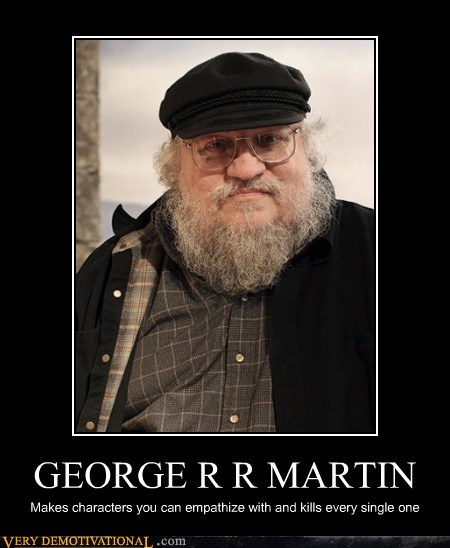
Author of Game of Thrones
Now, I’ll admit to making fun of the body count of George R.R. Martin’s Game of Thrones series. Truthfully, I don’t have a problem with him or his series. I think it’s great that he’s brought fantasy into the spotlight. It paves the way for new fantasy authors and shows there’s a public interest in the genre. Sure, he kills characters with the same casualness that a person would mow the lawn. That’s what he wrote and he’s proven that it works . . . for him.
Legends of Windmere: Beginning of a Hero debuted on February 27th, 2013. Since then, I’ve received occasional messages that critique my books. No problem. I can handle that because I can’t please everyone. The confusion (not frustration) stems from when people tell me that I HAVE TO write like Game of Thrones. I’m serious. People have told me that Luke Callindor should have died in the first book in order for it to be good. There’s also the popular ‘need more politics’ request. I’m never sure what to say about that.
This isn’t to say I won’t kill a character. Anyone who read Prodigy of Rainbow Tower knows I’ll do it. I just want them to be rare and with a lot of impact. Whenever someone tells me about a character death in Game of Thrones, they’re laughing or saying it so casually that I wonder about the impact. Betting it’s better in the books though because I have upset people by saying ‘Red Wedding’. Heck, I made a fan weep by playing ‘White Wedding’ by Billy Idol on my iPod a little too loud. You know, I give Mr. Martin a ton of credit for creating something so beloved.
And that’s what every author wants. Not to be the guy who writes like the other guy, but one who is known for his work. Fantasy is hard with all of its tropes and fans being very picky about what they like and don’t like. Now, people think high body counts and political plots are what’s important. Adventuring stories with high magic like Legends of Windemere are kind of on the edge for now. They’ll never go away entirely and one day the roles may reverse. Fantasy is a big genre full of imagination, so both types can coexist side by side.
So, what do other people think when they hear people tell them that a book should be more like another book? What do authors think when they are told you should copy a famous author’s style and habits?



 Legends of Windemere
I think they want other authors to recreate the thrill they experienced when first reading the book or series they love. Well, if they look long enough I’m sure they’ll find someone who’ll do just that.
LikeLike
I can understand that and it shouldn’t be too hard. You have a lot of people who jump on a bandwagon to get a little fame. Twilight led to a ton of vampire stories being submitted and self-published. I read years ago that some agents and publishers refused to accept anything with vampires because of the flood.
LikeLike
That’s how it always goes with books, movies, and television programs. Even music. There are always imitations that follow. The strange thing is that if you aren’t on the bandwagon everyone says you’re being left behind—until they’re behind you.
LikeLike
Yeah. Hate the person who isn’t part of the mob and then jump to their side when the shininess of the first thing fades. This is why fandoms make me nervous. I can’t get behind the fervor and always wonder if they love the thing because it’s good or because it’s popular.
LikeLike
If you change to be like someone else, the other person will have a twin and you’ll be all gone. 🙂
LikeLike
I can always count on you for a true and deep statement that brings everything to clarity. Guess a lot of people love the idea of clones, never realizing that 9 times out of 10 the clones pale in comparison to the original or turn psychotic.
LikeLike
If someone wants Game of Thrones, they should read Game of Thrones. If someone tells me I should write like X author, then I certainly know who not to add to my familial gene pool.
(Oh, was that a bit harsh?)
LikeLike
I agree. Do you mean adding the fan or the author?
LikeLike
The fan. If they can be called that with such a statement. To me, a fan appreciates what something is rather than what something is not (as a negative). There are positives to being ‘not’.
LikeLike
I think there are fans and then FANS who embody the source word of fanatic. That second group are the ones that tend to turn me off to stuff.
LikeLike
I’ve always thought of ‘fanatic’ being the unwanted, extended edition of ‘fan’ anyway.
LikeLike
Makes sense to me. I should look at it that way.
LikeLike
I don’t think it’s right, but that is how the formulaic writing styles get established. Those genre styles sell, and become what people expect. That’s where I think indies play a significant role in the reader market…to provide something creatively done different.
LikeLike
That is an important niche. If new styles and ideas don’t flow into a genre then it becomes stagnant. That could destroy the genre.
LikeLike
Precisely. My husband is a voracious reader of crime fiction, but he complains that is has become boring and predictable, so i have suggested some indie authors (whom had had been opposed to trying because of what he had “heard” about indies, even though his wife is one). At least now he is willing to give them a try. I don’t think he will be disappointed. I picked the best off of a book review blog for crime fiction.
LikeLike
It’s funny how people give indie authors such a hard time because of the high level of junk out there. It’s much more dense than traditional authors, but they have their clunkers too. If every published book was a masterpiece then reviewers would never have a 1 or 2 star part of the system.
LikeLike
Exactly, he is always pointing out book bloopers to me in his traditionally published works that he reads.
LikeLike
I’ve found those, but I don’t make a big deal of it. Humans make these things and humans make errors.
LikeLike
Well, copying another author is definitely a no-no. Drawing inspiration from them? Sure! But taking George RR Martin’s formula of bloody politics and killing off everyone isn’t the way to go. Speaking of killing everyone, kudos to you for not doing that. To be honest, I would actually like Game of Thrones a lot more if he stopped killing off so many characters. Their deaths are poignant and dramatic, sure, but … I don’t know, I just don’t like it when everyone I like dies off. I like immersing myself in the lives of characters, and I have a hard time connecting to someone if I know they might get offed in the next twenty pages.
LikeLike
After awhile, even a dramatic death loses its impact because it’s been done so often. As you said, eventually a reader will stop becoming attached to characters because they’re expected to die. It can even get to the point where the surprise is when a character lives through a risky situation.
LikeLike
And that’s the thing. Like, when I try to guess what will happen in future Game of Thrones books, the first thing I can say without a shadow of a doubt is that half the characters I care about will die. Once I get that through my head, their deaths lose impact because I know they’re dying — it’s just a matter of who, when, where, and how.
LikeLike
I know people that do that with Joss Whedon. I did it with Avengers. I was more interested in figuring out who would die before I saw the movie that the rest was almost an after-thought. Though, technically he tricked us all on that one.
LikeLike
Good point well made! You should write in the style that suits you best otherwise your writing will sound forced. And if that means not killing off characters – too bad.
LikeLike
Exactly. Though, I admit I get annoyed if every character survives unscathed. Especially in stories with action.
LikeLike
I’m still cranky you killed off one of my favorites. *sigh* I hope you give that one a spin off book, “The Early Years” or something like that.
LikeLike
The character’s early years aren’t that interesting. I’m sad to see that one go, but I realized a while back that part of the legend is how the death happened. I feel wrong doing anything beyond a ghostly appearance in a future book.
LikeLike
never watched game of thrones beyond a five minute clip here and there… but my NaNo story would probably receive the opposite as you in that people would probably criticize that my story is too political… my view to killing characters is as long as it advances a story…although my big war is about to start so I expect over the last nine chapters there will be a lot more of the killing off of characters…
LikeLike
War scenes tend to get a pass because people understand that death happens in that situation. It’s expected. I think there is an audience for very political stories considering the social atmosphere of today. The issues are so in our face that seeing it embedded in fiction seems almost natural.
LikeLike
Write the way you need to write in order to communicate what you need to communicate. As for Game of Thrones – I never heard of it until the T.V. show and I couldn’t get past the first episode.
LikeLike
I never saw the TV show, but I started reading the book. I do plan to give another shot some day. It’s just so big and I feel like I don’t have the proper time and focus to tackle it. What happened in the first episode?
LikeLike
I think I can read about violence, rape, and incest more easily than I can watch it. None of those are things I want to read about all the time, but at least the images I create are a little easier to deal with.
LikeLike
Good point. If we create it from words, we can temper the image to make it easier to handle. On the screen, we have to avert our eyes or walk away. Unless a person has a high tolerance for that. I know some people that watch such things without a problem. I have a high tolerance for violence, but not much for the other two.
LikeLike
If all books of a particular genre followed the same formula wouldn’t reading…and writing for that matter become tediously boring? I much prefer variety and shouldn’t the goal of writing be to write something unique, something that no one else has written, I certainly think it is.
LikeLike
I agree. I think when people are in love with a series or a method, they put up blinders until they get bored with the repetition.
LikeLike
Someone said “If you wrote more like (unnamed) I would represent you.” I am still unrepresented
LikeLike
I’m always amazed when agents and publishers say that. It’s really telling.
LikeLike
I think what you’ve got so far is great. Strong characters, very likeable, great pacing and a lot of action. So I wouldn’t worry too much about trying to follow the Game of Thrones formula, even though, admittedly, it’s mega popular right now.
I see literally about 100-200 hundred new release movies a year, and whether it’s a rom com, drama, action, or sci-fi, the majority of it is pretty formulaic. Maybe only about 2% of new release movies are truly original and make you think: “Wow, I’ve never seen anything like this before!”. But is being formulaic a bad thing at all? No it isn’t. Absolutely not. Majority of the time, it’s not the original movies that are the best, but it’s the ones that follow a tried and true formula, but they do it SO WELL, like Titanic and Avatar. James Cameron knows he isn’t reinventing the wheel when it comes to storytelling, but he does it in a way that “affects” the reader, and ultimately, it’s the characters we care about.
Case in point: Gravity.
Just a simple, simple film. People have complained that it barely contains a story, but they’re totally missing the point. It doesn’t set out to do that. It’s a survival tale stripped back to it’s barest and that’s all it needs. And if the director/creative mind + actors and everyone else behind it can pull off the execution in a most brilliant way, then he/she has more than done the job.
And my Gravity example can be applied to your situation because you understand your intent: entertain the reader. And so far, I think you’ve done the job easily.
LikeLike
Good points. There is something about the tried and true, which seems to be needed to some extent. Take ‘Hunger Games’, which is big right now. It shares similarities with Battle Royale even though they’re not carbon copies. That’s where some people create the confusion. They want those quirks to be repeated in another story instead of the basic formula. So, they’re focusing on the unique parts and treating them as the standards.
LikeLike