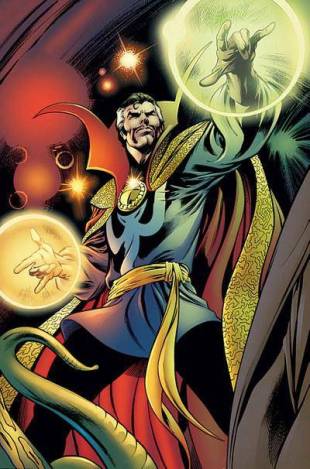
Doctor Strange from Marvel Comics
(This comes from a March question that took me a while to think about. Sorry for the delay.)
It took me a while to find a good picture for this post and that search also lead me to a realization. Mostly because I remember Doctor Strange up there who is a Superhero that uses magic. Now, you may say magic isn’t a defining factor of fantasy heroes and you would be right. Yet, it still connects more to them than the comic-based guys. There are more science, natural, and non-powered superheroes than those that function off magic or medieval weaponry. Still, there’s a lot of crossing over, so you can’t go with weaponry and magic to show that there is a difference. After all, Captain America uses a shield and Green Arrow uses . . . arrows.
So, what does make the difference between fantasy and superhero stories? As usual this is my own opinion, but I’m going to go with the goals, length of adventure, and the overall setting. Let’s hit them one at a time:
Overall Setting
I’m going to mention this one first because it’s a little shaky. Going by Legends of Windemere, you can say that Nyx definitely fits into the power level of a comic-based superhero. She is greater than your average Windemerian (that a word?) like those that live in more modern worlds. Yet, Nyx and her friends live in a world that is more fantastical than others. Monsters and magic are not a sudden surprise like it would be in most comic book worlds. As you may notice, the majority of superheroes exist on Earth and that places them in a world where a dragon is met with a moment of disbelief. We all think we’d run away from the dragon right away, but I think there would be that instant of not believing what we’re seeing. The setting of Windemere has these creatures as a known entity, which means the locals and heroes are used to them. Again, this one is shakier than the other two.
Goals of the Hero
By now you realize I mean comic book heroes when I say superhero, which tends to be the more common thought. One thing with superheroes is that their goal is to fight crime, protect the world, or do something that doesn’t have an actual end. Spider-Man and Batman will always be on the job until they die or give up. There will always be a galactic threat that requires the Green Lantern Corps. Meanwhile, the fantasy hero has a more focused goal. This can be overthrowing a warlord, finding a lost relic, or any number of quests. That is the key word too. A fantasy hero typically has ‘The Quest’ to drive them forward while superheroes might be better defined as having ‘The Mission’.
Length of Adventure
As noted above, a comic book superhero may never have an end to their journeys. Even if they die or retire, crime will continue and a new hero will step up to take on their surviving Rogue’s Gallery. For example, when Batman ‘died’ a few years back, there was a ‘Battle for the Cowl’ or something. Dick Grayson (first Robin) took over as the new Batman facing the same villains until Bruce Wayne revealed he was only sent to the past. If you’re more of a Marvel fan then go with Captain America shot by a ‘time bullet’ and replaced by Winter Soldier until he got back. My point here is that there will always be more villains and heroes taking up the mantles of the fallen. This might be because they become more symbols in their world than the characters we see them as.
As far as fantasy heroes go, they end their quest and that is typically it. Some may keep going, but they are more likely to kill their enemies and that changes all future adventures and threats. It’s rare that a fantasy hero goes for longer than a series. In fact, I can’t think of anyone besides Drizzt Do’Urden that has been adventuring for so long a time. The point here is that fantasy heroes normally have an end while superheroes normally go on until they need a reboot.